Avainsana: Transversal skills
Cultural Sensitivity as a Transversal Skill in Social Services
Introduction A number of unsuspected challenges set new demands for the social services. These challenges include, for instance, employee turnover or burnouts. Imbalance in the working environment in social services has clear consequences for client relationships. These structural and organizational challenges are encountered by clients. People are not robots - neither social workers, nor clients. In a systematic world, all are connected to each other. In social work, its context is an unwritten promise and aim that all clients are to be treated equally and met as unique individuals with different life situations. According to IFSW (ifsw.org) The International Federation of Social Workers, social workers strive for sustainable social development through the promotion of social work best practices and engagement in international cooperation. The key values and core elements are social justice, human rights and inclusiveness. Cultural sensitivity Already since the beginning of the 21st century, "cultural competence" in social work has been questioned. According to this view, in social work that respects diversity, it is essential to learn from the clients’ experience as complex individual, cultural, and structural power relations are present in their lives. (1) In social work, the emphasis is on cooperation, listening and creating a common understanding with clients to tackle, for example, lack of cultural sensitivity. Cultural competence can be seen as part of TS skills. According to Raatikainen and Rantala-Nenonen (2, s. 12) cultural sensitivity has been defined as an “ability to evaluate and develop one's cultural awareness, or to have the knowledge, awareness, and acceptance of other cultures, and the willingness and capacity to understand people from different backgrounds, and to embrace diversity”. Methodology and data collection We asked how social worker's transversal skills can best support and strengthen interaction in the client relationship and how transversal competence can contribute to structuring the interactive dimension of social workers[1]. Data was collected by an open questionnaire in the project's feedback session (11/2022), in pair discussion (Master’s Degree of Social Work). The survey was conducted in pairs (n=23), with a duration of approximately one hour. The participants’ backgrounds were the following: schools and vocational educational institutions, early childhood education, child protection, services for families with children, services for the disabled, substance abuse and mental health work (client work, administrative work), in Helsinki capital region. The participants had prior knowledge of the topic. They had organized a seminar related to the topic as part of their studies (influence and communication skills) and in the summer school. There were 14 questions in total but only one of them is considered in this blog post: How transversal skills relate to social work that respects diversity? Participants were asked to discuss both empowering and detrimental examples (with clients, in structural work, as work approach), and how could TS skills and values be connected? (3). Data analysis and results The analysis of the data was carried out using a theory-driven approach to TS skills (deductive approach), and identifying the elements of diversity, combined with material-based content analysis*). TS skills include Critical and creative thinking (CCT), Interpersonal, interaction and emotional skills (IE), and learning to learn skills (LL). According to our analysis, the responsibility lies with the social worker when encountering the client, and TS skills (IE) can help create a safe situation and space. The answers strongly emphasize the possibility of new and joint learning with the help of TS skills and consideration of the client's life experience. TS skills are also seen from the perspective of the work community; as an opportunity, but also as a risk. One impression is that TS skills could also structure the work and operating environment more broadly, so that the client's participation would be better possible. The results are manifested on the client competence perspective, e.g. while developing services or the possibility of learning together: using the clients’ TS skills and considering their life experiences . "Transversal skills can strengthen everyone's individuality and support due to the fact that social work can produce services based on information received from clients.” “All transversal skills are needed to support diversity; empathy, creativity and encountering skills are particularly emphasized. For example, how to connect native Finns and clients with different languages, especially when there is no common language. A lot of sensitivity, problem-solving ability and listening skills, and understanding of non-verbal communication are needed.” Additionally, according to the results, the responsibility lies with the employee when meeting the clients: good transversal skills are a means for respectful encounters, which in turn is the starting point for creating a safe situation and space. Conclusions To our question about how descriptions of transversal competence can contribute to structuring the interactive dimension of social workers' client competence and multifunctional work, as well as competences required in them, we conclude that all TS skills are needed, although the importance of language, and the importance of understanding diversity are highlighted. The results indicate that, as future professionals, social services students have the opportunity to promote encounters that value diversity by utilizing TS skills more broadly than solely from the perspective of interpersonal, interaction and emotional skills. Authors Eija Raatikainen (PhD) Principal Lecturer, Licenced Social Worker, Project manager and researcher, RDI -coordinator/Innovation center MUAS/Participation and agency - project portfolion. Co-editor, Journal of Socialpedagogy (https://journal.fi/sosiaalipedagogiikka) Katriina Rantala-Nenonen (MsSoc) is a senior lecturer and project manager in Metropolia UAS. She teaches social sciences for students in Bacherol and Master Degrees. Katriina works also as a specialist in HyMy Village Wellbeing and Health Services of MUAS based on an ecosystem approach. In the ITSHEC-project she was working as a developer. Niina Pietilä (Licenciate of Social Sciences, licensed social worker) works as a teacher in Metropolia's social services degrees and was working in the ITSHEC project. References Rugkåsa, M. & Ylvisaker, S. 2019. From culturatisation to complexity - a critical view on the cultural competence discourse in social work. Nordic Social Work Research 11:3. 239-248. Raatikainen E & Rantala-Nenonen K. 2022. Pedagogical Framework. In: Carrió M, Rosa N, coordinators. Learning strategies to promote transversal skills on health and social care studies: a methodological guide. Barcelona: ITSHEC. p. 7-20. Cohen, L., Manion, L., & Morrison, K. (2000). Research Methods in Education (5th ed.). Routledge. [1] The presentation ‘Transversal Skills as Support and Strengthening of Client Relations’ was given at the University of Helsinki, in Social Work Research Days 2023, on February 15–16. The theme of the days was Social Work and Diversity (Helsinki.fi) The Metropolia team (Eija Raatikainen, Katriina Rantala-Nenonen and Niina Pietilä) gave the presentation which presented a part of a research group session, called ‘Preventable Change and Assessment of Change Processes in the Community’. (Itshec.fi)
Peer learning and cooperative learning support students’ transversal skills development in interprofessional and multicultural context
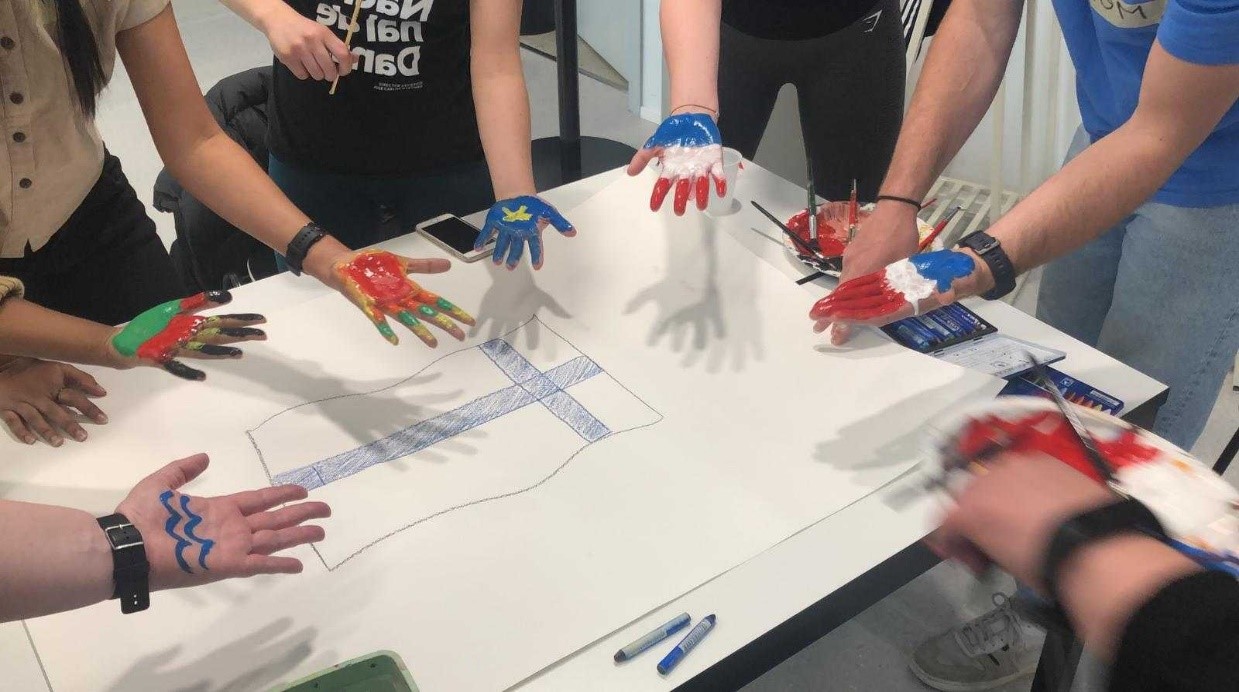
According to Buting (2020), students' knowledge and skills improve during peer learning. More importantly, shifts in their mindsets and worldviews are also important results of peer learning (Bunting 2020). At Metropolia, the master students of social services studies facilitated peer and cooperative learning for other students. The session was called ‘Wellbeing Day’. Students arranged it at the end of April at Hymy Wellbeing Village, on Myllypuro campus. The 'Wellbeing Day’ was part of the master students of social services studies, but at the same time, it was a ‘welcoming session’ for exchange students. The exchange students had started their exchange period at Metropolia just a couple weeks before the ‘Wellbeing Day’. The master students implemented the session as part of Professional communication and societal influencing studies. Transversal skills as a core theme in the ‘Wellbeing Day’ The aim of the day was to get the students to know each other, share information and discuss wellbeing at work and during studies, and learn. Moreover, the aim was to share information and discuss transversal skills. The main question of the session was; “how can transversal skills and wellbeing support each other in working life?” For example, a cooperative learning process includes (Gillies 2016, 41-42) five parts. They are: i) actively listening to each other, ii) sharing ideas and resources, iii) commenting constructively on each other’s ideas, iv) accepting responsibility for one’s behavior, and v) making decisions democratically. On the Wellbeing Day, the master students of social services studies applied these elements by guiding cooperative peer learning sessions between participants. In addition to this, master students studied and practiced their professional communication and influencing skills, as well as facilitation skills, through co-operational learning methods. The master students of social services Niina Eloranta, Tuuli Häärä, Tara Pihlajaniemi, Mira Pridham and Mari Raatikainen arranged the Wellbeing Day for exchange students in the multidisciplinary learning and development environment, HyMy Wellbeing Village. The supervising lecturers of the Wellbeing Day were Katriina Rantala-Nenonen and Marianne Roivas. Outcomes of the day As a result of the day, it was easy to recognize that while students facilitate each other, they are all learning, not just transversal skills in theory, but also learning from experience (Passarelli & Kolb 2012). According to master students’ reflection and feedback; “It was an inspiring wellbeing day with exchange students from different countries. We started the day with a short warm-up. After that, we learned together what transversal skills are and how they can be utilized in our studies, but also in future working life and wellbeing in the work community. (The master students of social services studies). The future working life needs professionals with the ability to facilitate discussion and co-creative methods with unfamiliar and multiprofessional groups. Also, understanding transversal skill as a shared ability is needed to work with unfamiliar people and invariably changing interprofessional teams. Gilliens (2016) has argued that social skills that facilitate students’ interactions during small group discussions are necessary. Along with that, and in any case, students often talk about what they have learned inside and outside the classrooms (Boud 2001). Therefore, it can be very beneficial to utilize even more and open-mindedly peer learning, while teaching and learning transversal skills. “At the end of the session, we had three ‘workstations’ where students toured in their own small groups. The themes of the stations were in line with transversal skills: Critical and creative thinking, Interpersonal and socio-emotional skills and Learning to learn”. (The master students of social services studies). Transversal skills can contribute to more sustainable working conditions, where people can collaborate and are open to new cultures. Ultimately, after this experience, we can say (based on students’ feedback) that peer and cooperative learning can support the development of transversal skills in an interprofessional and multicultural context. Further, by using peer-facilitated learning sessions, we can improve many of the students’ skills - not just professional, but also transversal skills (critical and creative thinking, learning to learn, interpersonal and social-emotional skills). For example, cultural competence is part of transversal skills (interpersonal and social-emotional skills, cultural sensitivity), and it has been defined (in ITSHEC project) as an individual's ability to recognize, assess, appreciate, and respect the unique backgrounds of others. Therefore, while talking about peer learning and transversal skills, it is important to recognize cultural aspects, not just of patients/clients, but also of health and social care professionals. By having strong cultural competence, professionals can prevent and minimize inequalities (Volberding et al. 2022) and design services to be more qualified, open and accessible for all. All in all, based on this experience and previous research (Larraz et al. 2017), it can be said that peer learning and cooperative learning can be one way to support students’ transversal skills development. Authors Eija Raatikainen, Katriina Rantala-Nenonen, Niina Eloranta, Tuuli Häärä, Tara Pihlajaniemi, Mira Pridham, Mari Raatikainen Eija Raatikainen and Katriina Rantala-Nenonen are lecturers at Metropolia University of Applied Sciences. Niina Eloranta, Tuuli Häärä, Tara Pihlajaniemi, Mira Pridham and Mari Raatikainen are students in Master Program of Social Services References Boud, D. 2001. Introduction: making the move to peer learning, 1-21. In Boud, D., Cohen, R. & Sampson, J. (eds.) Peer Learning in Higher Education: Learning from & with Each Other. Kogan Page Limited, London. Bunting, B. 2020. The implications of learning mindsets for the first-year experience and other key transitions. In A. Baldwin, B. Bunting, D. Daugherty, L. Lewis, & T. Steenbergh (Eds.), Promoting belonging, growth mindset, and resilience to foster student success (pp. 31–49). Columbia, South Carolina: National Resource Center for the First-Year Experience and Students in Transition. Gillies, R. M. (2016). Cooperative Learning: Review of Research and Practice. Australian Journal of Teacher Education. Manuscript 2902. Larraz, N. & Vázquez, S. & Liesa, M. (2017). Transversal skills development through cooperative learning. Training teachers for the future. On the Horizon, Vol. 25 No. 2, pp. 85-95. https://doi.org/10.1108/OTH-02-2016-0004 Passarelli, A. & Kolb, D. (2012). The Learning Way: Learning from Experience as the Path to Lifelong Learning and Development. The Oxford Handbook of Lifelong Learning. 10.1093/oxfordhb/9780195390483.013.0028. Volberding, J. & Madrak, E. & Harrison, A. & Bray, N. & Farrar, N. & Murray, K. & O'Brien, M. & Wymore, R. & Davidson, B. & Drinnon, S. (2022). Improving Interprofessional Practice and Cultural Competence with Interprofessional Education. 115. Poster session presented at Oklahoma State University Center for Health Sciences Research Week 2022, Tulsa, Oklahoma, United States.
Interprofessional Approach for Transversal Skills in Higher Education

Current and future challenges of societies need multi- and interdisciplinary, but also interprofessional approaches for us to adapt to and solve unpredictable situations and problems. The support needs of clients in social and health services can be very diverse. Thus, currently also social and health care legislation in Finland requires professionals to cooperate in a multidisciplinary manner whenever necessary. Therefore, working in social and health care services requires not only professional competences but also transversal skills. According to World Health Organization (2010, p.7), interprofessional work is defined as follows: “When two or more health professions learn about, from, and with each other to foster effective collaboration and improve the outcomes and quality of care”. Interprofessional work is positively associated with job satisfaction, autonomy and engagement (2). Additionally, interprofessional work is needed to alleviate employees’ workload and prevent burnout (3). At best, the power of interprofessional work is that each professional can offer help and support to each other. In other words, interprofessional work is beneficial for clients, but also for employees. However, even if every professional has their own specific core skills and demands, transversal skills are needed. Transversal skills are also often called ‘soft skills’, ‘key skills’, ‘core skills’ or ‘transferable skills’ (Gogging et al. 2019) and ‘generic skills’ (5, 6). Educating interprofessional work professionals and transversal skills While educating students, in interprofessional education practice, students of different health professions learn ‘from, with and about each other’ (7). During the educational process, interprofessional relationships between identity, knowledge, and professional power can be explored together (8). There are demands for all professions for collaboration because interprofessional work professionals need each other to achieve the best solutions and results for clients (see for example Social Welfare Act 2014). The best results can only be achieved with professionals’ strong collaboration skills and open-minded attitudes. Furthermore, education in social and health care rarely provides opportunities for practicing and developing interprofessional collaboration skills before students’ transition to working life, and it mostly focuses on technical and substantive aspects of work (Saaranen 2020). Therefore, general skills, like transversal skills, are important. Transversal skills are one suggestion to; build a bridge between social and health care professionals and support flexible collaboration between different professions. For example, OECD has pointed out that social and emotional skills (empathy, respect, self-efficacy, responsibility and collaboration) are becoming essential at workplaces (OECD Future of Education and Skills 2030). Transversal skills in higher education In many EU countries, national education policies have highlighted the relationship between education and work, and the importance of students’ generic competencies connected to them. For example, social and emotional skills have been rising in importance in education policy and in the public debate (OECD). Transversal skills can be seen as part of the idea of lifelong learning, “all learning activity undertaken throughout life, with the aim of improving knowledge, skills and competences within a personal, civic, social and/or employment-related perspective” (European Commission 2001, 9). They are not just the ‘best image of flexible employability in the labor market’ (6), but also transferable skills to improve personal flexibility and to increase possibilities on unpredictable labor markets. Transversal skills are quite a new phenomenon in the higher education context. There has been more discussion of generic skills in primary and secondary schools. Now, Metropolia has launched an ITSHEC (Integration of transversal skills into healthcare and social care higher education and curriculum) project concentrating on three transversal skills: Critical and Creative Thinking Interpersonal and Socioemotional Skills Learning to Learn Our definitions and limitations are based on project applications. In the project, we have had a preliminary data collection of participants’, university students, experiences of learning transversal skills in their studies. The data was collected in spring 2021. Students from Finland, Spain and Croatia took part in the focus group interview. Collected and analyzed data will be used to produce a Methodological Guide, an outcome of the project to be released in January 2022. In this article we present some results derived from the results of the interviews in Metropolia. According to the data, Master students (10) listed different examples of situations in their study field where they need to take transversal skills into account. In this text, we present two questions and their results. One of the questions was “In which situations do you believe that transversal skills are important?” Students’ experiences of transversal skills According to the students’ answers, transversal skills are touched upon in all work-life encounters, in service user interface situations, in all decisions where different situations are evaluated and in working community interactions, where one has to regulate oneself or control someone else’s emotional regulation. All of these can thus be combined with working life interactions, development and self-development. “Need to think how to act as a supervisor if you are critical of something in your work with service users: can I completely disagree with the service users? How do I feel about it and how do I take the matter forward, even if I disagree with them?” “Interaction and emotional skills and social influence are emphasized in working life and client work.” Some pedagogical tips for teaching and learning transversal skills The second question was focused on teaching and learning strategies. The question was, “What do you think are the most useful strategies for developing the following skills: critical and creative thinking, interpersonal/socio-emotional and citizen-oriented skills and learning to learn?” As a result of the interviews, students pointed out that studying in groups and discussions together are useful strategies for developing both critical and creative thinking and interpersonal/socio-emotional skills. Teacher supervising the discussion and reflecting with students was felt very important and relevant pedagogical way to improve transversal skills, especially while developing critical and creative thinking. ”Self-assessment and peer review after collaborative learning is a useful strategy for developing transversal skills.” (One student in the group interview) According to one student, a useful strategy for developing creative thinking is that student has to use some new method in solving a given problem. Students listed different kind of teaching and learning strategies to develop transversal skills, such as: Group discussions, collaborative learning Oral exams in groups and informal discussions with other students Self-assessment and peer review of students’ papers Essays: a student has to use source literature as well as reflect one’s own experiences in the field Group discussions based on work experience/internships of students Creating safe learning environment to practice transversal skills Case work Using virtual reality, case simulation To sum up, there are many different possibilities to teach transversal skills. Still, the intended learning outcomes and pedagogical approach in teaching specify and define teaching and learning strategies. After all, reflection is a key for deeper learning outcomes, regardless of learning content. Conclusion Transversal skills and competences are recognized in general in upper secondary schools (Finnish National Agency for Education), but not so much yet in higher education. According to Finnish National Agency for Education (2021), they are an interpretation of values, attitudes, skills and will. They are formulated into the core curriculum. In higher education, these competences are missing even though, for example, the social services curriculum is based on national (ARENE, the Rectors’ Conference of Finnish Universities of Applied Sciences) and international (EQF, European Qualifications Framework) competences. There has not been much attention to transversal competences. However, a complex world with unpredictable challenges and regulation concerning multidisciplinary between different fields require flexible professionals who can work in changing interdisciplinary and interprofessional groups. In other words, we need to pay more attention to higher education students’ transversal skills and to develop them during their studies (e.g. Isacsson 2016; Raatikainen & Rantala-Nenonen 2021). References World Health Organization 2010. Framework for Action on Interprofessional Education & Collaborative practice. Kaiser, S., Patras, J. & Martinussen, M. 2018. Linking interprofessional work to outcomes for employees: A meta-analysis, 41 (3), 265-280. McCarthy, L.P. 2021. Social Work Burnout in the Context of Interprofessional Collaboration, Social Work Research, 45 (2), 129–139. Goggin D. & Sheridan I & Lárusdóttir, F. & Guðmundsdóttir G. 2019. Towards the Identification and assessment of Transversal skills. Conference Paper. DOI: 10.21125/inted.2019.0686. Jääskelä, P. & Nykänen, S., & Tynjälä, P. 2018. Models for the development of generic skills in Finnish higher education. Journal of Further and Higher Education, 42 (1), 130-142. Tynjälä, P. & Virtanen, A. & Klemola, U. & Kostiainen, E., & Rasku-Puttonen, H. 2016. Developing social competence and other generic skills in teacher education: applying the model of integrative pedagogy. European Journal of Teacher Education, 39(3), 368-387. Freeth, D. & Fry, H. 2005. Nursing students and tutors perceptions of learning and teaching in a clinical skills center. Nurse Education Today (2005) 25, 272-282. Olson & Brosnan 2017 in Loura e.g. 2021, p. 62. Loura, D., Arriscado, A.E., Kerkstra, A., Nascimento, C., Félix, I., Guerreiro M.P. & Baixinho, C. 2021. Interprofessional Competency Frameworks in Health to Inform Curricula Development: Integrative Review. New Trends in Qualitative Research, 6, 63–71. Social Welfare Act 1301/2014. Saaranen, T. 2020. Interprofessional learning in social and healthcare – learning experiences from large group simulation in Finland. 2021. Future of Education and Skills 2030. SKILLS FOR 2030 (PDF). European Commission (EC) 2001. Making a European area of lifelong learning a reality. Brussels: European Commission. Freeth, D. & Hammick, M. & Reeves, S. & Koppel, I &. Barr, H (2005). Effective Interprofessional Education: Development, Delivery and Evaluation. Miettinen, R. & Pehkonen, L. & Lang, T & ja Pihlainen, K. 2021. Euroopan Unionin elinikäisen oppimisen avaintaidot, Eurooppalainen tutkinto viitekehys ja oppilaitosten opetussuunnitelmien kehittäminen. Ammattikasvatuksen aikakauskirja, 23 (2), 13-31. OECD Survey on Social and Emotional Skills Finnish National Agency for Education (2021) ARENE 2010. Suositus tutkintojen kansallisen viitekehyksen (NQF) ja tutkintojen yhteisten kompetenssien soveltamisesta ammattikorkeakouluissa. The European Qualifications Framework for Lifelong Learning (EQF) (2008) Luxembourg: Office for Official Publications of the European Communities (PDF) Isacsson, A., Salonen, A. O., & Guilland, A. (2016) Transversaaliset taidot tulevaisuuden ammattikorkeakoulun mahdollisuutena. Ammattikasvatuksen Aikakauskirja, 18(4), 61–67. Raatikainen, Eija & Rantala-Nenonen, Katriina (2021) Transversaalit taidot ammatillisen kasvun jäsentäjänä. Teoksessa Jakonen, M., Houni, P., Mutanen, A., Halonen, I. & Aali, P. (2021). Työn järjestyksiä. YFI julkaisuja.11. Jyväskylän yliopisto. Authors Eija Raatikainen (PhD) is a Principal lecturer in Metropolia University of Applied Sciences. Her academic focus is ”Trust” and “Empathy”, as phenomenon in different fields; like in Social Work, multiprofessional co-creation and project work, as well as educational practice and pedagogy. Additionally, she has a long track record as a project manager in various projects. Katriina Rantala-Nenonen (M.Soc.Sc.) is a senior lecturer at Metropolia University of Applied Sciences. She teaches social sciences and works in national and international projects of social services and education. In ITSHEC project she works as a developing lecturer. More about ITSHEC on UPF’s website The article has been published earlier in Tikissä-blog of Metropolia University of Applied Sciences


Katriina Rantala-Nenonen
päätoimittaja
Lehtori, YTM
katriina.rantala-nenonen@metropolia.fi
p. 040 641 8303
Hilla Niemi
koulutussuunnittelija
hilla.niemi@metropolia.fi
p. 050 567 8049

Eveliina Korpela
Lehtori:suomen kieli ja viestintä, FT
eveliina.korpela@metropolia.fi
p. 040 641 8336
Toimituskunta toimittaa blogin sisällöt ennen niiden julkaisua. Uudistuva sosiaalialan osaaminen –blogin toimituskunta on aloittanut työnsä 15.6.2018.
Ammatillinen koulutus asiakaslähtöisyys Asiakkaan oikeudet Ehkäisevä lastensuojelu Eija Raatikainen empatia Etiikka Henkilökohtainen budjetointi hyvinvointi Hyvinvointipolitiikka ikäihmiset Kasvatus Kehitysvammaisten palvelut Kelpoisuusehdot Kotihoito Koulu Lapsiperheiden palvelut Lastensuojelu Maahanmuuttaja Metropolia ammattikorkeakoulu Moniammatillinen yhteistyö nuoret Nuorten hyvinvointi Opinnäytetyöt Osaaminen Osallisuus Perhepolitiikka Päivähoito Sirkka Rousu Sosiaali- ja terveyspalvelujen kehittäminen sosiaaliala sosionomi Sosionomi ylempi AMk-tutkinto Sote-uudistus Syrjäytyminen Työhyvinvointi Työllisyys Työttömyys Vaikuttavuus valinnanvapaus Vanhemmuus Varhaiskasvatus vuorovaikutus Yhdenvertaisuus Ylempi amk-tutkinto