
Avainsana: Zinaida Grabovskaia
Older employees open up a new horizon in service work

Where to get help with children and house work, if you are a busy professional? Who to ask for help? Where to get reliable help? Where one can offer own help, if there is a wish to help others? - These questions were at the center of many student projects in “Service design” course held at the Summer Business School-2019 at Metropolia UAS. A Finnish service enterprise, Onnexi, was invited to the course as a successful example of an enterprise solving this puzzle. Challenges of a busy professional This summer Master’s students participated in “Service Design” course where student teams conceptualized own ideas for new or improved services. Not surprisingly, most of the students - who work as employees for companies and study alongside full-time work - were keen to explore and design daily services that they urgently need yet missing in their own lives. Young mothers proposed a service concept for a platform to contact other mothers for exchange of free babysitting services. Parents of school children proposed improvements to WILMA. Those who experienced long queues in hospitals proposed improvements to emergency visit notifications and queuing. The project that found most interest, however, was an imaginary service of “Buying & selling time”. The proposal was to launch a service platform where clients can ask for and find almost any services that a family may need - starting from organizing a children’s birthday, looking after a child or an elderly person, and up to lawn mowing, or carpenter work. Busy professionals admit that this type of service is highly needed yet missing in their lives! To address this interest, a special guest, Onnexi Oy, was invited to the course and share their know-how in this service area. Onnexi.fi - a Finnish example of solving a “busy professional” problem When looking for a real example of such a “buying and selling time” service, one can be surprised that it is almost missing or extremely scarce in Finland. This also struck attention of Ulla-Maija Soininen, now CEO of Onnexi Oy, when she herself was in search of a similar service. Ulla-Maija, not long ago an employee of KONE and a specialist in industrial process development, was in search of helping hands to look after her lonely mother who lived in Northern Finland, a long way away from Hyvinkää. No one in the family lived in the North anymore, and no search for a reliable aid could help Ulla-Maija to solve this puzzle. Ulla-Maija, with her background in process development, invested a great deal of her time to conduct a systemic search only to discover that there is no one to help her. It soon became evident that, if she wanted to get help, she would need to organize such a service herself. After some deep thinking and attending short-time entrepreneurial courses, Ulla-Maija decided to bravely try and start her own service enterprise, firstly in small steps, alongside her main work. As many other entrepreneurs, Ulla-Maija soon discovered that her project takes much more time that she expected, but it also started becoming more and more important to her as her true heart was put into the job. Knowing the global trends for ageing population (1), and the Finnish trend for more unemployment in the older groups (2), Ulla-Maija decided to match the needs with the demand - and base her service on the most reliable employee group, the older people themselves. Services by older employees As she tells herself, Ulla-Maija never previously suspected that there are so many active, motivated, physically well-fit retirees, who are looking for a meaningful job, which they can do excellently. Being a busy professional herself, she was on the other side of the puzzle for most of her life. Now, when she discovered her own new meaning in life, Ulla-Maija decided to focus fully on her service idea. She finds great joy in helping to match the right people - those who are full of energy, experience and motivation to help, with those who are in need of help and have multiple tasks at their hands. As for the client base, the picture has turned out to be not so black and white as it was initially expected. The older age groups also make a big client segment themselves - for the household routines, cheering-up visits, help with IT and use of tools, and nowadays even for professional medical services by the older nurses! This latest demand came as a surprise for Ulla-Maija as a client organization turned to Onnexi for help. Onnexi was able to provide them with older nurses. Following this success, more and more organizations are now turning for help to Onnexi’s older workers. Currently, Onnexi, a Finnish enterprise that operates in Kanta-Häme, Turku, Pori and Tampere, offers services provided by the older age groups to families and other elderly. In other words, Ulla-Maija was able to realize her dream and successfully launched a new service, where the support is provided only by the older-aged workers. The service offerings are now growing fast, and Onnexi started arriving also to other Finnish regions. Social entrepreneurship as a trend The trend for social entrepreneurship and business with meaning has grown visibly since early 2000s. It has become a popular topic in business literature, and the “social value” of business is now discussed by big business names such as Michael Porter (3). Business with a social meaning is now a well-recognized trend, and as an entrepreneurial activity it is often defined as “an innovative use of resources to explore and exploit opportunities that meet a social need in a sustainable manner” (Sud et al. 2009) (4). Social media and internet often serve as the main channels for promoting and selling such services, getting the word-of-mouth across, as well as for immediately publishing feedback and reviews, and thus providing a platform for both finding and offering social services. The business model by Onnexi seems to offer something that is yet new in Finland but somewhat familiar in other countries (such as a famous example of “German grandmothers”). In the case of Onnexi, the service seem to tap those sectors that previously were not considered for service work - the older workers domain, even for traditionally “younger” employment sectors such as nursing jobs. In addition to social entrepreneurship, this service idea can be considered from the perspective of Sharing economy, since it places the use of untapped resources at the heart. Offering better than Sharing economy: “Service Design” lessons of Master’s students Sharing economy is generally defined as a model to use the underused resources. “Sharing economy is the product of a new age where underutilized assets become peer-to-peer services for hire, enabled by the internet and smartphones”. (5) Thus, key ingredients in Sharing economy are: (a) identifying and creatively re-thinking the available resources for sharing, (b) use of service platforms. A though-provoking example from Onnexi shows how “the puzzle of a busy professional” can be approached via sharing of under-used resources. Moreover, another learning from Onnexi comes from solving “the Sharing economy puzzle”. (The Sharing economy puzzle is created by its two biggest concerns, trust and taxes, that come as a result of direct peer-to-peer sharing, and they bother potential customers very much). In both respects, Onnexi sets a unique example of solving these concerns and provider important learning for others in this sector. For Master’s students, the biggest learning came from inspiring deep reflection on the role of service design for conceiving successful services. While students in their imaginary projects had challenges in providing security for a free-access “Buying & selling time” service, Ulla-Maija approaches trust and security as the corner-stones of her service idea. Her service is designed in such a way that all workers at Onnexi are full-time employees, not volunteers. They make an indispensable part of the enterprise, all of them are well-known in Onnexi, and thus the clients can trust them. Ulla-Maija invests a lot of her time matching the talents and interests of her employees with the needs of the clients, with the aim of building long-lasting ties between the families and their aids. In other words, the sharing problems get solved! Regarding other learnings, this year’s service design projects showed a shift in student interest from developing industrial services towards testing out own service ideas, especially in social and shared services. As such, their service design projects focused on exploring the opportunities how to launch new service platforms, exchange baby-sitting services, make WILMA user-friendly, spent less times in hospital or hotel queues, and - especially frequently - how to get & offer reliable and safe help for homes and families. In Metropolitan area UAS universities, this growing trend has been recognized and recently turned into a new learning module “Sharing economy” based on 3AMK cooperation between Metropolia, Haaga-Helia and Laurea. (6) The learning journey will continue into a new, inspiring direction! ========================== About the authors Ulla-Maija Soininen is a CEO of Onnexi Oy that she founded to address a growing need for finding reliable help. Zinaida Grabovskaia is Metropolia’s instructor in Service Design and Head of Master’s programme in Business Informatics, who is welcoming innovative service businesses to share ideas with the students and learn together. References Bughin, J. and Woetzel, J (2019). Navigating a World of Disruption. McKinsey Online. Yle uutiset, Lahti, 28.8.2019. Väestö ikääntyy ja työttömyys kasvaa – Lahdessa huollettavien osuus väestöstä lisääntyy. Driver, M. (2012). An Interview with Michael Porter: Social Entrepreneurship and the Transformation of Capitalism. Academy of Management Learning & Education, Vol. 11, No. 3, 421–431. Sud, M., Van Sandt,C.V., and Baugous, A. (2009). Social Entrepreneurship: The Role of Institutions. Journal of Business Ethics, 85: 201-216. Paajanen, S. (2016). Business-to-Business Resource Sharing: White Paper. VTT: Business Innovation & Foresight. - Definitions of Sharing Economy. A New Learning Lane: Circular Economy for Sustainable Growth 15 credits (5.11.2019). Onnexi Oy Facebook LinkedIn Metropolia’s Summer Business School
The Dark Side of Statistics
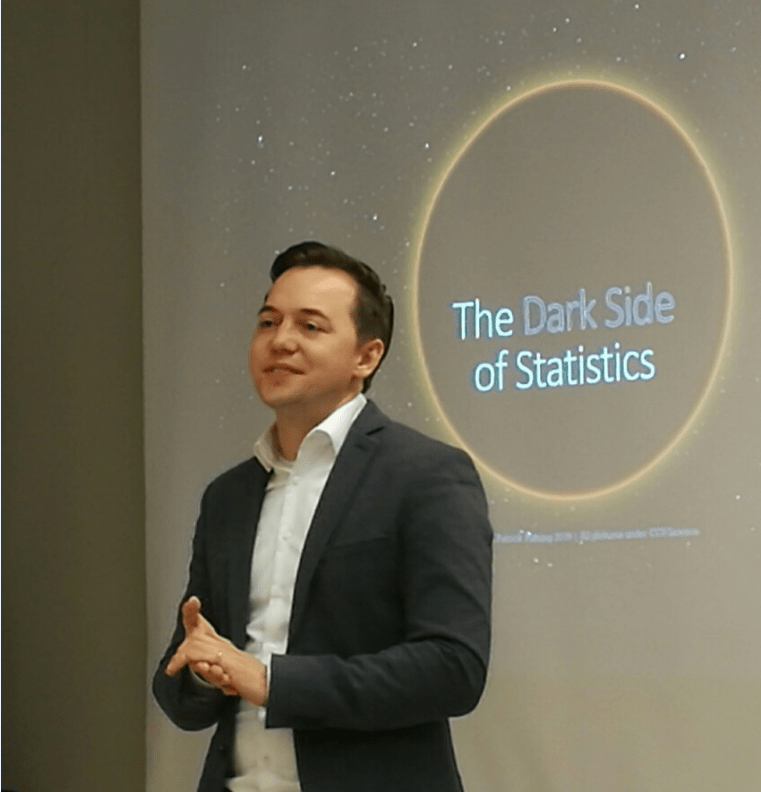
“The dark side of statistics may become a trap, if the subject is not used professionally. Among the current wide use of data analytics and popularization of statistical tools, we need to know more about statistics and understand it deeper. It will help to avoid its dark side”, believes Prof. Dr. Patrick Planing from Stuttgart Hochschule für Technik, a partner University of Metropolia. He shared his views with the students of Master’s program in Business Informatics in a guest visit to Metropolia University of Applied Sciences. Traps of Statistics Typical of Media: Miscalculations Statistics has gained a lot of credibility is society over the years. Readers of newspapers and popular journals are used to reading unusual, sometimes shocking news, and get easily convinced as soon as statistics is mentioned. In practice, however, a sloppy use of statics can lead to even fake news, when the concussions are drawn superficially, but positioned as if based on careful statistical analysis. Consider this claim: “The proportion of suicides in all deaths is highest among the people under 20 years with 25%, compared with 10% among 30-40 year olds, and less that 2% among over 70 year olds”. Conclusion (wrong): “So, the decision to commit a suicide decreases more and more with the age”. Can we agree with this claim? If we look at it closer, there are many flows in this claim. First, there are no absolute numbers, which makes it unknown how many actually died in every age group. As a result, the current proportion cannot be correct since the death numbers in each groups are different. Also, there are no reasons indicated for the other deaths (they may be due to traffic accidents, diseases, etc), which makes the picture distorted, as there may be a growing number of other reasons for death in older age groups. If such news are published in press, they look scientific, but the public should not be deceived. If we read this claim slowly, think of the context, and consider if this is possible at all, we can see that it cannot be correct, and does not allow to judge reliably about the behaviors of different age groups. More Traps for Media: Misinterpretations There are many of such false news. One very famous example originated from a study conducted by Denmark, universities, that investigated which students complete and which drop their studies. The drop rate was up to 40% over the first year, so it was important to explore the reasons for this. The research group discovered a surprising and rather confusing result. They found a negative correlation between the drop rates and the drinking habits of students. But it was not the conclusions that comes immediately to mind (that drinking habits lead to drop outs), but the opposite. The surprise was that the regularly drinking students dropped less! All world media shared these unbelievable news: the more you drink, the more successful you are in your studies! “Sober students are more likely to drop off” were the headings in many media. But could we really draw such a conclusion form this statistical study? No, we cannot. First of all, this cannot be a conclusion but a hypothesis, as there may be other variables interfering into this correlation. In other words, it is not that “X correlates with Y”, but “X correlates with Z (a third variable), which correlates with Y”, and other variables may be missing from the analysis. For example, social occasions may contribute to completing the studies. Maybe, it is the active social life that helps success in the studies (the students, who did well, and did not drop, did not fear the exam, probably because they socialized with others). Since this statistical study did not look deeper into the habits, we just do not know. As statistics professionals know, correlation does not indicate any causality. In other words, the most likely explanation may not be the truth. True reasons may be many. A simple answer is to check carefully before making claims. Traps of Statistics for Professional Science: In Significance Level and Data Openness However, even the correct process of interpreting the data can lead to wrong results that are seemingly based on correct statistics. If we look beyond popular media, there are still many underlying reasons (not only the fake news) why statistics can be “lying with the numbers”. It may happens, for example, if someone is trying to make sense of statistics - in any science, in biology, chemistry, economy etc. - without awareness of specific flaws that may be awaiting. One of the reasons of flawed results in science, especially in the past, is the way how we do science. It often dictates wrong conclusions. The current statistical rates of measuring the acceptability of science results started in 1925, with the British statistician Ronald Fisher offered a cup of tea with milk to his colleague, Muriel Bristol. Muriel refused this cup saying that Fisher poured tea first and milk second into her cup, while she likes it the other way round. She also claimed that she can see it at a glance which liquid was poured first. Fisher arrange a special experiment for her, to check how many times she could correctly make such a prediction. Fisher concluded that "Bristol divined correctly more than enough of those cups into which tea had been poured first to prove her case". But how many cups are enough? Since Fisher’s influential 125 books, the statistical significance was accepted at the rate of 5% for scientific results to prove “true”. In 1925, Fisher’s believed that 6-8 cups were “well enough” (starting from Fisher’s statistical book), and since then a significance rate of 5% has been accepted by science as “well enough” for many disciplines, and often continues till now. In practice, however, statistical significance does is not equal to a real life significance. If we have a significantly large size of sample, even the smallest effect can be calculated as a significant result! By now, enough evidence is collected by statistics that argue against a blind adoption of the 5% significance level (and this is still the rate to get published in medicine, for example!) reliable results cannot be obtained. In 1925 it was probably ok, but it cannot be accepted any more, although it still happens today. If someone tests a new drug against 5% significance level, it simply does not make sense, as the significance level alone does not tell us anything about the effect of the drug.. This is clear to all who know statistics and its behavior. This is where “bad science” comes from that has come into light in recent years. The answer is to have a significant difference, and do not accept low levels with 5% of proof. This is not any more acceptable and there is a lot of discussion around it nowadays. How to Avoid These Traps in Science and Business? Therefore, good science needs to have, first of all, to pay attention to the significance levels and the size of the sample group. Next, good science will also absolutely necessary analyze the difference, measuring the true effect size. Good science should check all the factors carefully, by testing the same correlation in random groups, the bigger the groups, the better the ground! At the same time, professional scientists cannot rely only on correlation. The problem with correlation is that is does not say anything, it does not prove any causality. This is why there is a need to establish experiments. A good reading here is the book “Designing experiment” Fisher, 1943. My message to students is do not be fooled by media or “poor” science who do not understand the dark side of statistics. Also, for professional scientists, it is important to stop use “null” hypothesis tests, or testing the opposite instead of testing the actual phenomena. Such “null” tests lead to a lot of confusion (like in patient statistics developed in 19th century, instead of using significance testing). But the main issue for science is the absolute necessity to publish the data (instead of a 5-page note about conclusions, which can be drawn incorrectly). Give the raw data, show it, tell how much and what was measured; or if not publish, demonstrate the data to experts, similar to the practice in referenced journals. This initiative is called “Open data initiative”, there still could be flawed data, but this openness about the simple will increase reliability of science results. Management of organizations should also be aware of these effects. Management needs more educations in order to use the statistics produced by consultants and own staff more effectively. This is especially evident for Marketing research. There was a big discussion in “Spiegel” magazine recently, and some professionals even claim that all marketing research is flowed since consultants are not educated in statistical methods. This discussion shows that deeper knowledge of statistical methods is needed for professional in all fields, journalists, politicians, even scientists. A wide society also need to be more demanding and create pressure to prove the grounds for conclusions based on statistics. Without a careful check of the utilized data samples, the data analysis process and interpretation, no reliable conclusions are possible, even from such a precise discipline as statistics. ================================================= Prof. Dr. Patrick Planing - a guest speaker from Stuttgart Hochschule für Technik teaching Statistics and Statistics Models for big data. His interested include business psychology, future thinking, predictions, strategy scenarios, and many other interesting topics related to data. Zinaida Grabovskaia, PhL - a lecturer and Head of Business Informatics Master’s Program at Metropolia University of Applied Sciences. Zinaida is interested in inviting the latest and most important topics to professional discussion with Metropolia Master’s students.
Customer Experience is a Critical Topic for Business
Customer experience today is included in the strategies of most companies. It has been high on the agenda already for years. Yet, as we have seen from the students’ investigations every year, in spite of being on the high-level agenda, there is still a lot to do on the practical level. Easily, when we think about the next steps, we think very big - about digitalization, augmented reality, big data, just to mention a few examples. However, a lot of company internal practices need to be considered to ensure the personnel is motivated and capable to do their best to deliver delightful experiences for the customers both in the digital and physical channels. Sometimes this means that normal, ‘old-fashioned’ things need to be put in place – such as visibility to the goals that the company has defined for customer experience, or to the actions are being carried out, or transparency and access to data, and communications. Developing the mindset and company culture (see video here) are crucial for delivering great experiences. Customer Journey – a Key Tool for Developing Customer Experience A key tool for understanding and developing customer experience is Customer Journey. A customer journey is a presentation that consists of all encounters that a customer has with a company – either in digital or in physical channels. It includes interactions that are designed by a company – like web sites, advertisements, retail stores – but also touch points that are not in the company’s hands, like reviews and articles published by media – or opinions provided by friends or influencers in social media etc. Customer Experience Requires Holistic Thinking Customer Experience, according to the definitions that I particularly like by Manning and Bodine (2012) and Watkinson (2013), relates to the whole array of interactions with the company, even before the first actual contact happens. In other words, customer experience happens in every single encounter with a company. Presently, we are going very speedily into the direction when more and more companies want to differentiate with customer experience. It is widely understood that product and technology orientation need to transform to customer orientation - truly understanding the needs and preferences of customers. On this path, companies still have a lot to do. Toward Customer Centric Company To help students understand the topics of customer focus, customer orientation and even customer obsession (as many companies, Zalando as one example, call their customer centricity), I felt I need to develop a tool for students to conduct a current state analysis in their companies. I felt it was logical to develop it based on a model that covers five key areas of customer-focused practices in any company. These five areas are: Listening to customers, Analyzing customer insights, Engaging employees, and Acting towards customer centricity, which together lead to Commitment to Customers. With the tool ‘Customer centricity reality check’, each of these areas is investigated by asking a set of questions that help the organization assess how mature they currently are, and set their goals and agree development activities to reach the goals. Every year after the lectures and assignment in the ‘Customer Oriented Business’ course, some students come and tell a wonderful story. After conducting the ‘Customer centricity reality check’ they have managed to convince their management to take some big steps in re-thinking how to improve their company practices to ensure success in customer experience. After Being a Successful Lecturer, Johanna Vesterinen is Learning a New Phase in Life After 5 year in Metropolia, I have a lot of positive impressions. Firstly, working with the course has every year been really rewarding and interesting. The students have their own experience from working life, and the discussions in class have always been very engaging, since the students can learn so much from each other, and share knowledge with their peers. The students’ motivation has always been extremely high! Always, at the end of the completed course, at the Graduation ceremonies where I was invited, I have seen and felt that the students have accomplished their study goals. It gives a strong feeling of reward also to the instructors. Johanna’s Career Path to Expert of Customer Experience As for my background, it is not typical for my area, but probably is becoming more and more typical now. I first studied foreign languages, and was a teacher for four years. Then, I went to business and worked for 17 years for the Finnish Institute for International Trade (FINTRA at that time). I was first responsible for the department of Languages and Intercultural Communication. Then, I got a second responsibility for training programs in International Business Management. From there, I moved to Nokia and worked in HR for Competence development and then moved to the Quality organization, and then to Customer Insights. An interesting figure that I recently found from a book by Evans and Burnett “Designing Your Life” (2016) is that only 27% of graduates in the U.S. end up working in the field of their major subjects. I think I belong to the other group. My experience in Nokia was like going through a university in a practical way. In this type of big company you get to learn so many things from so many areas that I can say it was the best working experience I have had. But the experience was not only about the content of work, it was also all the great people I learned to know there and with whom I still keep contact. So, I am grateful for the 14 years that I spent there. In all working places, I have seen the value of knowing your customers and designing your services for them. This works as a great motivator both on the individual and the organizational level and makes your work worth while. During my career, writing study books has been one of my hobbies. One of the most memorable projects was when we wrote study books with a group of friends for the Finnish broadcasting company, but there were also a few others, and the last one was the book “Committed to Customers” that was the main reading for Industrial Management Master’s s students. This book is not about designing the customer experience, but about developing practices inside the company to ensure that different units in the company take customer experience to their agendas, and to all the employees, to build business based on Customer insights. "Retiring Means Learning a New Phase in Life" What I want to do now… I’m very fond of learning foreign languages, and I will continue learning French and Italian. I also love travelling, and I will take care of my family, both the younger and the older generation. What I have learnt is that retirement means a busy life after a busy life! Also, I am involved in group mentoring with the Helsinki University Alumni organization, and I find it very rewarding. Mentoring is never a one-way road. You give something from your experience, and you gain a lot in return from the young people. This is something that I definitely want to continue. Every time my personal features have been assessed (and with so many years in business life this has happened a lot), it has become clear that the first and most important thing for me is learning. Learning is something that is super-valuable and really affects my wellbeing: I want to learn new things all the time. If I do not have any activities going on to learn new things, I do not feel well. When asked what I would advise to the students, I would say: absorb everything that you can get form your Program! It is one of the greatest opportunities in life! Be present at lectures, be in contact with your peer students, develop networks, and also challenge the instructors and each other, and yourself, too. I understand that it is hard work, but I have seen no one who would have regretted this hard work, it is really worthwhile! It may be tough to combine employment, family and the studies, but if you need help - ask for it; and if you see that your co-student needs help, go and offer your help. The most important thing is, believe in yourself, you can do it! References Vesterinen, J. (2014). Committed to Customers: A 5-step Model for Delivering Great Customer Experiences. Helsinki: Suomen liikekirjat. 132 pages. ISBN: 9789519155364. Vesterinen, J. (2015). Customer Experience - Actions for Companies: Video. Helsinki: Metropolia University of Applied Sciences. 3 min. Available: https://www.youtube.com/watch?v=fFh8q5Y8xPY&feature=youtu.be&list=UU9mG6ja6NiQ71BamUtBlhyw Evans, D. and Burnett, B. (2016). Designing Your Life: How to Build a Well-Lived, Joyful Life. Knopf Publishing Group. 272 pages. ISBN: 9781101875322. Manning, H. and Bodine, K. (2012). Outside In: The Power of Putting Customers at the Center of Your Business: Forester Research. Amazon Publishing: Kindle Edition. 270 pages. ISBN: 9781491514221 Watkinson, M. (2013). The Ten Principles behind Great Customer Experiences. Pearson: Financial Times Series. ISBN: 8601404277474
Helping Sustainability: Consumer’s Influence Can Reach till the End of Supply Chain
By Sabari R. Prasanna and Zinaida Grabovskaia Metropolia’s part-time lecturer Sabari R. Prasanna, who teaches Business students on supply chains, visited Master’s program in Industrial Management and raised awareness of social and environmental issues in supply chains. It was an important visit that created discussion on sustainability issues across the whole supply chain with supply chain managers and professional purchasers. Master’s students of Industrial Management program are full-time professionals who are involved in decision-making and selecting suppliers on a daily basis. As sustainability becomes an ever more important issue for businesses, students were interested to discuss the ways how sustainability can be increased thought the efforts of both, responsible business and responsible consumers (Prasanna, 2015). What is sustainability and what it means for companies? A change to sustainable ways of doing business is a welcoming change, actively supported by legislation in many types of business sectors. Companies themselves also use sustainability as a competitive advantage. Energy companies, for example, use environmental benefits of alternative energy as an argument for being more attractive than, for example, fuel-based energy. Railways argue that they are more sustainable than road transportation since they create much less environmental pressures, and so on. Yet, companies still have to ‘sell’ this expensive change of becoming more sustainable to their shareholders. The old logic of ‘increase revenues – decrease costs’ is still very much prevalent in many businesses. Such businesses often argue for ‘reducing pollution by 10%’ rather than asking themselves How can we stop polluting? This logic of small steps is very much ingrained in public opinions as well, promoted by lobbyist and some politicians. In practice, to become more sustainable, companies need first to convince their shareholders that such a change is needed. Further on this road, the idea of running sustainable business practices should also win over priorities of financial profits (Epstein & Roy, 2001). As a result, the companies that wish to become more socially responsible, environmentally friendly and overall more sustainable, still need to make a lot of efforts to promote sustainability to their own shareholders. However, the stakeholders in doing business sustainably create a much wider community than the shareholders of any company. In case of an environmental disaster, or a human right violation, it is a much wider community that is affected, not just the immediate shareholders of a business. Thus, to influence shareholders, it is necessity to make first of all the stakeholders (i.e. a wider community) more interested in sustainability. This is a very powerful group that votes with their money, and can simply boycott an ugly business by refusing to buy from them. Nowadays, there are many examples of such consumer voice. As consumers, we have a huge power. However, what we know as consumers is yet very little, and – regrettably - there is often little interest in sustainability. As a result, consumers may not know that there are sometimes ugly things happening at the front end of the supply chain. There is a shocking example of cocoa firms kidnapping children to work as forced child labor in Ivory Cost. There is a film in Youtube about it. We all consume chocolate, but few know how cocoa suppliers commit horrible crimes in pursuit of reducing costs. Another example is production of palm oil that has led to massive deforestation in Malaysia and Indonesia, leading to rapid reduction in the Orangutans population due to disappearing rain forests. These are examples of violations done in pursuit of increasing shareholders value by lowering costs, and show what may happen, if no constrains are put to such practices. Here, legislators can lead the change by demanding the companies to become accountable for sustainability (as done, for example, in Sweden). With support from legislators, the new way for a business to look at sustainability is from the perspective of the triple bottom line (TBL) – stressing social, economic, and environmental elements. It means that not just profits, sales and products should be important, but also wider values beyond that - social and environmental perspectives, as well as wider economic and human rights issues. Still, there are many questions around sustainability, and managers are often confused - is there a moral mandate to practice sustainable ways of doing business? Who will pay for it? Is there any business opportunity in sustainability? Sabari believes that this last question is the most important one. If a business can create value from sustainability, then it raises sustainability to a totally different level of interest from business and stimulates innovating sustainable practices. To support responsible business on this way, there exist many encouraging examples from forerunning companies (such as Fazer Group). There are also examples of change in conceptual understanding of running business sustainably by big names in business science (such as Prof. Philip Kotler). Kotler was the father of the famous ‘4Ps’ – a marketing mix that drives profitability: Product, Price, Place, and Promotion. In one of his recent editorials in ‘Journal of Marketing’, Kotler indicates sustainability as a fifth critical element in addition to his well-known 4Ps, and argues for sustainability as a vital issue for any business (Kotler, 2011). Universities are also very active in promoting responsible buying and even coined a new term, pro-sumerism. One example is a podcast about research by Georgetown University, USA (Deloitte Insights, 2018). A lot of positive things are currently happening across many sectors. Holland abolishes the use of gas cars (only hybrids and electric cars will stay), companies in Norway start cleaning the ocean, etc. Policy makers together with general public come up with better practices to save the future. The only possible answer is to re-think the old paradigm of ‘increase revenue - reduce costs’. To make it happen, the pressure should come out from the public, so that it will make business to change the old harmful practices. As managers, in everyday decision making as well as in personal life, we all need to exercise our influence toward more sustainable ways of doing business, and through becoming more sustainable in our decisions as consumers. Sabari R. Prasanna is a Doctoral candidate at Hanken School of Economics specializing in humanitarian supply chain management, who is finalizing his PhD studies and is a part-time teacher in Metropolia’s Business school, Myyrmäki campus. He used to be an Assistant Professor in BIM, India. Sabari is currently interested in supply chain sustainability and making it attractive for business. Zinaida Grabovskaia (PhL) is senior lecturer and head of master’s program in Industrial Management at Metropolia UAS. The program specializes in service business especially for big industrial players. References Epstein, M. J., & Roy, M. J. (2001). Sustainability in Action: Identifying and Measuring the Key Performance Drivers. Long range planning, 34(5), 585-604. Deloitte Insights (2018). Turning Consumers into Prosumers for Ethical Shopping: Interview with Neeru Paharia: [Podcast]. Available from: https://www2.deloitte.com/insights/us/en/multimedia/podcasts/nudgeapalooza-2-behavioral-economics-insights.html Kotler, P. (2011). Reinventing Marketing to Manage the Environmental Imperative. Journal of Marketing, 75(4), 132-135. Prasanna, R. S. (2015). Management Ingredients to Embrace the New Paradigm: Green. European Business Review, 27(3), 318-333.
We are in sharing business for 35 years already
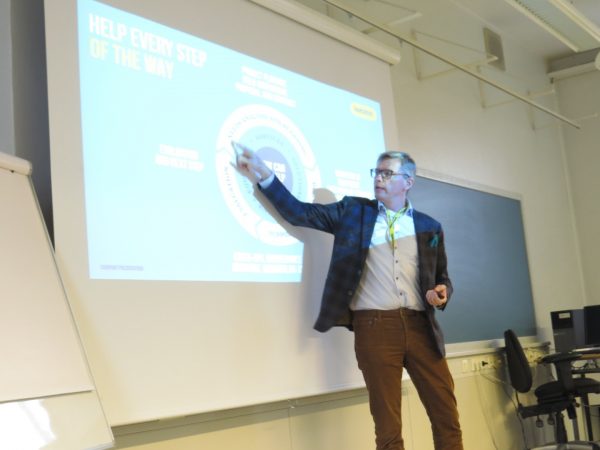
By Mikael Kämpe & Zinaida Grabovskaia Sharing economy gets more and more popular today. Sharing of assets safes money and frees the capital to concentrate on core competences of businesses and people. RAMIRENT is one of biggest and oldest Finnish companies that focuses on machinery and equipment, and rental of professional equipment. Nowadays, Ramirent is also famous for multiple services related to construction, industry and even to big events! Mikael Kämpe, Executive Vice-President of Ramirent Finland, visited the Industrial Management Master’s program and talked to students about the art and craft of providing services. Our business is making a safe construction place Ramirent, a leading Finnish company that is now also very visible in Europe, was established in 1955. In 2017, annual net sales reached 191,5 MEUR in Finland (Group 724M€). Ramirent is a market leader in Finland, Baltics, Norway, Poland, Czech and Slovakia, except in Sweden and Denmark. The main customer of the company is construction business, as well as the companies and sites that resemble construction, for example, shipyards and big events. Our main business is to make a safe construction place. But we are not a building company. We provide equipment, know-how, services, and customized services for construction sites. In services, our core focus is on a wide range of equipment rentals. In Finland, appr. 40% of our business relate to services, and we tend to focus more on services combined with our equipments. We have developed a ‘One-stop-shop’ offering for machines and equipment. This includes renting the light machinery, heavy machinery, and also more complicated rental services - safety equipment, scaffolding, tower cranes (here, we are second in Finland), hoists, power and heating, lifts, renting modules for construction workers, etc. In addition, our services include planning for temporary sites, site services, training, logistics, and fuel services. These services make appr. 40% of our business in Finland. One example of Ramirent’s recent projects is Tripla in Pasila. We are a ‘one-stop-shop’ supplier and partly run the site logistics for this project. We also provide a lot of temporary solutions, such as scaffolding and weather protection services (heating, moisture protection, etc), since we have very challenging weather in Finland. Under our scaffolding system that covers the building, the workers can do their work even in rain and snow. Currently, construction is booming. The growth is visible especially in the capitals and big university cities. There is also a rising number of small construction companies. As a result, the competition is getting tighter. Also, the demand for equipment is changing quite fast. European regulations always tighten the level of safety and emissions and thus tell us what equipment to use. As a result, construction sites become more and more complex, especially for big companies. Focus on people as the biggest asset To help our customers to run a construction site, we start with (a) the needs analysis and planning, continue to (b) delivery and support, and end with (c) evaluation when the equipment comes back. Upon the machinery return, we check, refill, clean it, and also fix it, if necessary. For fixing, we send the equipment to specialized hubs. We have currently 58 customer centers across Finland and specializing hubs for different types of equipment. Based on our experience, it helps if maintenance is centralized. Another reason for the hub structure is the logistics of spare parts, and having all similar equipment in one place. Whatever we do, we always focus on people as the biggest asset. And the general trend is that we take better and better care of people. Interestingly, equipment rental business is a unique area where Finnish companies are the biggest in Europe. In addition to rental services, we also developed a digital platform RAMISMART. Länsimetro, for example, uses this system. One part of it is ‘Time and Attendance’ which tell how many people are on the site, and to the tax office which workers and companies are working. After having this system for a couple of years, we started thinking what else we can do with it and launched ‘RAMISMART Machine Control’. With this system, we can follow who is using the machine and authorize the access to it. The big data is not yet utilized, equipment is not yet speaking with each other, but this is definitely the future. Big events as a new service area Finally, big events has recently become a customer for our services. As big events require temporary infrastructure - quite like a big construction site - we started providing rental services for big events. For example, we built the infrastructure, temporary stores and shops, change rooms, fences, scaffolding, etc. for such events as Flow Festival, Tall Ships Race and Helsinki Ice Challenge in Kaisaniemi. In 2018, appr. 150 events have been conducted this year only. This service started as a marginal activity but now has grown into a larger business. Thus, do not be surprised seeing Ramirent when going to a festival. This is not a coincidence but a new service area for a company that has know-how and competences in managing equipment, logistics and services for big sites. The text is based on Mikael Kämpe’s presentation materials written by Zinaida Grabovskaia. Mikael Kämpe Executive Vice-President of RAMIRENT Finland Oy and a guest speaker on developing service business in Industrial Management Master’s studies Zinaida Grabovskaia Senior lecture, Head of Master’s program in Industrial Management, Metropolia. The program specializes in service business especially for big industrial players.

The editorial team will provide the content of the Masterminds blog before publication.
The editorial team started its work at the beginning of 2022.
Pia Koirikivi, chief editor in Masterminds blog, Pedagogical Specialist
Minna Kaihovirta, Manager of Dialog
Iira Lankinen, Principal Lecturer
Riikka Wallin, Publications Specialist
Zinaida Grabovskaia, Senior Lecturer
Salla Kivelä, Principal Lecturer
asiantuntija yamk business informatics Business Informatics Master’s Program CERN Bootcamp Construction Business hankinnat hankintastrategia hankintatoimi ilmastonmuutos Industrial Management Industrial Management Master’s program johtaminen koulutus kulttuurituotanto Marjatta Kelo master Master's Thesis masterminds Masterminds blog Master of Engineering Master’s degree Metropolia Metropolia AMK Metropolia Master's Metropolia UAS metropolia YAMK opinnäytetyö osaaminen service design Sharing economy sosiaali-ja terveysala sosiaaliala study trip Sustainability talotekniikka terveyden edistäminen terveydenhuolto työhyvinvointi ura yamk YAMK-tutkinto YAMK opinnäytetyö ylempi AMK ylempi ammattikorkeakoulututkinto Zinaida Grabovskaia
