
Hyvää palvelua ei nyhjästä tyhjästä

Mikä on palveluyrityksen tärkein resurssi? Prosessit, joilla palvelua tuotetaan? Työvälineet, joilla palvelua voidaan tarjota asiakkaille? Palvelukonsepti itsessään? Palvelu on prosessi, joka koostuu lukuisista eri tekijöistä ja usein monimutkaisesta palveluekosysteemistä. Palveluntarjoaja voi palvelunhallinnan, toisin sanoen erilaisten prosessien ja toimintojen avulla varmistaa, että sen tarjoamat palvelut todella tuottavat arvoa asiakkaille. Kuitenkin, koska palvelu syntyy useimmiten ihmisten välisenä toimintana, on palvelutuotannossa merkittävässä roolissa palvelua tuottavat ihmiset. Yritys voi panostaa vaikka kuinka paljon prosesseihin ja julistaa toimivansa asiakaskeskeisesti, mutta jos se unohtaa palvelua tuottavat ihmiset, tärkeimmän resurssinsa, jää yrityksen menestys puolitiehen. Tyytyväiset työntekijät, jotka asennoituvat työhönsä innostuneesti, tuottavat tutkitusti parempaa palvelua kuin työhönsä leipiintyneet kollegansa. Hyvä asiakaskokemus taas lisää asiakasuskollisuutta, mikä vuorostaan näkyy positiivisena tuloksena viivan alla. Asiakaskokemuksesta huolehtiminen on toki palvelualoilla oleellista, mutta oman henkilöstön hyvinvoinnista huolehtiminen on kriittistä. Juha Tuulaniemi korostaa myös ihmisten merkitystä palvelukokemuksen muodostumisessa kirjassaan Palvelumuotoilu (Talentum 2011). Tuulaniemen mukaan ”asiakaspalvelu on vaikuttavin näyttö siitä, miten brändi kohtelee sinua”. Toisin sanoen brändi ei pelkästään näy, vaan se koetaan ja tämän takia olisi ensiarvoisen tärkeää huolehtia, että työntekijöillä on edellytykset palvella asiakkaita hyvin. Miten siis varmistaa, että työntekijöillä on edellytykset menestyä työssään? Suorituskyvyn edellytyksille ei ole olemassa mitään tyhjentävää määrittelyä, mutta sen voidaan katsoa olevan taso, millä työntekijät kokevat työtehtävässä menestymisen edellytysten olevan, ja miten työhyvinvointi koetaan. Kaikessa yksikertaisuudessaan, työn mielekkääksi kokemiseen vaikuttaa valtavasti työn sujuminen arjessa. Kun työntekijät ymmärtävät oman työnsä merkityksen osana kokonaisuutta ja saavat mahdollisuuden kehittää osaamistaan ja työtapojaan, ollaan jo pitkällä. Harvard Business Review’n artikkelin mukaan työssä erinomaisesti menestyvien työntekijöiden loiston taustalta löytyy kaksi tekijää: elinvoimaisuus ja oppiminen. Työntekijät, jotka kokevat olevansa elossa, intohimoisia ja innostuneita aikaansaavat energiaa itsessään ja toisissa. Ihmiset, jotka kehittävät osaamistaan, uskovat myös todennäköisesti enemmän omiin kasvumahdollisuuksiinsa. Työn mielekkyyttä voi itse systemaattisesti pyrkiä kasvattamaan, mutta mielekkyys, kuten ei myöskään hyvä palvelu, koskaan synny tyhjiössä, vaan on aina osana ympäristöä, työyhteisöä ja työtehtäviä. Keskittymällä työntekijöiden suorituskyvyn edellytysten parantamiseen ja innostuksen ruokkimiseen, yritys voi vaikuttaa positiivisesti myös palvelutuotannon laatuun sekä asiakastyytyväisyyteen. Tämän ei pitäisi olla mikään yllätys, mutta silti yllättävän harva yritys aidosti panostaa henkilöstönsä suorituskyvyn edellytyksiin. Henkilöstökustannukset palvelualoilla ovat yrityksen isoin kuluerä, joten miksi et huolehtisi, että suurin sijoituksesi tuottaa parhaalla mahdollisella tavalla? Panosta siis henkilöstökokemukseen ja tee työntekijöistäsi suurimpia fanejasi. Tunteet tarttuvat, joten avain erinomaiseen asiakaskokemukseen ja kasvavaan kassavirtaan piilee innostuneissa työntekijöissä. Silja Saviranta Kirjoittaja on valmistunut Metropolian Liiketoiminnan kehittämisen YAMK-tutkinto-ohjelmasta. Photo by Ian Schneider on Unsplash
The Dark Side of Statistics
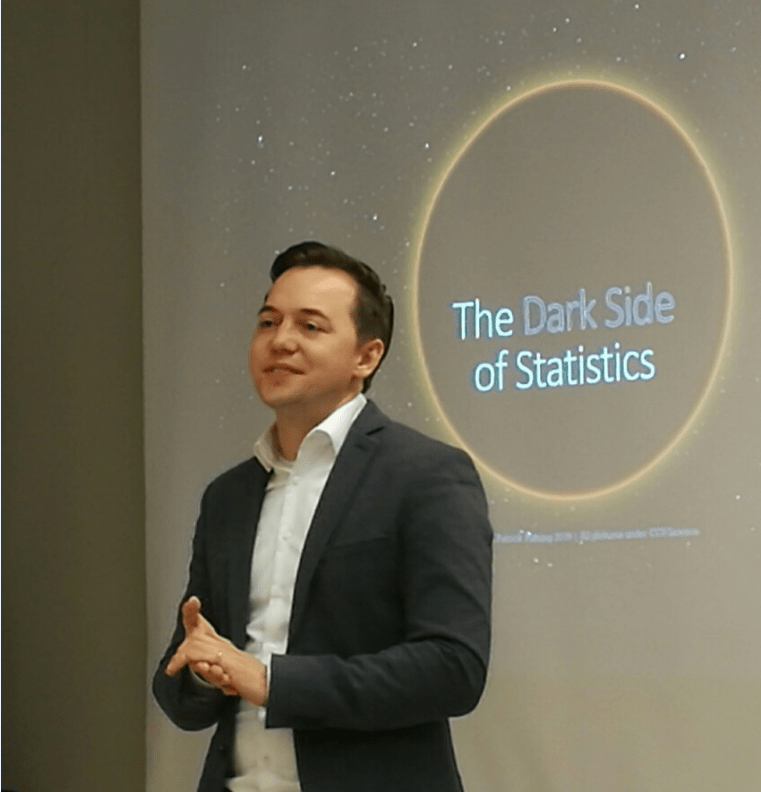
“The dark side of statistics may become a trap, if the subject is not used professionally. Among the current wide use of data analytics and popularization of statistical tools, we need to know more about statistics and understand it deeper. It will help to avoid its dark side”, believes Prof. Dr. Patrick Planing from Stuttgart Hochschule für Technik, a partner University of Metropolia. He shared his views with the students of Master’s program in Business Informatics in a guest visit to Metropolia University of Applied Sciences. Traps of Statistics Typical of Media: Miscalculations Statistics has gained a lot of credibility is society over the years. Readers of newspapers and popular journals are used to reading unusual, sometimes shocking news, and get easily convinced as soon as statistics is mentioned. In practice, however, a sloppy use of statics can lead to even fake news, when the concussions are drawn superficially, but positioned as if based on careful statistical analysis. Consider this claim: “The proportion of suicides in all deaths is highest among the people under 20 years with 25%, compared with 10% among 30-40 year olds, and less that 2% among over 70 year olds”. Conclusion (wrong): “So, the decision to commit a suicide decreases more and more with the age”. Can we agree with this claim? If we look at it closer, there are many flows in this claim. First, there are no absolute numbers, which makes it unknown how many actually died in every age group. As a result, the current proportion cannot be correct since the death numbers in each groups are different. Also, there are no reasons indicated for the other deaths (they may be due to traffic accidents, diseases, etc), which makes the picture distorted, as there may be a growing number of other reasons for death in older age groups. If such news are published in press, they look scientific, but the public should not be deceived. If we read this claim slowly, think of the context, and consider if this is possible at all, we can see that it cannot be correct, and does not allow to judge reliably about the behaviors of different age groups. More Traps for Media: Misinterpretations There are many of such false news. One very famous example originated from a study conducted by Denmark, universities, that investigated which students complete and which drop their studies. The drop rate was up to 40% over the first year, so it was important to explore the reasons for this. The research group discovered a surprising and rather confusing result. They found a negative correlation between the drop rates and the drinking habits of students. But it was not the conclusions that comes immediately to mind (that drinking habits lead to drop outs), but the opposite. The surprise was that the regularly drinking students dropped less! All world media shared these unbelievable news: the more you drink, the more successful you are in your studies! “Sober students are more likely to drop off” were the headings in many media. But could we really draw such a conclusion form this statistical study? No, we cannot. First of all, this cannot be a conclusion but a hypothesis, as there may be other variables interfering into this correlation. In other words, it is not that “X correlates with Y”, but “X correlates with Z (a third variable), which correlates with Y”, and other variables may be missing from the analysis. For example, social occasions may contribute to completing the studies. Maybe, it is the active social life that helps success in the studies (the students, who did well, and did not drop, did not fear the exam, probably because they socialized with others). Since this statistical study did not look deeper into the habits, we just do not know. As statistics professionals know, correlation does not indicate any causality. In other words, the most likely explanation may not be the truth. True reasons may be many. A simple answer is to check carefully before making claims. Traps of Statistics for Professional Science: In Significance Level and Data Openness However, even the correct process of interpreting the data can lead to wrong results that are seemingly based on correct statistics. If we look beyond popular media, there are still many underlying reasons (not only the fake news) why statistics can be “lying with the numbers”. It may happens, for example, if someone is trying to make sense of statistics - in any science, in biology, chemistry, economy etc. - without awareness of specific flaws that may be awaiting. One of the reasons of flawed results in science, especially in the past, is the way how we do science. It often dictates wrong conclusions. The current statistical rates of measuring the acceptability of science results started in 1925, with the British statistician Ronald Fisher offered a cup of tea with milk to his colleague, Muriel Bristol. Muriel refused this cup saying that Fisher poured tea first and milk second into her cup, while she likes it the other way round. She also claimed that she can see it at a glance which liquid was poured first. Fisher arrange a special experiment for her, to check how many times she could correctly make such a prediction. Fisher concluded that "Bristol divined correctly more than enough of those cups into which tea had been poured first to prove her case". But how many cups are enough? Since Fisher’s influential 125 books, the statistical significance was accepted at the rate of 5% for scientific results to prove “true”. In 1925, Fisher’s believed that 6-8 cups were “well enough” (starting from Fisher’s statistical book), and since then a significance rate of 5% has been accepted by science as “well enough” for many disciplines, and often continues till now. In practice, however, statistical significance does is not equal to a real life significance. If we have a significantly large size of sample, even the smallest effect can be calculated as a significant result! By now, enough evidence is collected by statistics that argue against a blind adoption of the 5% significance level (and this is still the rate to get published in medicine, for example!) reliable results cannot be obtained. In 1925 it was probably ok, but it cannot be accepted any more, although it still happens today. If someone tests a new drug against 5% significance level, it simply does not make sense, as the significance level alone does not tell us anything about the effect of the drug.. This is clear to all who know statistics and its behavior. This is where “bad science” comes from that has come into light in recent years. The answer is to have a significant difference, and do not accept low levels with 5% of proof. This is not any more acceptable and there is a lot of discussion around it nowadays. How to Avoid These Traps in Science and Business? Therefore, good science needs to have, first of all, to pay attention to the significance levels and the size of the sample group. Next, good science will also absolutely necessary analyze the difference, measuring the true effect size. Good science should check all the factors carefully, by testing the same correlation in random groups, the bigger the groups, the better the ground! At the same time, professional scientists cannot rely only on correlation. The problem with correlation is that is does not say anything, it does not prove any causality. This is why there is a need to establish experiments. A good reading here is the book “Designing experiment” Fisher, 1943. My message to students is do not be fooled by media or “poor” science who do not understand the dark side of statistics. Also, for professional scientists, it is important to stop use “null” hypothesis tests, or testing the opposite instead of testing the actual phenomena. Such “null” tests lead to a lot of confusion (like in patient statistics developed in 19th century, instead of using significance testing). But the main issue for science is the absolute necessity to publish the data (instead of a 5-page note about conclusions, which can be drawn incorrectly). Give the raw data, show it, tell how much and what was measured; or if not publish, demonstrate the data to experts, similar to the practice in referenced journals. This initiative is called “Open data initiative”, there still could be flawed data, but this openness about the simple will increase reliability of science results. Management of organizations should also be aware of these effects. Management needs more educations in order to use the statistics produced by consultants and own staff more effectively. This is especially evident for Marketing research. There was a big discussion in “Spiegel” magazine recently, and some professionals even claim that all marketing research is flowed since consultants are not educated in statistical methods. This discussion shows that deeper knowledge of statistical methods is needed for professional in all fields, journalists, politicians, even scientists. A wide society also need to be more demanding and create pressure to prove the grounds for conclusions based on statistics. Without a careful check of the utilized data samples, the data analysis process and interpretation, no reliable conclusions are possible, even from such a precise discipline as statistics. ================================================= Prof. Dr. Patrick Planing - a guest speaker from Stuttgart Hochschule für Technik teaching Statistics and Statistics Models for big data. His interested include business psychology, future thinking, predictions, strategy scenarios, and many other interesting topics related to data. Zinaida Grabovskaia, PhL - a lecturer and Head of Business Informatics Master’s Program at Metropolia University of Applied Sciences. Zinaida is interested in inviting the latest and most important topics to professional discussion with Metropolia Master’s students.
Customer Experience is a Critical Topic for Business
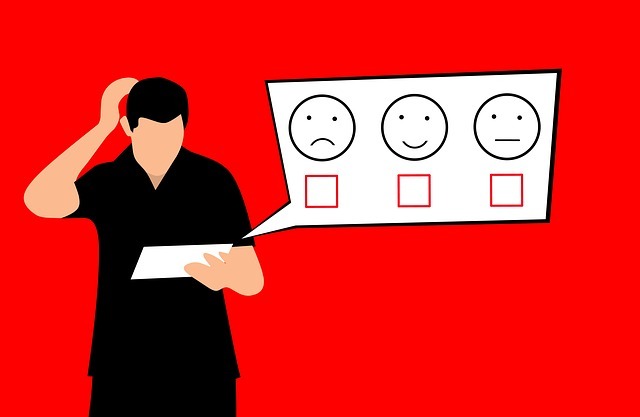
Customer experience today is included in the strategies of most companies. It has been high on the agenda already for years. Yet, as we have seen from the students’ investigations every year, in spite of being on the high-level agenda, there is still a lot to do on the practical level. Easily, when we think about the next steps, we think very big - about digitalization, augmented reality, big data, just to mention a few examples. However, a lot of company internal practices need to be considered to ensure the personnel is motivated and capable to do their best to deliver delightful experiences for the customers both in the digital and physical channels. Sometimes this means that normal, ‘old-fashioned’ things need to be put in place – such as visibility to the goals that the company has defined for customer experience, or to the actions are being carried out, or transparency and access to data, and communications. Developing the mindset and company culture (see video here) are crucial for delivering great experiences. Customer Journey – a Key Tool for Developing Customer Experience A key tool for understanding and developing customer experience is Customer Journey. A customer journey is a presentation that consists of all encounters that a customer has with a company – either in digital or in physical channels. It includes interactions that are designed by a company – like web sites, advertisements, retail stores – but also touch points that are not in the company’s hands, like reviews and articles published by media – or opinions provided by friends or influencers in social media etc. Customer Experience Requires Holistic Thinking Customer Experience, according to the definitions that I particularly like by Manning and Bodine (2012) and Watkinson (2013), relates to the whole array of interactions with the company, even before the first actual contact happens. In other words, customer experience happens in every single encounter with a company. Presently, we are going very speedily into the direction when more and more companies want to differentiate with customer experience. It is widely understood that product and technology orientation need to transform to customer orientation - truly understanding the needs and preferences of customers. On this path, companies still have a lot to do. Toward Customer Centric Company To help students understand the topics of customer focus, customer orientation and even customer obsession (as many companies, Zalando as one example, call their customer centricity), I felt I need to develop a tool for students to conduct a current state analysis in their companies. I felt it was logical to develop it based on a model that covers five key areas of customer-focused practices in any company. These five areas are: Listening to customers, Analyzing customer insights, Engaging employees, and Acting towards customer centricity, which together lead to Commitment to Customers. With the tool ‘Customer centricity reality check’, each of these areas is investigated by asking a set of questions that help the organization assess how mature they currently are, and set their goals and agree development activities to reach the goals. Every year after the lectures and assignment in the ‘Customer Oriented Business’ course, some students come and tell a wonderful story. After conducting the ‘Customer centricity reality check’ they have managed to convince their management to take some big steps in re-thinking how to improve their company practices to ensure success in customer experience. After Being a Successful Lecturer, Johanna Vesterinen is Learning a New Phase in Life After 5 year in Metropolia, I have a lot of positive impressions. Firstly, working with the course has every year been really rewarding and interesting. The students have their own experience from working life, and the discussions in class have always been very engaging, since the students can learn so much from each other, and share knowledge with their peers. The students’ motivation has always been extremely high! Always, at the end of the completed course, at the Graduation ceremonies where I was invited, I have seen and felt that the students have accomplished their study goals. It gives a strong feeling of reward also to the instructors. Johanna’s Career Path to Expert of Customer Experience As for my background, it is not typical for my area, but probably is becoming more and more typical now. I first studied foreign languages, and was a teacher for four years. Then, I went to business and worked for 17 years for the Finnish Institute for International Trade (FINTRA at that time). I was first responsible for the department of Languages and Intercultural Communication. Then, I got a second responsibility for training programs in International Business Management. From there, I moved to Nokia and worked in HR for Competence development and then moved to the Quality organization, and then to Customer Insights. An interesting figure that I recently found from a book by Evans and Burnett “Designing Your Life” (2016) is that only 27% of graduates in the U.S. end up working in the field of their major subjects. I think I belong to the other group. My experience in Nokia was like going through a university in a practical way. In this type of big company you get to learn so many things from so many areas that I can say it was the best working experience I have had. But the experience was not only about the content of work, it was also all the great people I learned to know there and with whom I still keep contact. So, I am grateful for the 14 years that I spent there. In all working places, I have seen the value of knowing your customers and designing your services for them. This works as a great motivator both on the individual and the organizational level and makes your work worth while. During my career, writing study books has been one of my hobbies. One of the most memorable projects was when we wrote study books with a group of friends for the Finnish broadcasting company, but there were also a few others, and the last one was the book “Committed to Customers” that was the main reading for Industrial Management Master’s s students. This book is not about designing the customer experience, but about developing practices inside the company to ensure that different units in the company take customer experience to their agendas, and to all the employees, to build business based on Customer insights. "Retiring Means Learning a New Phase in Life" What I want to do now… I’m very fond of learning foreign languages, and I will continue learning French and Italian. I also love travelling, and I will take care of my family, both the younger and the older generation. What I have learnt is that retirement means a busy life after a busy life! Also, I am involved in group mentoring with the Helsinki University Alumni organization, and I find it very rewarding. Mentoring is never a one-way road. You give something from your experience, and you gain a lot in return from the young people. This is something that I definitely want to continue. Every time my personal features have been assessed (and with so many years in business life this has happened a lot), it has become clear that the first and most important thing for me is learning. Learning is something that is super-valuable and really affects my wellbeing: I want to learn new things all the time. If I do not have any activities going on to learn new things, I do not feel well. When asked what I would advise to the students, I would say: absorb everything that you can get form your Program! It is one of the greatest opportunities in life! Be present at lectures, be in contact with your peer students, develop networks, and also challenge the instructors and each other, and yourself, too. I understand that it is hard work, but I have seen no one who would have regretted this hard work, it is really worthwhile! It may be tough to combine employment, family and the studies, but if you need help - ask for it; and if you see that your co-student needs help, go and offer your help. The most important thing is, believe in yourself, you can do it! References Vesterinen, J. (2014). Committed to Customers: A 5-step Model for Delivering Great Customer Experiences. Helsinki: Suomen liikekirjat. 132 pages. ISBN: 9789519155364. Vesterinen, J. (2015). Customer Experience - Actions for Companies: Video. Helsinki: Metropolia University of Applied Sciences. 3 min. Available: https://www.youtube.com/watch?v=fFh8q5Y8xPY&feature=youtu.be&list=UU9mG6ja6NiQ71BamUtBlhyw Evans, D. and Burnett, B. (2016). Designing Your Life: How to Build a Well-Lived, Joyful Life. Knopf Publishing Group. 272 pages. ISBN: 9781101875322. Manning, H. and Bodine, K. (2012). Outside In: The Power of Putting Customers at the Center of Your Business: Forester Research. Amazon Publishing: Kindle Edition. 270 pages. ISBN: 9781491514221 Watkinson, M. (2013). The Ten Principles behind Great Customer Experiences. Pearson: Financial Times Series. ISBN: 8601404277474

The editorial team will provide the content of the Masterminds blog before publication.
The editorial team started its work at the beginning of 2022.
Pia Koirikivi, chief editor in Masterminds blog, Pedagogical Specialist
Minna Kaihovirta, Manager of Dialog
Iira Lankinen, Principal Lecturer
Riikka Wallin, Publications Specialist
Zinaida Grabovskaia, Senior Lecturer
Salla Kivelä, Principal Lecturer
asiantuntija yamk business informatics Business Informatics Master’s Program CERN Bootcamp Construction Business hankinnat hankintastrategia hankintatoimi ilmastonmuutos Industrial Management Industrial Management Master’s program johtaminen koulutus kulttuurituotanto Marjatta Kelo master Master's Thesis masterminds Masterminds blog Master of Engineering Master’s degree Metropolia Metropolia AMK Metropolia Master's Metropolia UAS metropolia YAMK opinnäytetyö osaaminen service design Sharing economy sosiaali-ja terveysala sosiaaliala study trip Sustainability talotekniikka terveyden edistäminen terveydenhuolto työhyvinvointi ura yamk YAMK-tutkinto YAMK opinnäytetyö ylempi AMK ylempi ammattikorkeakoulututkinto Zinaida Grabovskaia
