
Avainsana: Masterminds blog
Investoi organisaation osaamispääomaan – Kehitä sisäistä liikkuvuutta

Kehitimme ja otimme käyttöön sisäisen liikkuvuuden toimintamallin työpaikallani. Meillä sisäinen liikkuvuus tarkoittaa liikkumista tehtävästä toiseen kulkematta rekrytointiprosessin kautta. Vastakohtana on tilanne, jossa työntekijä lähtee määräaikaisuuden päättyessä, ja samalla oven avauksella sisään astuu uusi työntekijä samoilla kompetensseilla. Kehittämiselle oli kaksi tavoitetta: osaamistarve ja -tarjonta saadaan kohtaamaan paremmin ja organisaation henkiset rakenteet eivät estä liikkumista roolien, tehtävien ja toimintayksiköiden välillä. Henkisiä rakenteita ovat johtamis- ja organisaatiorakenteet, kulttuuri, ilmapiiri ja arvot (Otala 2008). Liikkuminen voidaan toteuttaa monin tavoin. Voit lähteä hoitamaan avointa tehtävää tai osallistua projektiin. Voit mennä työpariksi kokeneemmalle asiantuntijalle tai ”vaihtaa paitoja” työkaverisi kanssa muutamaksi päiväksi. Liikkuminen voi olla laatutyötä: sinut kutsutaan arvioimaan toisen toimintayksikön toimintaa, tai vertaiskehität omaa toimintaasi benchmarkkaamalla muiden hyviä käytäntöjä. Liikkumisen kesto voi vaihdella yksittäisistä päivistä vuoden mittaiseen työskentelyyn. (Helsilä & Salojärvi 2009; Otala 2008.) Henkilöstön liikkuvuudesta on hyötyä monella tavalla. Työntekijän osaaminen ja verkostot laajenevat. Samalla yhteistyömahdollisuuksien tunnistaminen helpottuu. (Viitala 2015.) Työnantajan näkökulmasta henkilöstön käytettävyys paranee, kun työkuormaa ja rahoitustilannetta voidaan tasoittaa työntekijän liikkuessa hiljaisempaa vaihetta elävästä toiminnosta hektisempään. Toisaalta käytettävyys paranee, kun kaikkien osaaminen saadaan hyödynnettyä mahdollisimman monipuolisesti. Oppimista ja uudistumista tukeva kulttuuri syntyy tuella ja kannustuksella Liikkuvuus vahvistaa oppimista ja uudistumista tukevaa organisaatiokulttuuria. Samalla, kun liikkuminen vahvistaa työntekijän resilienssiä ja oppimiskykyä, se muovaa johtajuutta kohti palvelevampaa roolia. Esihenkilön tehtävä on tukea työntekijää kehittymisessä, vaikka vastuu itsensä kehittämisestä onkin työntekijällä itsellään. Tämä tuki ja kehittymismahdollisuudet sitouttavat työntekijää organisaatioon. Olen lojaali ja työskentelen työnantajani hyväksi, jos työnantaja vastineeksi panostaa osaamiseni kehittämiseen pitkällä tähtäimellä ja huolehtii näin työmarkkina-arvostani (Sydänmaalakka 2012). Esihenkilöiden tuki ja kannustava asenne ovat avainasemassa, jotta työntekijä voi liikkua luontevasti toimintayksiköiden välillä. Vertaa tilannetta perheeseen, jossa vanhemmat asuvat eri osoitteissa. Siirtyminen osoitteiden välillä on nähtävä positiivisena ja lisäarvoa tuottavana. Osaoptimoinnille ja kyräilylle ei ole tilaa. Ovella lähtiessä toivotetaan mukavaa reissua! Samalla tavalla vastaanottaja ottaa tulijan ilolla vastaan, vaikka visiitti olisikin väliaikainen. Yhteinen ymmärrys, sopiminen ja avoin keskustelu ruokkivat kokeilunhalua ja lisäävät uskallusta siirtyä epämukavuusalueelle kasvattamaan kyvykkyyttä. Näin työyhteisöstä saadaan turvallinen kokeiluympäristö, jossa työntekijä voi kokeilla erilaisia rooleja ja asiantuntemusaloja. Samalla työntekijän itseluottamus ja ammatillinen identiteetti kasvavat. Investoinnin hintalappu Liikkuvuus on aina investointi. Lähettävä yksikkö saa uutta osaamista ja vaihtelusta virkistyneen työntekijän. Työntekijä pääsee kasvattamaan ammattitaitoaan ja verkostojaan. Vastaanottava yksikkö saa töilleen tekijän. Liikkuminen on kuitenkin sijoitus, eli kääntöpuolella on hintalappu. Lähettävässä yksikössä joudutaan järjestelemään tehtäviä uudelleen. Työntekijä joutuu astumaan epämukavuusalueelleen. Vastaanottavassa yksikössä joudutaan perehdyttämään saapuva työntekijä. Tähän auttaa asenne. Tehtäviä järjestellään jatkuvasti projektien alkaessa ja päättyessä. Aika tuntuu aina olevan huono työntekijän lähtemiselle, oli kyse sitten sisäisestä liikkuvuudesta, perhevapaasta tai sairastumisesta. Sellaista (työ)elämä on. Ihmisiä tulee ja menee. Epämukavuusalueelle astuminen tuntuu vatsanpohjassa, mutta kasvukivut ovat kehittymisen merkkejä. Tämä jos mikä kehittää nykytyöelämän arvoihin kuuluvaa muutosjoustavuutta, oppimaan oppimista ja oman oppimisen reflektointia (Eurofound 2016). Perehdytykseen kuluu aina aikaa, mutta oppiminen ja kokemusten jakaminen on aina molemminpuolista ja siksi hedelmällistä. Organisaatiotasoisten hyötyjen on oltava kustannuksia suurempia. Katse on nostettava yksikön kuluista ja hyödyistä talotasoisiin kustannuksiin ja hyötyihin. Rahoitus otetaan loppupeleissä aina yhteisestä pussista. Samalla tavalla työntekijät ovat organisaation yhteinen voimavara. Investoinnista saadaan hyöty ainoastaan, jos liikkujan työtehtävät kehittyvät osaamisen mukana. Uusi osaaminen ja verkostot ovat hyödyttömiä, jos niitä ei voida hyödyntää ja kehittää työssä (Hakonen & Hakonen & Hulkko-Nyman & Ylikorkala 2014, 227). Osaamispääoma saadaan hyötykäyttöön ainoastaan, jos uudenlaiselle tekemiselle annetaan tilaa ja resursseja. Mitä tällä investoinnilla saa? osaamisen laajentuminen ja syveneminen (Otala 2008) verkostojen laajeneminen ja yhteistyömahdollisuuksien tunnistaminen (Viitala 2015) vaihtelu ja virkistyminen (Saske 2019) työsuhteen jatkuminen (Saske 2019) rahoitustilanteen tasapainottaminen ja töiden sujuvoittaminen (Saske 2019) näkökulman laajentuminen organisaation toiminnasta kokonaisuutena (Viitala 2015) arvostuksen kasvu muiden työtä kohtaan (Viitala 2015) kehittämisimpulssien leviäminen toimintayksiköstä toiseen (Viitala 2015) kehittymismahdollisuuksien positiivinen vaikutus työntekijän sitoutumiseen (2008) kehittymismahdollisuuksien positiivinen vaikutus työnantajakuvaan (Otala 2008) Tällainen mallistamme tuli Kehittämämme malli sisältää prosessin, ohjeet, pelisäännöt ja roolit liikkumiselle. Voit tutustua malliin Innokylässä. Yhteisillä ohjeilla ja roolikuvausten vastuilla edistetään ennakoivaa ja avointa viestintää osaajatarpeista ja -tarjonnasta. Suorien yhteydenottojen lisäksi tarpeita ja tarjontaa törmäytetään yhteisellä intrasivulla, jossa tehtävistä ja tekijöistä voidaan ilmoittaa. Oppimista ja uudistumista tukevaa kulttuuria rakennetaan arjen johtamisessa tukemalla ja kannustamalla työntekijöitä liikkumaan, kehittymään ja verkottumaan yhteisen kattomme alla. Kirjoittaja Saana Saske, tradenomi (ylempi AMK), on valmistunut Metropolia Ammattikorkeakoulun Liiketoiminnan kehittämisen tutkinto-ohjelmasta. Lähteet: Eurofound 2016. Changing places: Mid-career review and internal mobility. Hakonen, Anu & Hakonen, Niilo & Hulkko-Nyman, Kiisa & Ylikorkala, Anna 2014. Palkitse taitavammin: palkitsemistavat esimiestyön ja johtamisen välineinä. Sanoma Pro, Helsinki. Helsilä, Martti & Salojärvi, Sari 2009. Strategisen henkilöstöjohtamisen käytännöt. Talentum, Helsinki. Otala, Leenamaija 2008. Osaamispääoman johtamisesta kilpailuetu. WSOYpro, Helsinki. Saske, Saana 2019. Sisäisen liikkuvuuden toimintamalli. Toimintatapa työkiertojen ja tehtäväjärjestelyjen toteuttamiseen. Opinnäytetyö. Metropolia Ammattikorkeakoulu. Sydänmaalakka, Pentti 2012. Älykäs organisaatio. Talentum, Helsinki. Viitala, Riitta 2015. Henkilöstöjohtaminen: strateginen kilpailutekijä. 4. uudistettu painos. Edita, Helsinki.
The Dark Side of Statistics
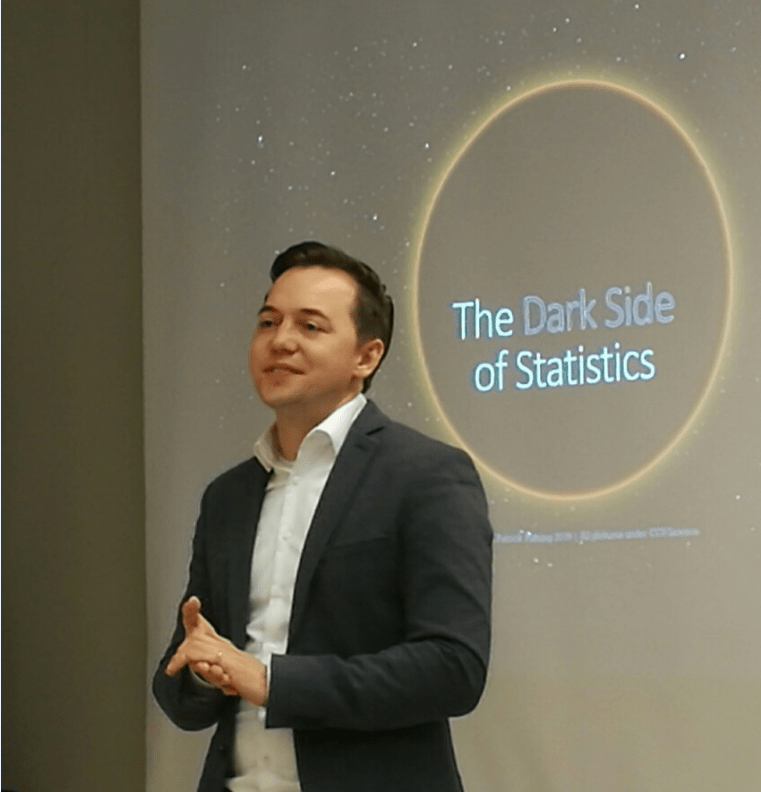
“The dark side of statistics may become a trap, if the subject is not used professionally. Among the current wide use of data analytics and popularization of statistical tools, we need to know more about statistics and understand it deeper. It will help to avoid its dark side”, believes Prof. Dr. Patrick Planing from Stuttgart Hochschule für Technik, a partner University of Metropolia. He shared his views with the students of Master’s program in Business Informatics in a guest visit to Metropolia University of Applied Sciences. Traps of Statistics Typical of Media: Miscalculations Statistics has gained a lot of credibility is society over the years. Readers of newspapers and popular journals are used to reading unusual, sometimes shocking news, and get easily convinced as soon as statistics is mentioned. In practice, however, a sloppy use of statics can lead to even fake news, when the concussions are drawn superficially, but positioned as if based on careful statistical analysis. Consider this claim: “The proportion of suicides in all deaths is highest among the people under 20 years with 25%, compared with 10% among 30-40 year olds, and less that 2% among over 70 year olds”. Conclusion (wrong): “So, the decision to commit a suicide decreases more and more with the age”. Can we agree with this claim? If we look at it closer, there are many flows in this claim. First, there are no absolute numbers, which makes it unknown how many actually died in every age group. As a result, the current proportion cannot be correct since the death numbers in each groups are different. Also, there are no reasons indicated for the other deaths (they may be due to traffic accidents, diseases, etc), which makes the picture distorted, as there may be a growing number of other reasons for death in older age groups. If such news are published in press, they look scientific, but the public should not be deceived. If we read this claim slowly, think of the context, and consider if this is possible at all, we can see that it cannot be correct, and does not allow to judge reliably about the behaviors of different age groups. More Traps for Media: Misinterpretations There are many of such false news. One very famous example originated from a study conducted by Denmark, universities, that investigated which students complete and which drop their studies. The drop rate was up to 40% over the first year, so it was important to explore the reasons for this. The research group discovered a surprising and rather confusing result. They found a negative correlation between the drop rates and the drinking habits of students. But it was not the conclusions that comes immediately to mind (that drinking habits lead to drop outs), but the opposite. The surprise was that the regularly drinking students dropped less! All world media shared these unbelievable news: the more you drink, the more successful you are in your studies! “Sober students are more likely to drop off” were the headings in many media. But could we really draw such a conclusion form this statistical study? No, we cannot. First of all, this cannot be a conclusion but a hypothesis, as there may be other variables interfering into this correlation. In other words, it is not that “X correlates with Y”, but “X correlates with Z (a third variable), which correlates with Y”, and other variables may be missing from the analysis. For example, social occasions may contribute to completing the studies. Maybe, it is the active social life that helps success in the studies (the students, who did well, and did not drop, did not fear the exam, probably because they socialized with others). Since this statistical study did not look deeper into the habits, we just do not know. As statistics professionals know, correlation does not indicate any causality. In other words, the most likely explanation may not be the truth. True reasons may be many. A simple answer is to check carefully before making claims. Traps of Statistics for Professional Science: In Significance Level and Data Openness However, even the correct process of interpreting the data can lead to wrong results that are seemingly based on correct statistics. If we look beyond popular media, there are still many underlying reasons (not only the fake news) why statistics can be “lying with the numbers”. It may happens, for example, if someone is trying to make sense of statistics - in any science, in biology, chemistry, economy etc. - without awareness of specific flaws that may be awaiting. One of the reasons of flawed results in science, especially in the past, is the way how we do science. It often dictates wrong conclusions. The current statistical rates of measuring the acceptability of science results started in 1925, with the British statistician Ronald Fisher offered a cup of tea with milk to his colleague, Muriel Bristol. Muriel refused this cup saying that Fisher poured tea first and milk second into her cup, while she likes it the other way round. She also claimed that she can see it at a glance which liquid was poured first. Fisher arrange a special experiment for her, to check how many times she could correctly make such a prediction. Fisher concluded that "Bristol divined correctly more than enough of those cups into which tea had been poured first to prove her case". But how many cups are enough? Since Fisher’s influential 125 books, the statistical significance was accepted at the rate of 5% for scientific results to prove “true”. In 1925, Fisher’s believed that 6-8 cups were “well enough” (starting from Fisher’s statistical book), and since then a significance rate of 5% has been accepted by science as “well enough” for many disciplines, and often continues till now. In practice, however, statistical significance does is not equal to a real life significance. If we have a significantly large size of sample, even the smallest effect can be calculated as a significant result! By now, enough evidence is collected by statistics that argue against a blind adoption of the 5% significance level (and this is still the rate to get published in medicine, for example!) reliable results cannot be obtained. In 1925 it was probably ok, but it cannot be accepted any more, although it still happens today. If someone tests a new drug against 5% significance level, it simply does not make sense, as the significance level alone does not tell us anything about the effect of the drug.. This is clear to all who know statistics and its behavior. This is where “bad science” comes from that has come into light in recent years. The answer is to have a significant difference, and do not accept low levels with 5% of proof. This is not any more acceptable and there is a lot of discussion around it nowadays. How to Avoid These Traps in Science and Business? Therefore, good science needs to have, first of all, to pay attention to the significance levels and the size of the sample group. Next, good science will also absolutely necessary analyze the difference, measuring the true effect size. Good science should check all the factors carefully, by testing the same correlation in random groups, the bigger the groups, the better the ground! At the same time, professional scientists cannot rely only on correlation. The problem with correlation is that is does not say anything, it does not prove any causality. This is why there is a need to establish experiments. A good reading here is the book “Designing experiment” Fisher, 1943. My message to students is do not be fooled by media or “poor” science who do not understand the dark side of statistics. Also, for professional scientists, it is important to stop use “null” hypothesis tests, or testing the opposite instead of testing the actual phenomena. Such “null” tests lead to a lot of confusion (like in patient statistics developed in 19th century, instead of using significance testing). But the main issue for science is the absolute necessity to publish the data (instead of a 5-page note about conclusions, which can be drawn incorrectly). Give the raw data, show it, tell how much and what was measured; or if not publish, demonstrate the data to experts, similar to the practice in referenced journals. This initiative is called “Open data initiative”, there still could be flawed data, but this openness about the simple will increase reliability of science results. Management of organizations should also be aware of these effects. Management needs more educations in order to use the statistics produced by consultants and own staff more effectively. This is especially evident for Marketing research. There was a big discussion in “Spiegel” magazine recently, and some professionals even claim that all marketing research is flowed since consultants are not educated in statistical methods. This discussion shows that deeper knowledge of statistical methods is needed for professional in all fields, journalists, politicians, even scientists. A wide society also need to be more demanding and create pressure to prove the grounds for conclusions based on statistics. Without a careful check of the utilized data samples, the data analysis process and interpretation, no reliable conclusions are possible, even from such a precise discipline as statistics. ================================================= Prof. Dr. Patrick Planing - a guest speaker from Stuttgart Hochschule für Technik teaching Statistics and Statistics Models for big data. His interested include business psychology, future thinking, predictions, strategy scenarios, and many other interesting topics related to data. Zinaida Grabovskaia, PhL - a lecturer and Head of Business Informatics Master’s Program at Metropolia University of Applied Sciences. Zinaida is interested in inviting the latest and most important topics to professional discussion with Metropolia Master’s students.
Establishing Global Transportation and Logistics for a Leading Finnish Company
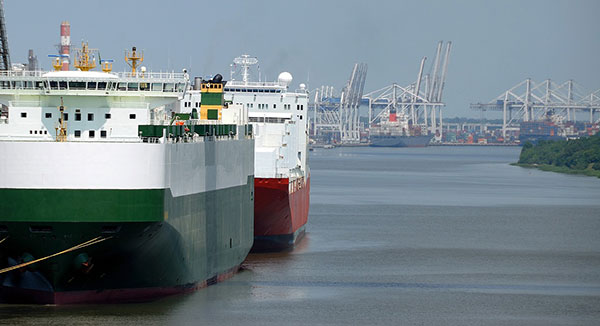
I remember myself some 3-4 years ago. I had a struggle in deciding if I could go and study in Helsinki for a Master’s degree, or is it totally out of question for me, as I lived in Rauma at that time. I decided to take this crazy step and travelled twice a week to Helsinki along with a full-time job. I became a student in Master’s program in Logistics Management. My studies were very interesting and fulfilling, but I could not get rid of my worries at work. My job challenge was to gain real benefit for the company by introducing common transportation and logistics services (by air and ocean) throughout a big corporation operating globally. This was a big and real challenge. Fortunately, I was able to concentrate on this problem in my Master’s thesis project. I researched the current state of logistics in business units, and revised the existing approach with the help of my colleagues and thesis instructors. These efforts helped to take a new perspective and look at the old and familiar problem with new eyes. The key suggestion for the company was to strengthen the global logistics by managing it through an effective steering global logistics group. This group should be connected by well-working communication between the responsible persons in business units. The next step was to investigate, collect and prioritize the needs and wishes of the business units, as well as to investigate their experiences with current logistics. Based on this information, and with the help of the members of the steering group, to establish a list if KPIs for the corporate logistics provider, that would address their needs, and conscientiously select the best out of the desirable providers. Only after it could be possible to introduce corporate contacts for transportation and logistics. The key finding was, that launching contracts with a global transportation and logistics providers alone is absolutely not enough. The critical issues are: (a) to involve the business units in constructive cooperation by identifying and following mutual interests and gains, and (b) to closely follow the implementation by monitoring a carefully selected list of KPIs that would reflect the real needs of business units. In short, to establish the needs, to identify mutual interests, and to closely follow the performance. This was an interesting and challenging job. I learned a lot while working for Metso and Valmet where all types of logistics were well-organized and extensively used, and my experience there was diverse. Half a year ago I got the position in Cargotec where I have been leading Logistics for the Cargotec group. The company has over 10 factories where equipment is produced in such countries as US, Poland, Malaysia, and China. On the other hand, spare parts warehouses are located, for example in France, and multiple other countries. All of these places need to be connected with well-working logistics. This is a challenge and a big gain for the company. Interestingly, this is also a continuation of my thesis topic, but growing in size and scale. After the first implementation, it will make another round of testing myself, the selected approach, and the new steering logistics group that will play a key role in these developments. I am looking forward to the future, to effective cooperation and enthusiastic and experienced colleagues, and to find good solutions together. The next immediate steps include defining the global logistics strategy for the next three years, hearing everyone, exploring the current ways, finding mutual gains, prioritizing and deciding together, and following implementations effectively. In addition, I want to thank my work colleagues, my fellow students, and Metropolia instructors from my previous studies. I use all my lecture notes and my thesis results from Metropolia still today. They have been absolutely helpful. Even though I graduated two years ago, I still remember your contribution to get us to graduate in time. It was really worth of travelling 67 times between Rauma and Helsinki, nearly 35 000 kilometers in total, between September and May 2016 by Onnibus. I am now living in Turku, where we moved from Rauma, and almost every week I am in Helsinki, Ruoholahti, passing by Metropolia. My many thanks to you all, from Pasi Kurkinen, the "long distance man". Pasi Kurkinen Pasi Kurkinen, Master of Engineering in Logistics Management (2016) lives in Turku and works for Cargotec Corporation as a Global category manager for logistics. He moved to this position half a year ago, after working with global logistics in Metso and Valmet. Two years ago Kurkinen also completed his Master’s thesis project in Metropolia UAS on his key challenge at work – how to implement unified logistics contacts in a global company, and how to commit business units to change from individual to corporate transportation and logistics. Kuvalähde: paulbr75, Pixabay.com, CC0.
Roadmap to Your Education – Where Are You Now? Where You Want to be Next?
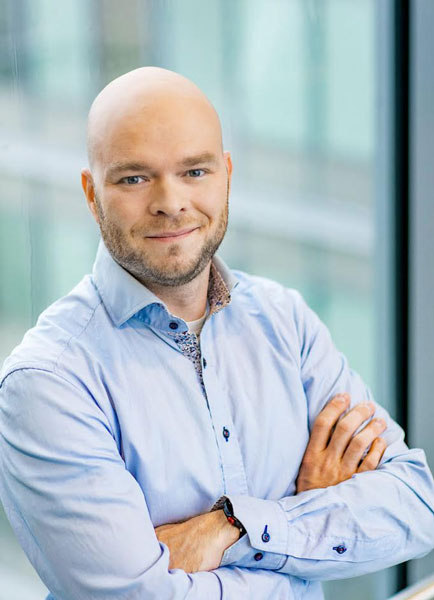
Just think of this fact: Forrester Research predicts that today's youngest workers will hold 12 to 15 jobs in their lifetime. How then to choose a study path, when you are 18 years old and hardly have any work experience? It seems we all need to become lifelong learners. I have accepted this fact and found for myself that two questions always help me: first, Where am I now? and most importantly, Where do I want to be next? Modern jobs are demanding, and require a large toolkit of skills that cannot come from only sitting in a classroom. Moreover, formal education to the job - at some point of life – may not be enough, if people also want to do the work they find inspiring and meaningful, but is going beyond their current qualification. In addition, different jobs and life experiences may reshape one’s interest areas. As a result, the need to learn new things comes about more often than ever before. Based on my own experience, to manage with this fast pace and change, I’d encourage young students to take a shorter study path after high school, and then acquire work experience according to one’s own interest areas. To illustrate my point, I will share my own experience. I started by completing my Bachelor’s degree in 2005 at Metropolia AMK (Stadia at that time) in Automotive Engineering. After four years of studying, as I realized already during my studies, I wanted to do research work and I aimed at VTT (Technical Research Centre of Finland). That was the best option in the field and my own best choice. Persistency - and a bit of luck - helped me to get a job at VTT as an R&D engineer, as I always dreamt. Next, after a couple of years of practical, highly educational work at VTT, I asked myself ‘Where do I want to be next?’. Honestly, I wanted to go abroad for new challenges and moved to the Netherlands, to work as a Testing engineer at TNO (the Dutch counterpart of VTT). During my time at TNO, I was lucky to work with major international engine and vehicle manufacturers. These years gave me practical knowledge about the business side of the automotive industry. Then, after experiencing the business side, the question loomed again; Where do I want to be next? I returned to Finland and back to VTT, as I now felt clearly that my interest area shifted from pure research to a more commercially oriented research work. As soon as I outlined my desire where I want to be next, I got a call from a headhunter offering an opportunity at Neste Oil as an Engine researcher. The role was precisely in my dream area, in-between the R&D and business units, which was a perfect match with my new ’where to go to’. Meanwhile I kept doing various short courses in communication, marketing, sustainability, and innovation to strengthen my Bachelor’s technical background with business expertise. Finally, after some four years, I felt a clear ‘next to go to’ in sales. But now it was a far too big stretch from my technical roles towards commercial work. Yet, the company trusted me and gave me the opportunity at Neste’s wholesale business unit as a Technical Account Manager. Pretty soon, I realized an acute need for in-depth knowledge in sales, marketing and business administration. This time, my next ‘where to go to’ was to get a Master’s degree from business studies. My basic requirement was to find a short, compact study module of an MBA type catered for the demanding technical environment. I found the best match at Metropolia, in Industrial Management Master’s studies. The curriculum was very close to an MBA course, with the topics I wanted to learn. Also, the classes and course tasks were organized in such a way that I could keep my new full-time work and even perform many of the given research assignments at my company. After a compact (and very tight!) year of super-interesting Master’s studies, I graduated from Metropolia, Industrial Management Master’s degree program as a Master of Engineering in 2015, much better equipped for my new role. It took me about two years to digest all the new knowledge and develop new skills, before my next ‘Where to go to?’ started maturing. This time, it felt as a clear call for business development. My job offered so many new challenges that a combination of technical knowledge with the expertise in sales - and knowledge of industrial services - really fired off well for me. A global shift to services, that makes the core of Industrial Management Master’s degree program at Metropolia, approach our team on a very practical level. We have faced a challenging task to introduce services into a very traditional industry. Luckily, after my Master’s studies, especially courses in Service business, I felt more confident in my work on many occasions. Even now, I keep complementing these skills through various short courses in Service design, which I found very useful. Now, I am also lucky to see how my team members decided to follow a similar study path and made into two extremely talented and intelligent students. They also keep asking the same questions: Where am I now? and Where do I want to be next? in order to decide which courses to take to match their interest areas, and it will probably help them in their future careers as well. I share this approach hoping that someone may find it useful for making one’s own choices. The world is changing in an ever-faster pace, and to keep up with this pace requires honesty and timely grasping lifelong learning opportunities. Tuukka Hartikka Commercial development manager Neste corp.

The editorial team will provide the content of the Masterminds blog before publication.
The editorial team started its work at the beginning of 2022.
Pia Koirikivi, chief editor in Masterminds blog, Pedagogical Specialist
Minna Kaihovirta, Manager of Dialog
Iira Lankinen, Principal Lecturer
Riikka Wallin, Publications Specialist
Zinaida Grabovskaia, Senior Lecturer
Salla Kivelä, Principal Lecturer
asiantuntija yamk business informatics Business Informatics Master’s Program CERN Bootcamp Construction Business hankinnat hankintastrategia hankintatoimi ilmastonmuutos Industrial Management Industrial Management Master’s program johtaminen koulutus kulttuurituotanto Marjatta Kelo master Master's Thesis masterminds Masterminds blog Master of Engineering Master’s degree Metropolia Metropolia AMK Metropolia Master's Metropolia UAS metropolia YAMK opinnäytetyö osaaminen service design Sharing economy sosiaali-ja terveysala sosiaaliala study trip Sustainability talotekniikka terveyden edistäminen terveydenhuolto työhyvinvointi ura yamk YAMK-tutkinto YAMK opinnäytetyö ylempi AMK ylempi ammattikorkeakoulututkinto Zinaida Grabovskaia
