
Avainsana: Industrial Management Master’s program
Customer Experience is a Critical Topic for Business
Customer experience today is included in the strategies of most companies. It has been high on the agenda already for years. Yet, as we have seen from the students’ investigations every year, in spite of being on the high-level agenda, there is still a lot to do on the practical level. Easily, when we think about the next steps, we think very big - about digitalization, augmented reality, big data, just to mention a few examples. However, a lot of company internal practices need to be considered to ensure the personnel is motivated and capable to do their best to deliver delightful experiences for the customers both in the digital and physical channels. Sometimes this means that normal, ‘old-fashioned’ things need to be put in place – such as visibility to the goals that the company has defined for customer experience, or to the actions are being carried out, or transparency and access to data, and communications. Developing the mindset and company culture (see video here) are crucial for delivering great experiences. Customer Journey – a Key Tool for Developing Customer Experience A key tool for understanding and developing customer experience is Customer Journey. A customer journey is a presentation that consists of all encounters that a customer has with a company – either in digital or in physical channels. It includes interactions that are designed by a company – like web sites, advertisements, retail stores – but also touch points that are not in the company’s hands, like reviews and articles published by media – or opinions provided by friends or influencers in social media etc. Customer Experience Requires Holistic Thinking Customer Experience, according to the definitions that I particularly like by Manning and Bodine (2012) and Watkinson (2013), relates to the whole array of interactions with the company, even before the first actual contact happens. In other words, customer experience happens in every single encounter with a company. Presently, we are going very speedily into the direction when more and more companies want to differentiate with customer experience. It is widely understood that product and technology orientation need to transform to customer orientation - truly understanding the needs and preferences of customers. On this path, companies still have a lot to do. Toward Customer Centric Company To help students understand the topics of customer focus, customer orientation and even customer obsession (as many companies, Zalando as one example, call their customer centricity), I felt I need to develop a tool for students to conduct a current state analysis in their companies. I felt it was logical to develop it based on a model that covers five key areas of customer-focused practices in any company. These five areas are: Listening to customers, Analyzing customer insights, Engaging employees, and Acting towards customer centricity, which together lead to Commitment to Customers. With the tool ‘Customer centricity reality check’, each of these areas is investigated by asking a set of questions that help the organization assess how mature they currently are, and set their goals and agree development activities to reach the goals. Every year after the lectures and assignment in the ‘Customer Oriented Business’ course, some students come and tell a wonderful story. After conducting the ‘Customer centricity reality check’ they have managed to convince their management to take some big steps in re-thinking how to improve their company practices to ensure success in customer experience. After Being a Successful Lecturer, Johanna Vesterinen is Learning a New Phase in Life After 5 year in Metropolia, I have a lot of positive impressions. Firstly, working with the course has every year been really rewarding and interesting. The students have their own experience from working life, and the discussions in class have always been very engaging, since the students can learn so much from each other, and share knowledge with their peers. The students’ motivation has always been extremely high! Always, at the end of the completed course, at the Graduation ceremonies where I was invited, I have seen and felt that the students have accomplished their study goals. It gives a strong feeling of reward also to the instructors. Johanna’s Career Path to Expert of Customer Experience As for my background, it is not typical for my area, but probably is becoming more and more typical now. I first studied foreign languages, and was a teacher for four years. Then, I went to business and worked for 17 years for the Finnish Institute for International Trade (FINTRA at that time). I was first responsible for the department of Languages and Intercultural Communication. Then, I got a second responsibility for training programs in International Business Management. From there, I moved to Nokia and worked in HR for Competence development and then moved to the Quality organization, and then to Customer Insights. An interesting figure that I recently found from a book by Evans and Burnett “Designing Your Life” (2016) is that only 27% of graduates in the U.S. end up working in the field of their major subjects. I think I belong to the other group. My experience in Nokia was like going through a university in a practical way. In this type of big company you get to learn so many things from so many areas that I can say it was the best working experience I have had. But the experience was not only about the content of work, it was also all the great people I learned to know there and with whom I still keep contact. So, I am grateful for the 14 years that I spent there. In all working places, I have seen the value of knowing your customers and designing your services for them. This works as a great motivator both on the individual and the organizational level and makes your work worth while. During my career, writing study books has been one of my hobbies. One of the most memorable projects was when we wrote study books with a group of friends for the Finnish broadcasting company, but there were also a few others, and the last one was the book “Committed to Customers” that was the main reading for Industrial Management Master’s s students. This book is not about designing the customer experience, but about developing practices inside the company to ensure that different units in the company take customer experience to their agendas, and to all the employees, to build business based on Customer insights. "Retiring Means Learning a New Phase in Life" What I want to do now… I’m very fond of learning foreign languages, and I will continue learning French and Italian. I also love travelling, and I will take care of my family, both the younger and the older generation. What I have learnt is that retirement means a busy life after a busy life! Also, I am involved in group mentoring with the Helsinki University Alumni organization, and I find it very rewarding. Mentoring is never a one-way road. You give something from your experience, and you gain a lot in return from the young people. This is something that I definitely want to continue. Every time my personal features have been assessed (and with so many years in business life this has happened a lot), it has become clear that the first and most important thing for me is learning. Learning is something that is super-valuable and really affects my wellbeing: I want to learn new things all the time. If I do not have any activities going on to learn new things, I do not feel well. When asked what I would advise to the students, I would say: absorb everything that you can get form your Program! It is one of the greatest opportunities in life! Be present at lectures, be in contact with your peer students, develop networks, and also challenge the instructors and each other, and yourself, too. I understand that it is hard work, but I have seen no one who would have regretted this hard work, it is really worthwhile! It may be tough to combine employment, family and the studies, but if you need help - ask for it; and if you see that your co-student needs help, go and offer your help. The most important thing is, believe in yourself, you can do it! References Vesterinen, J. (2014). Committed to Customers: A 5-step Model for Delivering Great Customer Experiences. Helsinki: Suomen liikekirjat. 132 pages. ISBN: 9789519155364. Vesterinen, J. (2015). Customer Experience - Actions for Companies: Video. Helsinki: Metropolia University of Applied Sciences. 3 min. Available: https://www.youtube.com/watch?v=fFh8q5Y8xPY&feature=youtu.be&list=UU9mG6ja6NiQ71BamUtBlhyw Evans, D. and Burnett, B. (2016). Designing Your Life: How to Build a Well-Lived, Joyful Life. Knopf Publishing Group. 272 pages. ISBN: 9781101875322. Manning, H. and Bodine, K. (2012). Outside In: The Power of Putting Customers at the Center of Your Business: Forester Research. Amazon Publishing: Kindle Edition. 270 pages. ISBN: 9781491514221 Watkinson, M. (2013). The Ten Principles behind Great Customer Experiences. Pearson: Financial Times Series. ISBN: 8601404277474
We are in sharing business for 35 years already
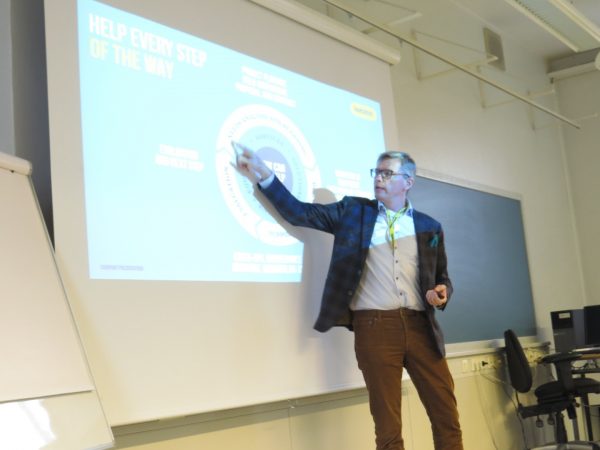
By Mikael Kämpe & Zinaida Grabovskaia Sharing economy gets more and more popular today. Sharing of assets safes money and frees the capital to concentrate on core competences of businesses and people. RAMIRENT is one of biggest and oldest Finnish companies that focuses on machinery and equipment, and rental of professional equipment. Nowadays, Ramirent is also famous for multiple services related to construction, industry and even to big events! Mikael Kämpe, Executive Vice-President of Ramirent Finland, visited the Industrial Management Master’s program and talked to students about the art and craft of providing services. Our business is making a safe construction place Ramirent, a leading Finnish company that is now also very visible in Europe, was established in 1955. In 2017, annual net sales reached 191,5 MEUR in Finland (Group 724M€). Ramirent is a market leader in Finland, Baltics, Norway, Poland, Czech and Slovakia, except in Sweden and Denmark. The main customer of the company is construction business, as well as the companies and sites that resemble construction, for example, shipyards and big events. Our main business is to make a safe construction place. But we are not a building company. We provide equipment, know-how, services, and customized services for construction sites. In services, our core focus is on a wide range of equipment rentals. In Finland, appr. 40% of our business relate to services, and we tend to focus more on services combined with our equipments. We have developed a ‘One-stop-shop’ offering for machines and equipment. This includes renting the light machinery, heavy machinery, and also more complicated rental services - safety equipment, scaffolding, tower cranes (here, we are second in Finland), hoists, power and heating, lifts, renting modules for construction workers, etc. In addition, our services include planning for temporary sites, site services, training, logistics, and fuel services. These services make appr. 40% of our business in Finland. One example of Ramirent’s recent projects is Tripla in Pasila. We are a ‘one-stop-shop’ supplier and partly run the site logistics for this project. We also provide a lot of temporary solutions, such as scaffolding and weather protection services (heating, moisture protection, etc), since we have very challenging weather in Finland. Under our scaffolding system that covers the building, the workers can do their work even in rain and snow. Currently, construction is booming. The growth is visible especially in the capitals and big university cities. There is also a rising number of small construction companies. As a result, the competition is getting tighter. Also, the demand for equipment is changing quite fast. European regulations always tighten the level of safety and emissions and thus tell us what equipment to use. As a result, construction sites become more and more complex, especially for big companies. Focus on people as the biggest asset To help our customers to run a construction site, we start with (a) the needs analysis and planning, continue to (b) delivery and support, and end with (c) evaluation when the equipment comes back. Upon the machinery return, we check, refill, clean it, and also fix it, if necessary. For fixing, we send the equipment to specialized hubs. We have currently 58 customer centers across Finland and specializing hubs for different types of equipment. Based on our experience, it helps if maintenance is centralized. Another reason for the hub structure is the logistics of spare parts, and having all similar equipment in one place. Whatever we do, we always focus on people as the biggest asset. And the general trend is that we take better and better care of people. Interestingly, equipment rental business is a unique area where Finnish companies are the biggest in Europe. In addition to rental services, we also developed a digital platform RAMISMART. Länsimetro, for example, uses this system. One part of it is ‘Time and Attendance’ which tell how many people are on the site, and to the tax office which workers and companies are working. After having this system for a couple of years, we started thinking what else we can do with it and launched ‘RAMISMART Machine Control’. With this system, we can follow who is using the machine and authorize the access to it. The big data is not yet utilized, equipment is not yet speaking with each other, but this is definitely the future. Big events as a new service area Finally, big events has recently become a customer for our services. As big events require temporary infrastructure - quite like a big construction site - we started providing rental services for big events. For example, we built the infrastructure, temporary stores and shops, change rooms, fences, scaffolding, etc. for such events as Flow Festival, Tall Ships Race and Helsinki Ice Challenge in Kaisaniemi. In 2018, appr. 150 events have been conducted this year only. This service started as a marginal activity but now has grown into a larger business. Thus, do not be surprised seeing Ramirent when going to a festival. This is not a coincidence but a new service area for a company that has know-how and competences in managing equipment, logistics and services for big sites. The text is based on Mikael Kämpe’s presentation materials written by Zinaida Grabovskaia. Mikael Kämpe Executive Vice-President of RAMIRENT Finland Oy and a guest speaker on developing service business in Industrial Management Master’s studies Zinaida Grabovskaia Senior lecture, Head of Master’s program in Industrial Management, Metropolia. The program specializes in service business especially for big industrial players.

The editorial team will provide the content of the Masterminds blog before publication.
The editorial team started its work at the beginning of 2022.
Pia Koirikivi, chief editor in Masterminds blog, Pedagogical Specialist
Minna Kaihovirta, Manager of Dialog
Iira Lankinen, Principal Lecturer
Riikka Wallin, Publications Specialist
Zinaida Grabovskaia, Senior Lecturer
Salla Kivelä, Principal Lecturer
asiantuntija yamk business informatics Business Informatics Master’s Program CERN Bootcamp Construction Business hankinnat hankintastrategia hankintatoimi ilmastonmuutos Industrial Management Industrial Management Master’s program johtaminen koulutus kulttuurituotanto Marjatta Kelo master Master's Thesis masterminds Masterminds blog Master of Engineering Master’s degree Metropolia Metropolia AMK Metropolia Master's Metropolia UAS metropolia YAMK opinnäytetyö osaaminen service design Sharing economy sosiaali-ja terveysala sosiaaliala study trip Sustainability talotekniikka terveyden edistäminen terveydenhuolto työhyvinvointi ura yamk YAMK-tutkinto YAMK opinnäytetyö ylempi AMK ylempi ammattikorkeakoulututkinto Zinaida Grabovskaia
