Avainsana: ICT development
Pros and Cons of Self-direction

Self-direction is a concept that has long existed in the business landscape, and its effect in teams has been a research subject for a long time. But what kind of framework is needed to support individual employee’s self-direction? Using an IT unit as an example, I am describing what kind of self-direction practices support the employee’s self-direction and what kind of issues hindered self-directed working. Furthermore, I will introduce how self-direction improves the daily work quality. Why are we talking about self-direction? There is not a common interpretation on what the self-direction means specifically, but on a general understanding it goes as follows; a person’s ability to perform without external guidance & control (Martela and Jarenko, 2017). The research subject is new because changes have happened in the world of business; technology has advanced to become knowledge-intensive and dynamic, allowing industries to innovate solutions previously unable to have been developed (Muthusamy at al., 2005). Work life has changed because of modernized thinking, which is leading organizations to meet new challenges in employee satisfaction. The emergence of measurement of self-direction is currently not on companies’ priority lists, as there is a lack of tools and promotion for doing this. However, this is the topic of the near future (Koutonen, 2020). Past research about the concept has led to opening a few questions: What business and individual based information is essential for enabling self-direction in a company? Are individual or company performance used as the model for organizational operation? Is individual information relevant for the company, and will it have effect between company chains? What practices support self-direction? What tools are required to support self-direction? (Koutonen, 2020.) Self-direction is one emerging concept in the changing work industry. New generations want to experience work as meaningful (Kiskonen, 2018). Organizations have difficulties in predicting or measuring an employee’s attitude towards own work and what possible consequences might occur (Lal, 2008); the lack of knowledge about self-direction could affect negatively on organizational strategies if not taken into account during re-evaluation of these. To know what information affects individual work performance, meaningfulness and evaluation is valuable when improving strategies, or when creating new ones. The information can lead to employees performing their jobs more self-directed and successfully. Organizations can utilize this information for company success by knowing how and what relevant business information visibility could help and motivate an employee to perform the job more self-directed and successfully, and if information visibility will affect self-direction’s usage and enrichment. So, how does an organization find out this, at least on the first look, non-tangible information? Subordinates, speak up! Management, take notes. The conceptual framework I built for my thesis (there were no existing ones to be found) aimed to find out how to assess current self-direction practices in an organization or unit by tackling multiple topics that eventually formed the basis for developing a self-direction supportive framework. Analysis of current values helped establishing a scope for the framework, current best practices established the themes, and current solutions established what utilization capabilities the framework could be used for. The conceptual framework helped developing the questions to evaluate a subject area’s (in my case, an IT unit) current self-direction practices. For example, two major factors in practicing self-direction were discussed from the individual employee’s perspective: what organization model, and what leadership model, do you identify following? Utilizing the conceptual framework to evaluate current self-direction practices will definitely vary depending on the research subject, but following areas were identified in the IT unit I analyzed: self-direction, autonomy, creative thinking, and independent decision-making in daily work is highly supported, while self-directed working is hindered by an overall lack of responsibility, documentation, workflows, and CRM transparency. In addition, guidelines for practicing additional voluntary self-direction supportive organizational thinking is missing. After so much research, it was uplifting to allow the employee to talk. As the results in the Thesis study demonstrated, what might be defined in the organization may not be what the employee perceives. Managers: allow the employee to identify how things work according to how one perceives it, not according to company guidelines. It might save much trouble to not assume that everything is clearly communicated and followed. What to do with the established strengths and weaknesses? Having an open mind about what kind of a framework should be developed, and eventually implemented, certainly benefits from having an S&Ws-analysis based on honest answers. As my IT unit current state analysis revealed, promoting self-direction should be further a focus area, while reacting to changes in the business environment should be an area for improvement. With clear evidence, developing a voluntary self-direction supportive change enablement framework was rapidly decided between company management and myself. My Master’s Thesis (Koutonen, 2020) demonstrates the development of the change enablement framework in detail, as with clear motivations for reasoning its existence. The framework has not yet been implemented in the IT unit, but is expected to be done in 2021, Q1. If implemented, the change enablement framework could improve the daily work quality and business environment in the IT unit. Scattered practices have always existed in roles and responsibilities, documentation, workflows, and internal and customer business environment transparency. The framework could help in creating a cohesive and professional working environment in the IT unit, which leads to more self-directed capabilities in own working. By developing and following a self-direction supportive framework, an organization could re-evaluate organizational strategies with visible outcomes of the implemented framework and utilize the information for company success by evaluating how and what information visibility could help and motivate the employee to perform own job more self-directed and successfully. Self-direction is a concept that has long existed in the business landscape, and its effect in teams has been a research subject for a long time. I hope that my Master’s Thesis study will be one of many research subjects about the concept’s effect from an individual’s perspective in a team. About the author Olli Koutonen works as an IT Consultant for an IT-house that specializes in providing customers technical environments in a rapidly evolving digital landscape. He has over five years of experience in multi-language customer-oriented services in the IT industry, from customer service & management positions to specialized consulting services. References Denis, J-L., Langley, A. and Sergi, V. (2012). Leadership in the Plural. The Academy of Management Annals, Vol. 6, No. 1. 211-283. [online] [Accessed 1 June 2020] Kiskonen, L. (2018). Itseohjautuvuus Työhyvinvoinnin Tukena: Varhaiskasvattajien Näkemyksiä Itseohjautuvuudesta Osana Työtään. [PDF] Metropolia University of Applied Sciences, Department of Social Services, Myllypuro. Bachelor’s Thesis. [Accessed 18 November 2019] Koutonen, O. (2020). Developing a Framework Supporting the Employee’s Self-direction in the Information Technology Unit. Metropolia University of Applied Sciences, Department of Business Informatics, Myllypuro. Master’s Thesis. Lal, H. (2008). Organizational Excellence Through Total Quality Management: A Practical Approach. ISBN: 978-81-224-2643-4. New Age International Publishers. Martela, F. and Jarenko. K. (2017). Itseohjautuvuus: Miten Organisoitua Tulevaisuudessa? ISBN: 978-952-14-3041-1. Alma Talent. Muthusamy, S., Wheeler, J. and Simmons, B. (2005). Self-managing Work Teams: Enhancing Organizational Innovativeness. Organization Development Journal, Vol. 23, Iss. 3.
Turning Public Services to Digital
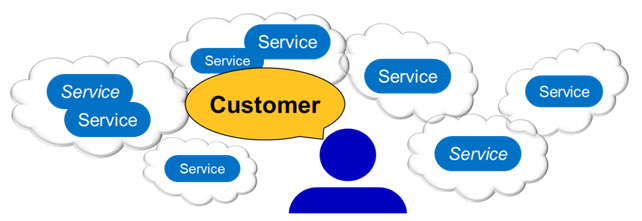
Master´s thesis “Total Portfolio for Public Services” (1) introduces the way to prepare existing public services for the digital era. Citizens and their life events can trigger new demand for digital public services, but introducing or improving digital services will require tectonic changes in the current service base. How does the current service base look like in public organizations? Most public organizations struggle with a myriad of independent services. Services and customer insights are scattered in disparate offices or entities; and so are the corresponding digital assets. This disparity makes the change towards a smooth digital experience hard and financially challenging to execute. As a result, customers often have to find and select their public services from bits and pieces of a fragmented, incoherent mass of services. Yet, citizens of today expect the same smooth experience from all services they consume – either digital of physical, public or private, automated or manual. What primarily matters for them is that the service gets its job done as expected, and when expected. It also matters that the customers can find the service easily. The cool “wow!” effect happens when the citizen gets the service available even before he or she realizes the need for it. And it is only after such a happy discovery that he or she starts inquiring how much the service can cost, and how the cost is charged i.e. through taxes, through insurance, or out of the pocket. If the cost is right, the citizen chooses the best option and enjoys the experience. Definitely, it is much nicer to pay a few dozens of euro for a childbirth, instead of 10 000 Euro or more, depending on potential complications. This angle is one of the strongpoints for consuming public services. They tend to be affordable and predictable without unexpected extra bills. Public service quality also tends to be high, as there is a lot of public attention, monitoring, and quality checks. In addition, public services are found in public offices, which makes them easy to spot. Private services must struggle much more for being noticed. In addition, many public services have traditionally been incumbent without much of a competition. All these factors make the current service base look very attractive and promising. But is it for long? Not only “what” but also “when” and “how easy” Digitalization changes this natural attractiveness of public services. A much wider, “heavier” public service base faces unprecedented direct rivalry and a threat of substitution from the private side in the ways that were not possible in pre-digital era (2, 3). Hence, today it is not enough to concentrate on the traditional strongpoints of public services (affordability, quality, wide coverage). These services must meet the customer needs better. Let´s start with “when”. In essence, public services consumption happens in certain life situations. When a child is born, certain childcare services are triggered. As the child grows, new service needs come to the picture, and they form a web of service needs. Imagine if those life situations could be identified and analyzed so well that the citizens could be offered the right services proactively. This is why Stiglitz-Fitoussi-Sen commission modeled the typical citizen´s core needs for the European Union in 2009 (4). Since then, for example, Finland and Estonia have established their Artificial Intelligence programs pursuing this capability to identify citizens’ life-events for focusing public services better (5, 6, 7). In other words, the providers of public services look ahead and have a clear vision how to be more proactive. So, after building such visions, why there is still a problem with “how easy” the public services can be? Unfortunately, this problem exists, and it is both managerial and technical. It originates from the fact that few public services are islands of their own, and they are not really restricted to certain service areas or tools either. Yet, the operational models of local governments have divisional silos which separate public services into the urban environment, cultural, education, social and health services. This dilemma makes an obstacle for triggering a change in public services into easy and proactive digital services, as envisaged above. What to do? My Master´s thesis (1) addresses these issues and proposes an approach to handling them through constructing a business operational concept named the ´Business Wheel´. The ´wheel´ first describes the related business dynamics and then suggests a Portfolio Management setup and the necessary organization around those portfolios. The key pivotal portfolio for a municipality is a Service Portfolio because local governments run hundreds of services. If they are run disparately, without clear service structures, it becomes almost impossible to match those hundreds of existing services with the citizen’s life situations in the way envisaged above. This is why the thesis recommends that local governments should consider the Service Portfolio and the customer life events first. Addressing both areas will directly lead to a need for fundamental transformation towards digital services, but there is also agility required in adapting strategic targeting. The success will depend on the ability to continuously assess the environment and effectively steer the execution. However, to capture the value, just steering and targeting is not enough. New and improved public services will be needed, which requires a substantial amount of innovation. All these parts of the ´Business Wheel´ and Service Portfolio practices should contribute to constructing a managerial ecosystem and prepare public services for a turnaround based on life-events triggered services. About the author Ilkka Kautto works as a directing chief specialist, ICT development in the City of Helsinki. He has over twenty years of experience in innovating and developing new digital solutions and related organizational capabilities in international technology cluster and public organizations. References Kautto, I. (2020). Total Portfolio for Public Services: How to Prepare Existing Public Services for a Turnaround to a Life-events Triggered Proactive Ecosystem. [Master´s Thesis]. Helsinki, Metropolia university of Applied Sciences. Christensen, C. et al. (2016). Competing Against Luck: The Story of Innovation and Customer Choice. 1st edition. New York, NY: HarperBusiness. Ulwick, A. (2017). Jobs-to-be-done for Government. April 19 2017. [online] [Accessed 2 March 2020]. Stiglitz, J. E. and Sen, A. and Fitoussi, J-P. (2009). Report by the commission on the measurement of economic performance and social progress. [PDF] [Accessed: 10 June 2020]. Sikkut, S. and Velsberg, O. and Vaher, C. (2020). #Kratt AI: The next stage of digital public services in #eEstonia. Republic of Estonia, GCIO Office. [PDF] [Accessed 25 February 2020]. Maunula, A. (2019). Julkisen sektorin digimenestyjät 2020, Suomi. [online] BearingPoint. [Accessed 19.1.2020]. Ministry of Finance (2020). The AuroraAI national artificial intelligence program begins – with the aim of using artificial intelligence to bring people and services together in a better way. [online] [Accessed: 10 February 2020].

The editorial team will provide the content of the Masterminds blog before publication.
The editorial team started its work at the beginning of 2022.
Pia Koirikivi, chief editor in Masterminds blog, Pedagogical Specialist
Minna Kaihovirta, Manager of Dialog
Iira Lankinen, Principal Lecturer
Riikka Wallin, Publications Specialist
Zinaida Grabovskaia, Senior Lecturer
Salla Kivelä, Principal Lecturer
asiantuntija yamk business informatics Business Informatics Master’s Program CERN Bootcamp Construction Business hankinnat hankintastrategia hankintatoimi ilmastonmuutos Industrial Management Industrial Management Master’s program johtaminen koulutus kulttuurituotanto Marjatta Kelo master Master's Thesis masterminds Masterminds blog Master of Engineering Master’s degree Metropolia Metropolia AMK Metropolia Master's Metropolia UAS metropolia YAMK opinnäytetyö osaaminen service design Sharing economy sosiaali-ja terveysala sosiaaliala study trip Sustainability talotekniikka terveyden edistäminen terveydenhuolto työhyvinvointi ura yamk YAMK-tutkinto YAMK opinnäytetyö ylempi AMK ylempi ammattikorkeakoulututkinto Zinaida Grabovskaia
