
3UAS + 25 students + big challenges = CERN BootCamp 2018
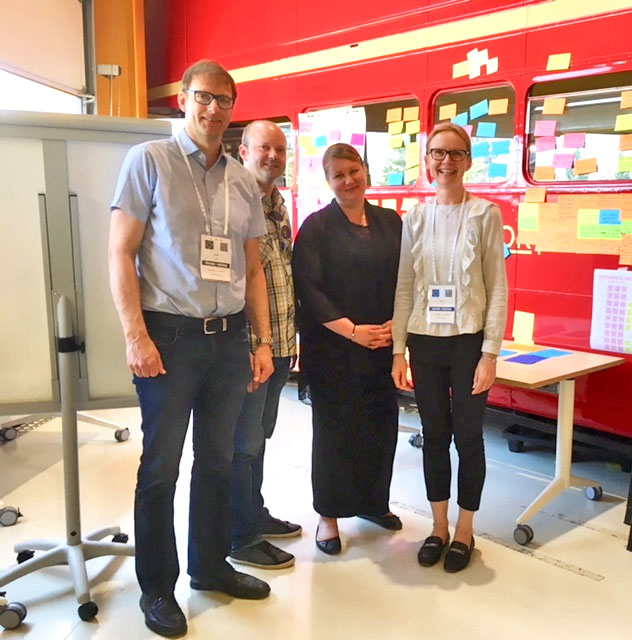
It has been a great pleasure to be involved in the CERN BootCamp project. We started the project together with the 3UAS (Metropolia, Haaga-Helia and Laurea) and Helsinki Institution of Physics (HIP) in the autumn 2017. This kind of collaborative work over the ‘school borders’ is definitely a work method from today! The CERN experiment The CERN BootCamp is an innovative and unique study concept for Master students. The concept was co-created by CERN, Laurea UAS, Metropolia UAS, Haaga-Helia UAS, University of Helsinki and companies. The focus of the studies is to solve demanding societal problems or challenges of the case companies by applying service design and design thinking methods and having a genuine human oriented, empathetic approach. We tried to follow a note: ”Instead of trying to create ideas from nothing, translate and adapt existing solutions or look for links to random stimuli. Ideas are usually the cornerstone of creativity and countless methods exist, often under multiple names, to create, filter and select them.” (Stickdorn, Hormess, Lawrence & Schneider 2018, 98) Selected themes covered the following issues: reducing plastic pollution in practice, making climate change effects visual to consumers in purchase decision situations, utilizing open data for example in health care or minimizing the gap between employers´ needs and workforce´s skills and capabilities. CERN and local companies as well as the universities offered facilitators and mentors for student groups during our week at CERN in the last June. We also wanted to use local companies in the process because smart companies are very interested in societal issues nowadays. They integrate marketing and corporate social initiatives into broader business goals. According to Kotler, Hesekiel and Lee (2012,10) businesspeople who mix cause and commerce are often portrayed as either opportunistic corporate "causewashers" cynically exploiting nonprofits, or visionary social entrepreneurs for whom conducting trade is just a necessary evil in their quest to create a better world. That is why marketing and corporate social initiatives require a delicate balancing act between generating financial and social dividends. The fact is that some companies are doing great business while doing Good! The CERN BootCamp After several meetings together with the 3UAS facilitators during the spring, it all started to turn into reality and we were finally at CERN in June to create the best bootcamp together with the students, the tutors and the CERN Ideasquare staff. It was a remarkable experience to see, how eagerly our group of multidisciplinary students threw themselves in the pool of challenges. Some teams seemed to forget even the lunchtime, so deep in their work they were while tackling with challenges of the plastic pollution, climate change, utilizing open data and minimizing the gap between employers´ needs and workforce´s skills and capabilities. The service design process includes among other things: Research, ideation, prototyping methods and facilitation methods (Stickdorn, Hormess, Lawrence. & Schneider 2018) and that path the students walked on. All the student groups had managed to get great interviews for Tuesday, which supported their research phase. Some went to visit at the WHO, some made a call to Stora Enso, visited the University of Geneve, law office, talked to experts at CERN and so on. Some of the groups changed their point of view totally after these discussions. Wednesday was a hard working day analyzing the results of the interviews, creating key insights and making ideation by using different tools, which were presented to the students during the lectures. By the end of the evening, the groups had decided and found their goal and the challenges were narrowed down. On Thursday it was exciting to see how many different kinds of prototypes started to build up and the visions and ideas of students got a tangible form. The final day arrived and everyone was working hard from early morning. After the lunch, it was the show time and we saw four spectacular presentations and innovations from our challenge groups! The students had put their great minds together and produced solutions that could even work as a start for a start-up company…How does titles like Drink like a Finn (a reusable plastic bottle with water quality indicator for tourists), Pelipiha, Foresight Hub and Greenbasket sound like into your ears? The solutions were variable but we need to remember social innovation doesn’t have fixed boundaries: it happens in all sectors, public, non-profit and private. Indeed, much of the most creative action is happening at the boundaries between sectors, in fields as diverse as fair trade, distance learning, hospices, urban farming, waste reduction and restorative justice (Murray, Caulier-Grice & Mulgan, G. 2010,3). What we learnt The student feedback was quite amazing: “The CERN Boot Camp has been the most rewarding learning experience through the whole of my studies with so many different people I met with new views and not the least the opportunity to visit and stay at the incredible and almost surreal CERN.” “I learned much more about service design process, ideation and about CERN than I expected. The networking side came as a positive surprise. I never could have imagined to get so many good tips from so experienced and knowledgeable people.” “Best course I've ever had. Some of my other courses tend to be repetitive but this is something new and a definite added-value to my skills and experience. I was so inspired and mentally revitalized.” Looking forward to the BootCamp of 2019! Anne Turunen Anne Turunen worked at Metropolia UAS as a senior lecturer, and she was a tutor on the first CERN Bootcamp. References: Murray, R., Caulier-Grice, J. & Mulgan, G. 2010. The Open Book of social innovations. UK: The Young Foundation, Nesta. Stickdorn, M., Hormess, M., Lawrence, A. & Schneider, J. 2018. This is service design doing. A practitioners handbook. Applying Service Design Thinking in the real world. California: O’Reilly Media Inc. Kotler, P, Hesekiel, D. & Lee, N. 2012. Good Works! Marketing and Corporate Initiatives that Build a Better World...and the Bottom Line. New Jersey: John wiley & Sons, Inc. Information on CERNBootcamp 2019: marianne.pitkajarvi@metropolia.fi
How Can Your Company Achieve Invincible Competitive Advantage Through Customer-centricity

Despite the industry or organization, we live in the world where customer has the bargaining power more than ever before. This has led companies into desperate seek of ways to beat their competitors; some by innovating new products or service, which unfortunately is quite short-sighted, while the other companies focus on finding long-term success factors by researching the ultimate needs and desires of the customer and using those findings to transform them into more customer-centric organization. According to Gartner, customer-centricity is to understand and meet the expectations of the customer. Forbes recommends having deep discussion with key stakeholders in order to provide services with extra twist of special, tailor-made experience inside it. Harvard Business Review brings the last twist into the concept of how to build customer-centric organization; the company culture has to be aligned with the customer needs. Seems quite easy to do but is it? Start by Identifying the Barriers for Customer-centric Way of Working My thesis focused on developing a new, customer-centric service model as the main business problem identified in the beginning was that company has over 40 different ways of working which comes from the number of employees of the company. You can only imagine the huge waste of resources, time and money but in addition, customers were not satisfied at all to the service. The on-going discussion around customer-centricity did not give me any practical advice on how to approach the issue in the case company. Thus, my investigation went deeper, and I ended up finding the framework of Jay Galbraith, the star model, which is used to design dynamic and customer-centric organization, step by step in a structured way. Validated Framework Keeps Your Work on Track - So Do The Customers! Star model framework can be used in many ways. In my thesis, it was used to analyse the current state of the service which brought out the weaknesses and strengths of the current service model. The framework has five dimensions which are in relation to each other, some more tightly than others. The strategy at the top is the key and pointing the direction and challenging you to think have you included your customer in it and how have you actually done it. Next dimension will verify the previous as the structure should be aligned according to your company’s customer-centric strategy. If all good so far, you can move on to next dimension, which is information and decision processes and flow referring how seamlessly and effectively information moves inside and outside of the company. After that you stop in the fourth dimension which is rewards. Rewarding people according their behaviour and results against customer-centric strategy is highly important and has to be considered carefully when building the model. The final dimension, people, is focused on creating right kind of culture and resource pool through right kind of recruitments, which refers to know-how and mindset of employees. Application of this model revealed that case company hadn’t really ever made any real or compelling service promise to customers on which they could commit themselves to and the same applied to the employees. As the research also revealed service delivery related issues which needed to be solved, it became clear what needed to be done. As an outcome of the thesis, the new customer-centric service model was built together with the customer and employees. Why do you think all these stakeholders were involved to the creation process? Answer is simple; customer-centric development work is always done together with a customer and internal stakeholders. Customer´s needs, desires and wishes cannot be decided on their behalf by the company management or employees. As an outcome in this case, the service model included the service promise, service delivery in addition to customer-centric service measurement and rewarding methods. All the key and standard elements of customer-centric service. Why You Need to Find Your Way into the Customer´s Heart? You must be wondering how this can be the invincible competitive advantage for your company. Think for the moment. Can the outcome be something your competitors copy and put in practice? Answer is clear, no they cannot. The outcome created together with you and your customer will always focus on building emotional bond between you and your customer and that is where the competitive advantage comes from, winning the heart of your customer. Additional info: Due to the case company policy, thesis isn’t available in Theseus. For further information, please contact: Katja Kokko katja.kokko@gmail.com Pia Hellman pia.hellman@metropolia.fi Recommended books: Designing the customer-centric organization: a guide to strategy, structure, and process, Jay R. Galbraith Designing Dynamic Organizations: A Hands-On Guide for Leaders at All Levels, Jay R, Galbraith, Diane Downey and Amy Kates Sources: Davis, Jennifer (2018). Get Paid for Paying Attention: 4 Lessons In Customer-Centricity. In Forbes. Accessed December 13, 2018. Galbraith Management Consultants (2018). Star Model. In Galbraith Management Consultants. Accessed December 13, 2018. Garner, Benson (2015). Implementing Your Business Model With the Galbraith Star Model. In Strategyzer. Accessed December 13, 2018. Goasduff, Laurence (2018). Is Your Organization Customer-centric? In Gartner. Accessed December 13, 2018. Yohn, Denise Lee (2018). 6 Ways to Build a Customer-Centric Culture. In Harvard Business Review. December 13, 2018. The image: Pixabay.com
Establishing Global Transportation and Logistics for a Leading Finnish Company
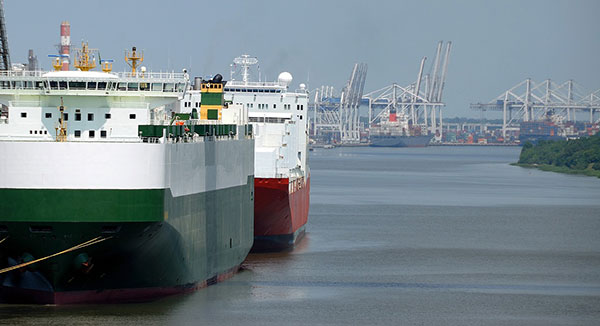
I remember myself some 3-4 years ago. I had a struggle in deciding if I could go and study in Helsinki for a Master’s degree, or is it totally out of question for me, as I lived in Rauma at that time. I decided to take this crazy step and travelled twice a week to Helsinki along with a full-time job. I became a student in Master’s program in Logistics Management. My studies were very interesting and fulfilling, but I could not get rid of my worries at work. My job challenge was to gain real benefit for the company by introducing common transportation and logistics services (by air and ocean) throughout a big corporation operating globally. This was a big and real challenge. Fortunately, I was able to concentrate on this problem in my Master’s thesis project. I researched the current state of logistics in business units, and revised the existing approach with the help of my colleagues and thesis instructors. These efforts helped to take a new perspective and look at the old and familiar problem with new eyes. The key suggestion for the company was to strengthen the global logistics by managing it through an effective steering global logistics group. This group should be connected by well-working communication between the responsible persons in business units. The next step was to investigate, collect and prioritize the needs and wishes of the business units, as well as to investigate their experiences with current logistics. Based on this information, and with the help of the members of the steering group, to establish a list if KPIs for the corporate logistics provider, that would address their needs, and conscientiously select the best out of the desirable providers. Only after it could be possible to introduce corporate contacts for transportation and logistics. The key finding was, that launching contracts with a global transportation and logistics providers alone is absolutely not enough. The critical issues are: (a) to involve the business units in constructive cooperation by identifying and following mutual interests and gains, and (b) to closely follow the implementation by monitoring a carefully selected list of KPIs that would reflect the real needs of business units. In short, to establish the needs, to identify mutual interests, and to closely follow the performance. This was an interesting and challenging job. I learned a lot while working for Metso and Valmet where all types of logistics were well-organized and extensively used, and my experience there was diverse. Half a year ago I got the position in Cargotec where I have been leading Logistics for the Cargotec group. The company has over 10 factories where equipment is produced in such countries as US, Poland, Malaysia, and China. On the other hand, spare parts warehouses are located, for example in France, and multiple other countries. All of these places need to be connected with well-working logistics. This is a challenge and a big gain for the company. Interestingly, this is also a continuation of my thesis topic, but growing in size and scale. After the first implementation, it will make another round of testing myself, the selected approach, and the new steering logistics group that will play a key role in these developments. I am looking forward to the future, to effective cooperation and enthusiastic and experienced colleagues, and to find good solutions together. The next immediate steps include defining the global logistics strategy for the next three years, hearing everyone, exploring the current ways, finding mutual gains, prioritizing and deciding together, and following implementations effectively. In addition, I want to thank my work colleagues, my fellow students, and Metropolia instructors from my previous studies. I use all my lecture notes and my thesis results from Metropolia still today. They have been absolutely helpful. Even though I graduated two years ago, I still remember your contribution to get us to graduate in time. It was really worth of travelling 67 times between Rauma and Helsinki, nearly 35 000 kilometers in total, between September and May 2016 by Onnibus. I am now living in Turku, where we moved from Rauma, and almost every week I am in Helsinki, Ruoholahti, passing by Metropolia. My many thanks to you all, from Pasi Kurkinen, the "long distance man". Pasi Kurkinen Pasi Kurkinen, Master of Engineering in Logistics Management (2016) lives in Turku and works for Cargotec Corporation as a Global category manager for logistics. He moved to this position half a year ago, after working with global logistics in Metso and Valmet. Two years ago Kurkinen also completed his Master’s thesis project in Metropolia UAS on his key challenge at work – how to implement unified logistics contacts in a global company, and how to commit business units to change from individual to corporate transportation and logistics. Kuvalähde: paulbr75, Pixabay.com, CC0.

The editorial team will provide the content of the Masterminds blog before publication.
The editorial team started its work at the beginning of 2022.
Pia Koirikivi, chief editor in Masterminds blog, Pedagogical Specialist
Minna Kaihovirta, Manager of Dialog
Iira Lankinen, Principal Lecturer
Riikka Wallin, Publications Specialist
Zinaida Grabovskaia, Senior Lecturer
Salla Kivelä, Principal Lecturer
asiantuntija yamk business informatics Business Informatics Master’s Program CERN Bootcamp Construction Business hankinnat hankintastrategia hankintatoimi ilmastonmuutos Industrial Management Industrial Management Master’s program johtaminen koulutus kulttuurituotanto Marjatta Kelo master Master's Thesis masterminds Masterminds blog Master of Engineering Master’s degree Metropolia Metropolia AMK Metropolia Master's Metropolia UAS metropolia YAMK opinnäytetyö osaaminen service design Sharing economy sosiaali-ja terveysala sosiaaliala study trip Sustainability talotekniikka terveyden edistäminen terveydenhuolto työhyvinvointi ura yamk YAMK-tutkinto YAMK opinnäytetyö ylempi AMK ylempi ammattikorkeakoulututkinto Zinaida Grabovskaia
