The possibility to participate in a study trip is included in several Metropolia Master’s programmes. Study trips and international study modules as well as exchange programs strengthen the international competencies of Master’s students. Business Informatics student Laura Invenius wrote about a study trip to Berlin.
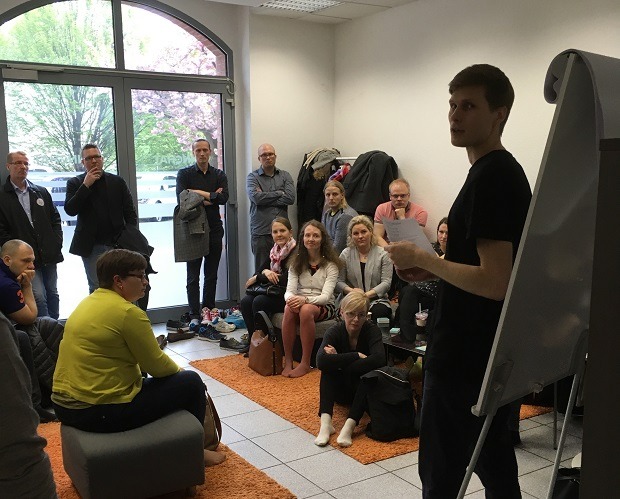
Innovation and Renewal course is a mandatory module for Business Informatics Master’s students. Luckily it included a two-day study trip to Berlin at the end of April 2017. The instructions stated that we needed to arrive to Berlin either on Wednesday evening or very early on Thursday and so we did! We had a WhatsApp group and people reported on regular intervals once they were arriving and so the excitement kept growing.
On Thursday, we had a visit to a local university and with Hochschule für Technik und Wirtschaft Berlin’s MBA students we did a group assignment together, in which we needed to innovate new business models for various companies. The discussion was vivid, both about the task, but also about the student life in Finland and Germany.
After the group presentations, a company named Futurice, introduced themselves. Originally from Finland, they are now located in various locations in Europe, and have changed their business model several times. They have an interesting concept and employee policy, trying to find different capabilities and skills and forming teams based on these.
On Friday, we visited Innovation Labs Berlin. It brings together startups in different phases and helps them through different challenges they might be facing. CEO Klaus Kammermeier told us about the startup scene in Berlin and why there are so many of them; living costs and quality of life in Berlin are good, the location in the center of Europe is excellent, those being the most important factors.
After a quick currywurst lunch and a visit to Brandenburg Tor, we headed to Finnchat. Finnchat is a Finnish company that provides chat services on company websites. They are well known in Finland already, and are now trying to get footstep in Germany. We made a group work around their sales and marketing funnel.
Quick visit to Kurfuerstendamm and then we had a fairwell dinner together at a very nice Italian restaurant in Mitte area. There was a lot of laughter and joy after an exciting program. Many of us stayed over the weekend and visited sights enjoying a sunny and warm spring weather.
Metropolia Master's bloggers
Bloggaajat ovat Metropolian YAMK-tutkintojen opiskelijoita, opettajia ja yhteistyökumppaneita. Aihepiirit käsittelevät laajasti ylemmän AMK-koulutuksen ajankohtaisia teemoja, työelämäyhteistyötä ja opiskelijoiden kokemuksia.
We also blog in English! Ota yhteyttä
The editorial team will provide the content of the Masterminds blog before publication. The editorial team started its work at the beginning of 2022. Pia Koirikivi, chief editor in Masterminds blog, Pedagogical Specialist Minna Kaihovirta, Manager of Dialog Iira Lankinen, Principal Lecturer Riikka Wallin, Publications Specialist Zinaida Grabovskaia, Senior Lecturer Salla Kivelä, Principal Lecturer
Bridging Worlds & A Journey of Growth
Only imagine being uprooted from one's life, leaving behind everything that was familiar, and stepping into an entirely new culture for higher education. It was not only the academic ambition per se, but also a leap of faith. This was where I stood at the crossroads of being an accomplished banking professional and yet a fresh student from Sri Lanka, when entering Finland with a resolution to grow, evolve, and thrive.
This was the reason, when choosing to study at Metropolia University of Applied Sciences, why it was so critical for me that this university would have a different approach to learning. I wanted a blend of theory and practical application to prepare my for the real world. It was a promise of not only academic insights but also of a holistic face-lift to my professional trajectory and personal journey.
Why Finland? Why Metropolia?
These were some of my many questions. I did my choice for reasons including Finland being ranked high in education and Metropolia for connecting the gap between theoretical and practical learning. I chose to risk and go ahead with the application.
With more than 18 years of work experience in the banking arena, I grew deeply interested in data analytics and operations efficiency. The Master's programme in Business Informatics at Metropolia was appealing not just for its industry relevance, but also for its practical application and problem-solving approach.
Challenges and Triumphs: The First Steps
Moving to Finland with my family was not an easy decision, as it would mean leaving behind a well-settled life and starting afresh. But this challenge was simultaneously an opportunity: the possibility of exposing ourselves to a new culture, new ideas, and new opportunities.
It all started with a journey of unexpected hurdles. Due to visa delays, I had to begin my studies remotely from Sri Lanka. What could have been an intimidating experience was relatively easy, thanks to the support from Metropolia. Online classes were well structured, keeping everyone engaged and moving forward in a fruitful direction, which the university itself clearly showing the ways how to stay connected and take part in the activities online.
Meanwhile, during this period, I also tried on my own initiative to complement my learning with additional activities and completed some optional courses in AI. Such a proactive approach allowed me not only to be on schedule but also enhanced my knowledge of emerging technologies, which proved so valuable later on when I was working on the thesis.
Settling in Finland
When my family and I finally arrived in Finland, the culture was warm in Reception and welcoming. Finland's emphasis on education and community integration were visible into every aspect of our new life, be it the language classes designed for migrants or the academic environment which felt very welcoming.
What really caught my attention when it came to Metropolia was how much they focused on collaborative and work-related learning. The classes are set up to ensure interaction, critical thinking, and practical application to concepts. This is not just education; it is preparation for the future.
The Metropolia Advantage: Theory Meets Practice
The education at Metropolia is different because it is not just about attending lectures and then doing an exam; it is about understanding how to use your knowledge in a real-life scenario. It was a nice discovery for me that Metropolia also provided learning opportunities beyond just the classroom. It offered opportunities for professional certifications (in Project Management and in Power BI), study tours, and company visits, which made it into a more diverse learning experience and enhanced both my knowledge and skills. This unique blend of academic theory and hands-on application, hallmarks of UAS studies, prepared me for real-world challenges, bridging the gap between classroom learning and workplace demands.
The Thesis Experience
The culmination of my studies was the completion of my thesis and the project was a real test of everything I had learned at Metropolia. The autumn semester was particularly demanding, as personal challenges tested my resolve. Although I began my thesis work early, the last two months became a race against time. With all credits except my thesis completed, I faced a pivotal decision: to graduate in December or postpone it for one more semester, until next June.
The unwavering support of my thesis supervisor and the staff of the Master’s degree programme in Business Informatics, was the turning point. Their professional guidance, empathetic approach, and steadfast encouragement were instrumental in helping me overcome the odds. They exemplified how Metropolia’s faculty truly invests in the success of their students, ensuring no one is left behind. Their belief in my potential and their determination to see me succeed pushed me toward the finish line. It is their guidance, combined with the practical learning approach of Metropolia, that allowed me to complete not only my thesis but also to deliver meaningful results.
Reflections & Lessons Learned
Looking back, my time at Metropolia has been a journey of growth, resilience, and discovery. Here are some of the key lessons I have taken away:
Adaptability is Key: Whether it is starting your studies remotely or integrating into a new culture, flexibility and willingness to adapt are essential.
Proactive Engagement Leads to Success: Taking initiative whether it is exploring additional learning opportunities or seeking help when needed can make all the difference.
Support Systems Matter: From family and friends to university faculty and peers, having a strong support network is invaluable.
Practical Learning is Empowering: Metropolia’s focus on applying knowledge to real-world problems prepares students not just to understand concepts but to use them effectively.
Advice for Future International Students
To those considering studies at Metropolia, my advice is simple: embrace the journey.
Plan Ahead: Whether it is organizing your study schedule or preparing for life in a new country, planning can ease the transition.
Stay Open to New Experiences: Finland has a lot to offer, from its education system to its culture. Be open to learning and growing both inside and outside the classroom.
Leverage Available Resources: Metropolia offers a wealth of resources, from language classes to career services. Make the most of them!
Stay Resilient: Challenges are inevitable, but they are also opportunities to grow. Stay focused on your goals and don’t hesitate to seek help when needed.
A Final Word
Metropolia is more than just a university, it is a community. It is a place where students from diverse backgrounds come together to learn, grow, and make a difference. My journey here has been one of the most rewarding experiences in my life, and I am so grateful for all the opportunities provided by it.
I carry with me, as I move on, not just the knowledge and skills I have learned but also the memories and lessons that have shaped me into what I am today. For everyone considering Metropolia, I´d say: take a leap. It is one decision that will challenge you, inspire you, and prepare you for a better future.
About the author
Jayampathini Kumarasinghe is a Master of Business Administration in Business Informatics (2024), a Metropolia´s alumnus, and an experienced banking professional from Sri Lanka who refreshed her professional skills in her Master´s studies at Metropolia and continues her professional career in Finland.
Both researchers and industry experts concur that workplaces with diverse and inclusive environments make positive impacts on organizations. They point out that having diversity, equity, and inclusion (hence DEI) initiatives at work improves corporate culture, client relations, enables the organization to move into new markets and even positively affects profitability. The three essential components – diversity, equity, and inclusion are interlinked and, when combined with business strategies, can help organizations thrive amid societal changes. (Ely and Thomas 2020.)
These topics inspired me during my MBA studies and I chose them as a topic for my Master’s thesis. In my thesis, I collaborated with a company in Finland that has a nascent DEI strategy and was interested to develop a roadmap to amplify the benefits of having DEI in the workplace to the company’s leadership.
Why the need to place a focus on DEI?
Diversity, Equity, and Inclusion (DEI), as a social pillar of sustainability policies, is part of the global goals in order to make a positive difference in own industry, as well as generate impact on society. DEI topics, as non-financial indicators, may be difficult to measure, unless they are conceptualized and well aligned to the strategy. This may pose a challenge to smaller companies, new to this area, and therefore the experience and developments in big companies deserve attention and dissemination.
Especially the appropriate selection of DEI indicators is the necessary step for any organization in the new era of CSRD. For organizations, key performance indicators (KPIs) are the essential managerial tools to determine whether the company is headed into the right direction. Metrics are vitally important, as evidenced by the proverbs "if you can't measure it, you can't manage it" and "what gets measured gets done" (Marr 2022). The DEI KPIs are important not only for reporting, but for implementing and truly “living” the strategy of the organization. They are indicative tools that will shed light on performance and point out the areas that require special care.
A look at EU’s Corporate Sustainability Reporting Directive (CSRD)
For the last two decades, the EU has been a champion in promoting DEI. The latest CSRD regulation (adopted since 5th January 2023) and its newly adopted EU standards (ESRS) include not only sustainability, but also - profoundly - social issues reporting, including DEI (see ESRS S1). As communicated in the EU Commission’s website on Corporate sustainability reporting:
“Companies subject to the CSRD will have to report according to European Sustainability Reporting Standards (ESRS). The standards were developed by the EFRAG, previously known as the European Financial Reporting Advisory Group, an independent body bringing together various different stakeholders. The standards will be tailored to EU policies, while building on and contributing to international standardisation initiatives.”
This latest EU CSRD legislation requires that all large companies disclose the information on the opportunities and risks they perceive as emerging from social and environmental issues, as well as their effects of their actions on the environment and human population (EU Commission, Press Corner, Q&A, 2023). At the European Commission's request, EFRAG (European Financial Reporting Advisory Group) drafted the standards to enforce the proposed CSRD, that focus on appropriate due process, transparency, and the knowledge of pertinent stakeholders. The 12 new standards (ESRS) cover the full range of sustainability issues and include the four significant “must-do” reports under the social facet, namely:
ESRS S1: Own workforce
ESRS S2: Workers in the value chain
ESRS S3: Affected communities, and
ESRS S4: Consumers and end-users.
The ESRS standards point to a range of recommended metrics for disclosures under the social pillar, namely in “ESRS S1: Own workforce” (such as the characteristics of the undertaking’s employees to collective bargaining and social dialogue). Figure 1 shows the range of KPIs in the newly adopted CSRD and ERSRS recommended for corporate reporting.
Figure 1. Metrics recommended by EFRAG for ESRS S1: Own workforce” (EFRAG 2022. Educational session on the first set of draft ESRS).
In addition, the newly adopted CSRD and ESRS give room for flexibility to organizations which specific aspects of DEI they can select for reporting on their DEI related topics. Especially the gender diversity policies are seen as the most common focus in workplaces and reporting practices. By having a gender-balanced workforce, companies can demonstrate their commitment to having an inclusive and equitable work environment.
This condition gives a unique chance to the front-running companies to excel and stand out among competitors by demonstrating their leadership via adopting not just mandatory, but wider reporting practices, beyond the required minimum.
Nordic companies are at the forefront in DEI reporting
Companies, especially the larger ones, have undergone digital and other transformations in the past decades. These changes were also closely related to sustainability and diversity issues. The organizations that successfully embraced these efforts as part of their business strategy were immediately spotted by other industry players, to a big extent, due to their excellence in reporting. These companies have managed to set examples of reporting that other organizations - as well as students in DEI topics - can learn from. The widely acknowledge examples of DEI leadership from Nordics include, for example, the following front-running companies. AFRY can be considered as an inspiring example of a leading international engineering, design, and advisory company when it comes to sustainability reporting. AFRY´s Annual and Sustainability Report 2023 (published in March 2024) measures and follows us on sustainability commitments through targets that encompasses its solutions, operations, and people. It also monitors its progress on a wide range of KPIs in DEI area (which is especially obvious when comparing to reports on DEI topics published in 2020 or earlier). Also, CGI make an interesting example among the largest IT companies in Finland that emphasizes in its DE&I governance. DEI is endorsed by the CEO and the executive committee, and that accountability for DE&I is a shared responsibility. DEI topics are embedded in the annual business plans for each Strategic Business Unit (for example, in CGI 2022 ESG report, p.45). The company clearly indicates its DEI targets and KPI also in its 2023 Sustainability report (published in 2024) and sets the targets, for example, to achieve the same level of gender diversity representation in leadership positions as is present across the entire company by 2025. (CGI 2023 ESG report, p.21).
These Nordic examples demonstrate that, by understanding and selecting measurable DEI targets and KPIs, the companies can create and follow more professional development plans, identify the multitude of domains where DEI can bring benefits to an organization, and thus point to a measurable impact of DEI on the overall performance. It makes this topic worth studying, also by the students at universities of applied sciences.
About the author:
Joan Mhyles Cruz is an MBA graduate in Business Informatics. In her student times, Joan was a student ambassador of Metropolia UAS and an advocate of DEI. She made this topic into her Master´s thesis done for one of the front-runners of DEI in Finland.
References:
AFRY (2022). Annual and Sustainability Report 2022. Retrieved on 30.10.2023. https://afry.com/sites/default/files/2023-04/annual-and-sustainability-report-2022.pdf
CGI (2022). Environmental, Social and Governance Report. Retrieved on 20.11.2023. https://www.cgi.com/sites/default/files/2023-03/cgi-2022-esg-report.pdf
CGI (2023). Environmental, Social and Governance Report. Retrieved on 20.04.2023.
https://www.cgi.com/sites/default/files/2024-05/cgi-2023-esg-report-en.pdf
Cruz, Joan Mhyles (2024). A DEI Roadmap for an Organization and Its Sustainability Reporting:Master´s Thesis. Metropolia UAS. https://urn.fi/URN:NBN:fi:amk-2024053018232
EFRAG (2022). Educational Session on Draft ESRS S1 Own workforce. Educational videos on the first set of draft ESRS (downloaded). Retrieved 30.11.2023. https://efrag.org/Assets/Download?assetUrl=%2Fsites%2Fwebpublishing%2FSiteAssets%2FFINAL_26.01_Long_S1_SR%2520PPT%25201%2520vers230126%2520%281%29.pdf
EFRAG (2022). European Sustainability Reporting Standards (Draft). ESRS S1 Own workforce. EFRAG November 2022. Retrieved on 20.11.2023. https://www.efrag.org/Assets/Download?assetUrl=%2Fsites%2Fwebpublishing%2FSiteAssets%2F13%2520Draft%2520ESRS%2520S1%2520Own%2520workforce%2520November%25202022.pdf
Ely, Robin J. and Thomas, David A. (2020). Getting Serious About Diversity: Enough Already with the Business Case. Harvard Business Review, Nov-Dec 2020. https://hbr.org/2020/11/getting-serious-about-diversity-enough-already-with-the-business-case
EU Commission. Corporate Sustainability Reporting. EU rules require large companies and listed companies to publish regular reports on the social and environmental risks they face, and on how their activities impact people and the environment. (online).
Retrieved on 01.02.2024.
https://finance.ec.europa.eu/capital-markets-union-and-financial-markets/company-reporting-and-auditing/company-reporting/corporate-sustainability-reporting_en
EU Commission (2023). People first – Diversity and inclusion. Fostering a diverse and inclusive workplace. Retrieved on 5.12.2023. https://commission.europa.eu/about-european-commission/organisational-structure/people-first-modernising-european-commission/people-first-diversity-and-inclusion_en#fostering-a-diverse-and-inclusive-workplace
EU Press Corner (2023). Questions and Answers on the Adoption of European Sustainability Reporting Standards. 31.07.2023 (Brussels). (online). Retrieved 20.11.2023. https://ec.europa.eu/commission/presscorner/detail/en/qanda_23_4043
EUROPA. EUR-Lex. Directive - 2022/2464. Official Journal of the European Union. Directive (EU) 2022/2464 of the European Parliament and of the Council of 14 December 2022 amending Regulation (EU) No 537/2014, Directive 2004/109/EC, Directive 2006/43/EC and Directive 2013/34/EU, as regards corporate sustainability reporting (Text with EEA relevance). 16.12.2022 (online). Retrieved on 10.12.2023. https://eur-lex.europa.eu/legal-content/EN/TXT/?uri=uriserv%3AOJ.L_.2022.322.01.0015.01.ENG&toc=OJ%3AL%3A2022%3A322%3ATOC
Marr, Bernard (2012). Key Performance Indicators: The 75 measures every manager needs to know. Introduction. KPIs are vital management tools (xxv). Pearson Education Limited.
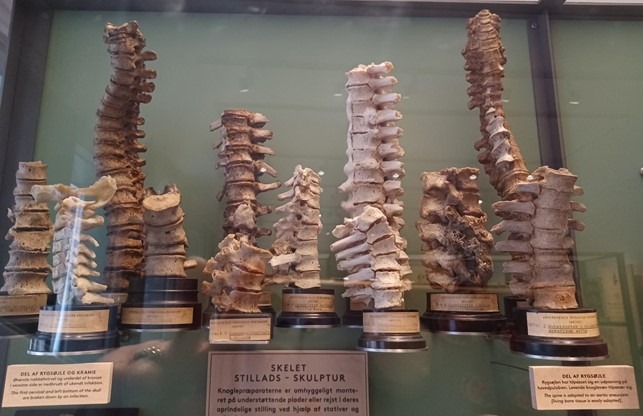
This blog reflects on my impressions ranging from disgust to respect in the Medical Museum of Copenhagen when exploring history and cultural well-being on the study trip with CRASH Master´s students of Metropolia. “The Body Collected” exhibition in the Medicinsk Museion presented the body parts collected from the 18th century to the present. The newest exhibits include dnas, cells and biopsies from bio banks, and the older ones were body parts, deformed foetuses, bones, skeletons, organs, tumours, lungs and so on.
Visit to museum in a study trip to Copenhagen
I took the stairs down to see the Indsamlade Menneske (“The Body Collected”) exhibition. The first element catching my eye was a full-term foetus in her mother’s womb. The birth had been obstructed due to the placenta being attached to other tissues and thus blocking the way out. I could clearly see the baby's face, hair, finger nails, all the possibilities of a new person being born.
And why can I explore these samples, which were collected up to 200 years ago? It made me think if it is ethical to present these now? and what kind of ethical questions existed 200 years ago?
Asking questions is a relevant part of ethics
I can only imagine what has happened to the mother since her body was left in the hospital. Family might have been poor, or the mother was ill, or she might have gotten pregnant by the wrong man, or without being married. No matter what was the reason, their bodies were left to science, because no one paid the hospital fees and did not collect their corpses for burial; and this is how surgeons learnt the anatomy of the human body and learnt to practise their profession. This was also the way, ethical or unethical, how hospitals operated, and this is how medical science developed.
I noticed a lot of unpleasant emotions and thoughts rising in my mind during this visit to the museum. Should I watch these at all? Can I be interested in the anatomy of a human, when it is presented via dead human beings and surely without consent? How many of the human rights and the laws are violated by portraying deceased person’s body parts? I do not have answers to these questions. I can only understand the history from the perspective of my time. This all seems so unethical considering modern time values and guidelines and legislation.
From disgust to respect
I continued my tour of the exhibition. Slowly, my disgust started to melt down. First, my emotion changed to wonder and interest, then to curiosity and finally to huge respect. It really hit me deeply. I realised that we would not have modern medicine without these scientists. They had the courage to explore human bodies in this way and teach the next generations by exploring these samples. It is way too easy to judge them with today’s ethical criteria and standards. Before these samples, the physicians were trained by exploring animal bodies. But we all can see the difference in the accuracy comparing, for example, the humans’ and the pigs’ anatomy. How many of us would be alive without the development and the research of these earlier generations?
The driving motive behind these actions and modern science is nevertheless exactly the same, human’s need to learn, explore, develop, and they have the scientific enthusiasm. All these, of course, in addition to the influence of such much more down-to-earth factors as professional competition, need for funding, reputational considerations, personal ambitions, etc. just like nowadays.
Later in the exhibition, I noticed that the museum had a separate room for ethical questions. They pondered on the same questions as I did. They asked from the audience if it is ethically bearable to have these collections presented to the public. The visitors’ answers varied from absolute “no” to “yes, of course”. My opinion swung to acceptance during the 30 minutes I spent watching these beautiful and remarkable samples.
What did I learn from ethics?
My main learning point was very simple and yet quite revolutionary on a deeper personal level. This experience touched on my physical body, my emotions, my thoughts and my biases. I felt my judgement and the resistance were melting away. My conclusion was that it is not fair to interpret history with current values and criteria.
Who am I to say 200 years later that those actions were unethical? I felt that seeing the exhibition offered me a mindset change. I understood the proportionality of ethics, and how all actions need to be evaluated related to that time and place when these actions happened with their participants.
How will this insight and experience influence me?
How can I generalise this insight to a wider level? I came up with the following reflections from my part.
What is ethical at this, modern time? What is ethical in our society and community? What are our values? In politics, values change every four years with the new elections, at least partly. Then, how about science? If science is based on our current understanding and knowledge, how should I think of what happened 20 years ago, and how will it be in 200 years to come?
I can only come to the conclusion that ethics and our understanding of ethics needs to be re-evaluated and it transforms constantly. And yes, historical structures need to be dismantled, like the colonisation and the patriarchy. We need to be prepared to ask difficult and unpleasant questions, and see those unbearable painful injustices that happened in our society. Similarly, we will be embarrassed and judged by future generations for the actions of today. But without stepping into the unknown areas and taking risks, there is no development, no creativity, and no new insights. It is for the future generations to judge us.
So, be fearless! Be the future-maker and take actions based on the values and ethics of our time and our understanding! Like Sanna Marin, the Prime Minister of Finland, encouraged us all to do in her speech at the New York University’s Commencement 17.5.2023 where she was recognized for her own courage.
Similarly, we need to honour those who were before us and our time. They did their very best with all the understanding, the experience and the knowledge they had. Let’s consider their work and actions with respect and learn from them. It sends a clear message to our generation: be bold to change and yet honour the history!
Why am I writing this?
I’m one of the hope-holders for the future. I believe in the good in human beings. I see it in people’s willingness to respect our future by finding the ways to save our nature and planet. They try their best to find a harmonious and sustainable way of living with other living organisms on earth.
So, what does this have to do with my experience in the Medical Museumn? I believe, it is exactly the same. Our enthusiasm is to learn, know, understand, develop, cure, find solutions, and ground them to the solid base of science, rather than contribute to prejudice of randomness. We strive to mix the knowledge and experiences with creativity to generate something new. We have the courage for new approaches, the tolerance of not knowing, but exploring constantly, and we have the attitude of respecting others and capacity to empathy; the ability to use our instincts and heart among the scientific knowledge.
When wandering in the exhibition, I connected to those persons and their imaginary stories, not only their collected body parts in the exhibition. Those persons have a meaning even hundreds of years after their death. They help me to understand the core of ethics, develop my professional and personal thinking, and ground my own life actions more on respect. In short, I have had inspirational moments with ethical questions in my life, work, studies and research! and I encourage you to do the same.
About the writer
Hanne Aura is a student in CRASH, Master’s Programme in Creativity and Arts in Social and Health Fields. She has a work history over 30 years, in such roles as nursing in psychiatric care, as a nursing expert and counsellor, as a specialist in social and health care data system development, as a key account manager, and as a therapeutic worker utilising embodiment and other creative approaches. Presently, she is a practitioner and student of the counsellor of Systemic Constellation.
References
Medicinsk Museion (2023). Medical Museion of København Universitet, Copenhagen. Web-site of the museum: https://www.museion.ku.dk/en/forside/
The Body Collected: Exhibition (2023). Medical Museion of København Universitet, Copenhagen. Web-site of the exhibition: https://www.museion.ku.dk/en/the-body-collected/ Also available as a virtual tour: https://www.museion.ku.dk/en/product/the-body-collected-en/
Speech by Prime Minister Sanna Marin at the New York University commencement on 17 May 2023. Prime Minister´s office (17.5.2023). https://vnk.fi/en/-/speech-by-prime-minister-sanna-marin-at-the-new-york-university-s-commencement-17.5.2023
Metropolia Master’s Alumni Event osallistui Nordic Business Forum -liveen 2.10.2017 ja saimme kuulla miljardööri Sir Richard Bransonin maanläheisen ja avaruuteen ulottuvan esityksen vastuullisuudesta, tarkoituksesta ja johtamisesta. Branson kuvasi menestyksensä moottoriksi uuden oppimisen, uudet haasteet ja uudet ihmiset. Hänelle saa pitchattua ideansa, jos osoittaa positiivisuutta ja halua nähdä hyvää – ”look best from the people”. Idea, jolla toisen ihmisen elämä tehdään paremmaksi, on bisnesidea, Branson totesi.
Bransonin ajatukset sopivat erinomaisesti kuntoutumisen ytimeen, yksilön ja ympäristön väliseen muutos-, oppimisprosessiin hyvän elämän tavoittelussa. Siinä yhteistoiminnan rakentuminen perustuu hyvän tahtomiseen toiselle (ks. Harra 2014: http://urn.fi/URN:ISBN:978-952-484-772-8).
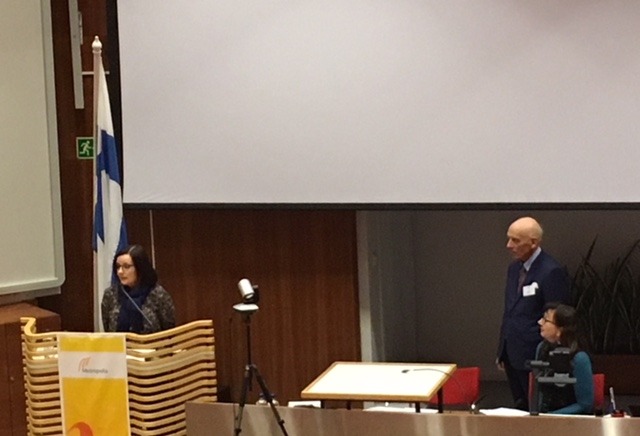
Saimme kuntoutusalalla olla ylpeitä, kun alumnitapahtumassa palkittiin parhaita Metropolia Master’s opinnäytetöitä ja yksi palkinnon saajista oli Taina Tolonen. Tainan työ ”Tsemppasi vieressä pikkuhiljaa eteenpäin”: osallisuutta mahdollistava nuorten aikuisten palvelu Nurmeksessa, löytyy verkkojulkaisuna: http://urn.fi/URN:NBN:fi:amk-2016112918107. Tainan työ ja puhe ilmensi alumnitapahtuman ydinviestiä toista ihmistä arvostavasta kohtaamisesta.
Tapahtuman keynote-puhuja, kestävän hyvinvoinnin asiantuntija Arto O. Salonen korosti sitä, että merkityksellisyys yksilölle syntyy aina suhteessa ympäristöön. Arto kysyikin esityksessään, onko kukoistavan yhteisön idea siinä, että paras meistä saa muut loistamaan ja yltämään omaan parhaaseensa?
Toivon, että kuntoutuksen koulutuksen tulevaisuudessa innostumme uuden oppimisesta kuten Branson, ja kuntoutumisen käytännöissä toimimme yhdessä kuten Litmanen, joka Arton esityksen mukaan pelaa muiden erinomaisuudet esiin.
Taitaakin olla niin, että onnen hetket kohtaa, kun huomaa auttaneensa toista ihmistä hänelle tärkeissä asioissa – kiitän Tainaa tästä.
Ja kiitos innostavan tapahtuman järjestäjille – nähdään ensi vuonna uudestaan!
Salla Sipari FT, yliopettaja
Kuntoutus ylempi amk tutkinto-ohjelma
Kuvassa: Taina Tolonen pitämässä puhetta, Metropolian tukisäätiön hallituksen puheenjohtaja Yrjö Blåfield ja Metropolian YAMK-tutkintojen kehityspäällikkö Marjatta Kelo kuulijoina.
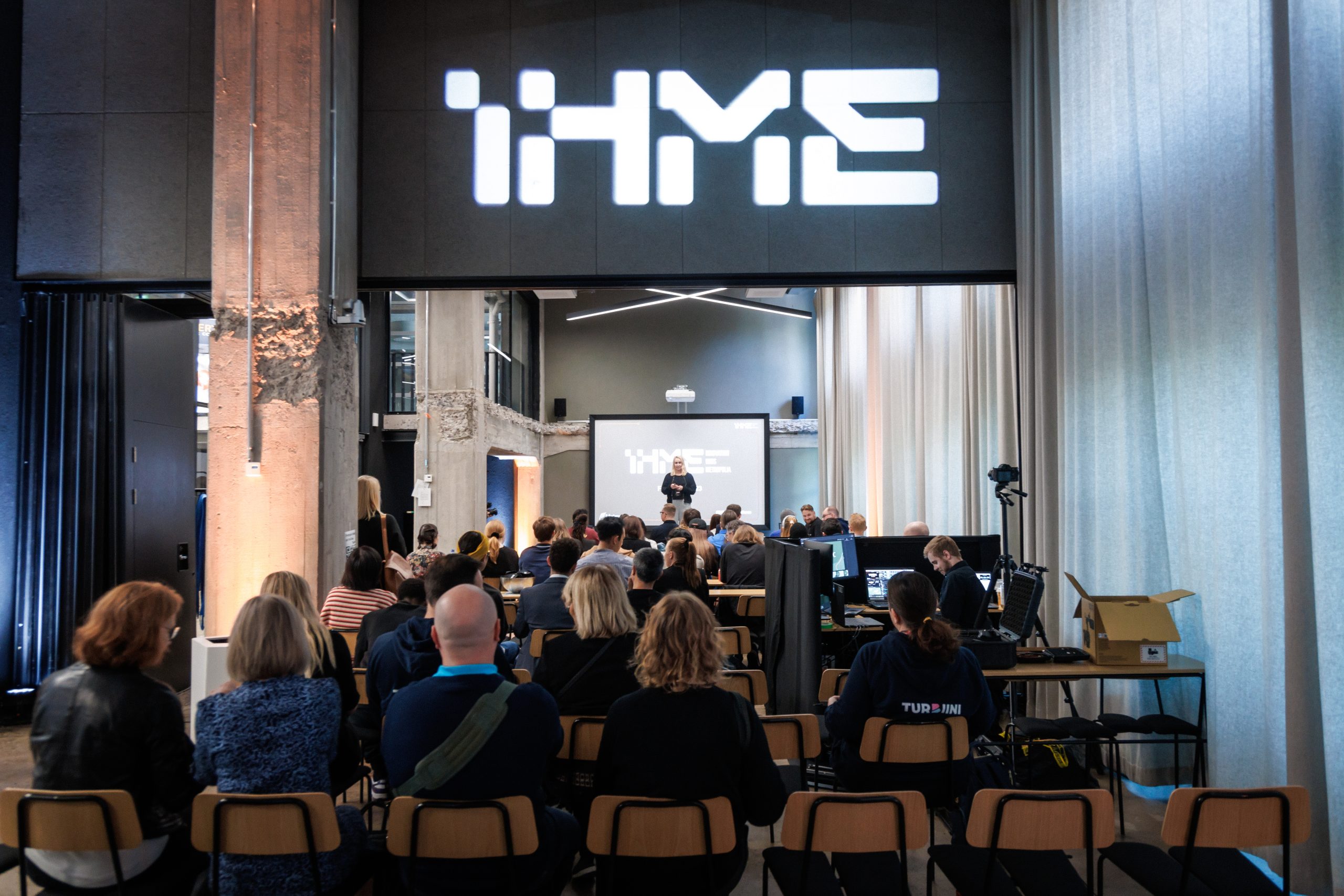
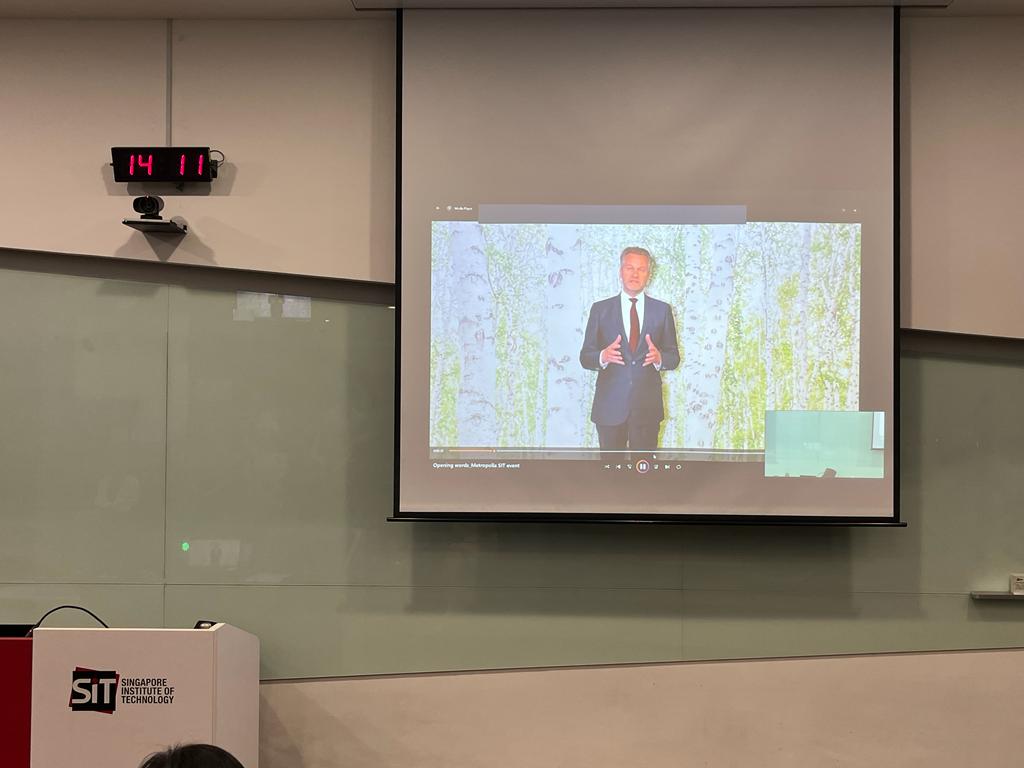
Already for the second time a workshop on the theme of advancing medical and health technologies in collaboration between Singapore Institute of Technology (SIT) and Metropolia University of Applied Sciences was organized in online-hybrid mode in Singapore on the 16th of August 2023. The workshop was opened by SIT Vice President Associate Professor Susanna Leong Su Jan who emphasized the importance of international collaboration in research and development in higher education institutions. The Ambassador of Finland in Singapore Antti Vänskä and Counselor for Education and Science Anna Korpi brought up similarities, strengths and challenges in Singaporean and Finnish societies, higher education and industry as well as the meaning and role of health technology in modern societies.
Overall, the focus of the workshop was on the role of technology in healthcare education and applied research in education and industry. Speakers of the seminar comprised Singaporean and Finnish public and private sector companies, health care organizations and higher education institutions.
Interesting speeches about health care innovations were delivered by Dr Mabel Yen Ngoc Nguyen, Co-Founder of Elocare Pte Ltd , Singapore, who spoke about Elocare’s mobile solution to manage menopause affecting women particularly in mid-life and Dr Darshan Kumar, Customer Success Manager, Aiforia (Finland) who shared about Aifora’s AI-based solutions for pathology image analysis. We also learned about modifying health through gut microbiome by Kaiyee Toh, Head, Laboratory and Research, AMILI, Singapore. The workshop also featured talks by Associate Professor Alfred Kow, Department of Surgery, and Dr Yujia Gao, Assistant Group Chief Technology Officer, both from the National University Hospital Singapore, who spoke about the need for liberalizing data flow by transforming data silos into a highly networked ecosystem and gave several use case scenarios on the use of AR/VR/AI for medical student education and staff training, which ultimately benefits patient care.
Finnish health technology company representants CEO Jouni Ihme from Innomentarium and Corporate Key Account Executive Ossi Koskinen from Siemens Heatlhineers highlighted the importance of health technology companies working together with higher education institutions’ (HEI) students, professors and researchers.
Citing CEO Jouni Ihme, “benefits of this kind of collaboration for health technology companies comprise having more resources such as HEI’s student’s and professors’ work participation for their research and development, access to HEI’s laboratory and other facilities needed for research and development as well as the scientific competence of HEIs for their use”.
The benefits of collaboration for the universities and their students comprise access to future health technology and research, possibilities to widen networks via health technology companies and advanced funding possibilities with health technology companies. For the students, collaboration with health technology companies give the possibility to study solving real life problems which motivates studying, getting familiar with health technology industries, possibility for internships and even workplaces after graduation.
Singapore and Finland are located far apart on the globe. However, with our previous collaboration since 2019, we have vastly similar outlook in vision and the important role of technology applied to the society. Principal Lecturer Eija Metsälä from Metropolia has previously stated, the text in the Finnish Act of the Universities of Applied Sciences about the pivotal role of Universities of Applied Sciences (932/2014) ‘’ to provide higher education for professional expert tasks and duties based on the requirements of the world of work and its development carry out applied research, development and innovation activities and artistic activities that serve education in universities of applied sciences, promote industry, business and regional development and regenerate the industrial structure of the region.’’ This is equally relevant to the Singaporean and global context.
Authors
Principal Lecturer, Docent Eija Metsälä, Metropolia University of Applied Sciences
Associate Professor Frank Guan, Singapore Institute of Technology
Assistant Professor Cheryl Pei Ling Lian, Singapore Institute of Technology
Associate Professor Cheow Wean Sin, Singapore Institute of Technology
Open innovation is when a company works in conjunction with an external group by opening up their business practices and data to create new solutions to business issues.
In 2021, the Helsinki Region was designated as a European Entrepreneurial Region (EER) and with this, Metropolia University of Applied Sciences took the opportunity to redesign one of their open innovation programmes to make it accessible by Small and Medium-sized Enterprises (SMEs). I came on board this project as a service design expert for two reasons, one to design the project according to service design methods, and two to provide the content expertise on the subjects - service design and the design sprint.
Facilitating open innovations in various forms
At Metropolia, one open innovation programme, 10 Days 100 Challenges (10D100C), has been running since 2018. The first three years of the 10 Days 100 Challenges event was designed as 10 full days with the learnings embedded in each day as the sprint progressed. The delivery of the event changed in 2020. It was transferred online, due to the Covid pandemic, and it was unfortunately canceled in 2021 at the last minute due to the same reason.
The European Entrepreneurship Region designation gave the opportunity for a re-think for the 2022 version of 10 Days 100 Challenges programme. It was decided that Small and Medium-sized Enterprises would benefit from the content that was taught during the event, but we understood that many would not be able to fully participate in the full 10-day event.
In order to make 10D100C programme accessible to the small and medium-sized companies, the teaching content was taken out of the event and made into an online course. By extracting the learnings, it makes them available to anyone who wants to learn about service design and improve their business development skills. This is why it has been built as a Massive Online Open Course (MOOC).
Creating a course everyone can access
A MOOC is a type of course that is created especially to be accessed by anyone who wishes to take it. That is the Massive and the Open part. Inevitably, to make it accessible to as many people as possible, it is also Online.
In this course, we have made it accessible at any time, meaning that there are no start dates or end dates. Participants do it at their own pace, starting and ending when they want. This type of course also requires the participant to be persistent and to finish under their own direction. This can be hard for some, but perseverance pays off with a new understanding of how to tackle business problems in a different way.
The development of the fully accessible course
The first part of creating this course was interviewing the leaders of SMEs. We focused primarily on companies with 5-20 employees but also interviewed slightly larger company representatives and other stakeholders. This research was to find out how much people know about service design and the design sprint methodology.
After the interviews, the first version of the course was created. It was from this Alpha version that we got internal feedback based on the content. From the feedback, there were some additions made to the content and further explanations made where it was necessary.
The Beta version of the content was tested in conjunction with the 2022 10 Days 100 Challenges event that took place May 30th to June 7th. The course was set as a prerequisite to attend the event. To make sure that everyone attending had a similar foundation of understanding in these methods.
The final version has been further developed on the feedback of the students who participated in the event. It has also been designed on the University of Helsinki MOOC Center’s platform. It will be officially launched and be open for anyone to take in April 2023.
Companies participating in the course
This course has been developed in a way that it is text-based, self-directed, and self-paced. This means that it there are no videos and one reason for this is that it is easy to update and respond to feedback. It is self-directed and self-paced because there is a deep understanding that those who are involved in small businesses or are entrepreneurs are very busy people.
The local small and medium-sized companies are also the least likely to have the time and money to take traditional professional development or human resources (HR) departments, which would organise training.
Author
Pamela Spokes works as a Service Designer in Metropolia’s RDI team. Originally from Canada, Pamela has years of experience in university admin focusing on international recruitment, marketing, and the international student/staff experience. With a Bachelor’s from Canada, a Master’s degree from Sweden, an MBA in Service Innovation & Design from Laurea, and her AmO from Haaga-Helia, she is interested in purposefully designed experiences that are centred around the user. Don’t be surprised if she knocks on your door to talk about learning co-creation methods through intensive learning experiences.Pamela Spokes







Kommentit
Ei kommentteja