
Web3 technology is fundamentally changing how creatives can monetize, connect with fans, and manage their content. Decentralized platforms, tokens, and smart contracts offer new ways to monetize, but they also challenge traditional intermediaries and business models. In this blog, I’ll explore how creatives can leverage the opportunities Web3 offers and new ways fans can participate in supporting and monetizing content.
Tokens: new concert tickets and fan clubs
From a revenue perspective, the core of an artist’s relationship with a fan is a token, which is a digital token. A token could be compared to a Linnanmäki amusement park ticket: you can’t get to the rides at an amusement park directly with euros, but by buying a ticket, you can get to the ride of your choice. In simple terms, a token is the digital equivalent of a single ticket, but in web3, the uses of a token are often more diverse, and their value can increase over time.
No middlemen: direct connection to fans
Traditionally, musicians have been dependent on major record labels and streaming services for the distribution of their music. This has often resulted in a significant portion of revenue going to middlemen: publishers, labels, agents, and other professionals who act as intermediaries between the artist and the audience.
With the new internet, decentralized platforms enable direct communication with fans without intermediaries. For example, platforms based on blockchain technology allow artists to publish their music directly to the public, while retaining full ownership of their works. They can use smart contracts to determine how the use of the work is regulated and how, for example, the revenue from sales is allocated to the music creators.
Traditionally, the connection with fans has been used as the basis for marketing: various mailing lists have been the basis for marketing, through which those who like the content created by the artist have been informed about new releases, for example. In the Web3 era, the role of the fan has been thought of differently: the fan is more of a partner than an object.
“Engage-to-earn” at the heart of the new fan culture
The engage-to-earn model is a new approach where both artists and fans benefit from active participation and interaction. In this model, artists can create digital tokens or NFTs (non-fungible tokens) that represent, for example, access to exclusive content, events, or other benefits.
Fans can earn these tokens by engaging in various activities, such as sharing the artist’s content, participating in discussions, or completing certain tasks. This creates a two-way relationship where fans receive rewards for their activity, and artists benefit from increased visibility and an engaged audience.
For example, in the music industry, Audius.co is a decentralized music streaming platform that aims to provide a fairer model for artists and fans compared to platforms like Spotify. The platform allows artists to release their new music directly to their fans without intermediaries and charges an introductory fee that gives the fan perpetual listening rights to the content.
The content comes with access to a fan club that offers direct interaction between artists and fans. For example, electronic music composer and producer Dave Tipper has released his music on the platform and offered fans $AUDIO tokens, which give access to, among other things, fan-only events and through them become part of the subculture created by fans.
Mirror.xyz, a platform for writers, allows content creators to publish their works. One of the platform’s successful experimenters was young author John Palmer, who wanted to publish an essay on his Mirror website. He sold tokens called $ESSAY, the proceeds of which were used to finance the writing of the essay. The agreement was that once the funding goal was reached, the essay would be published, and token holders would receive a share of something that could grow in value over time. The crowdfunded finished essay was sold on the online auction platform Zora. The proceeds were funneled back into the $ESSAY contract, increasing the value of each investor’s $ESSAY holding relative to the total value of the contract.
Decentralized financial services enable fans to participate as investors in artists’ projects. For example, fans can invest their funds in an artist’s new album or film project and receive a share of future revenues in return. This model utilizes smart contracts that ensure automatic and transparent profit distribution to both the artist and fans and other parties specified in the smart contract.
From fan to participant
In the Web3 world, fan participation doesn’t necessarily stop at the role of an investor. They can also participate in decisions related to the development of artists’ careers and financial success by joining decentralized autonomous organizations (DAOs). In these communities, fans acquire tokens that give them voting rights and the ability to influence the artist’s activities.
The Audius.co platform I mentioned earlier is governed by Audius token holders. These include both artists and fans. Token holders can vote on decisions related to the development of the platform, such as new features or terms of use. This model gives fans the opportunity to directly influence the operation of the platform and the visibility of artists, which can improve the financial opportunities of both fans and artists.
One of the DAOs for artists, creative professionals, and fans is the Friends with Benefits (FWB) community. Membership in the community is achieved by acquiring a certain number of FWB tokens, which grant both entry and voting rights in community decision-making. FWB functions as both a social club and a funding crypto community. FWB organizes various events and festivals for its members, combining music, art, and cryptocurrency-related discussions.
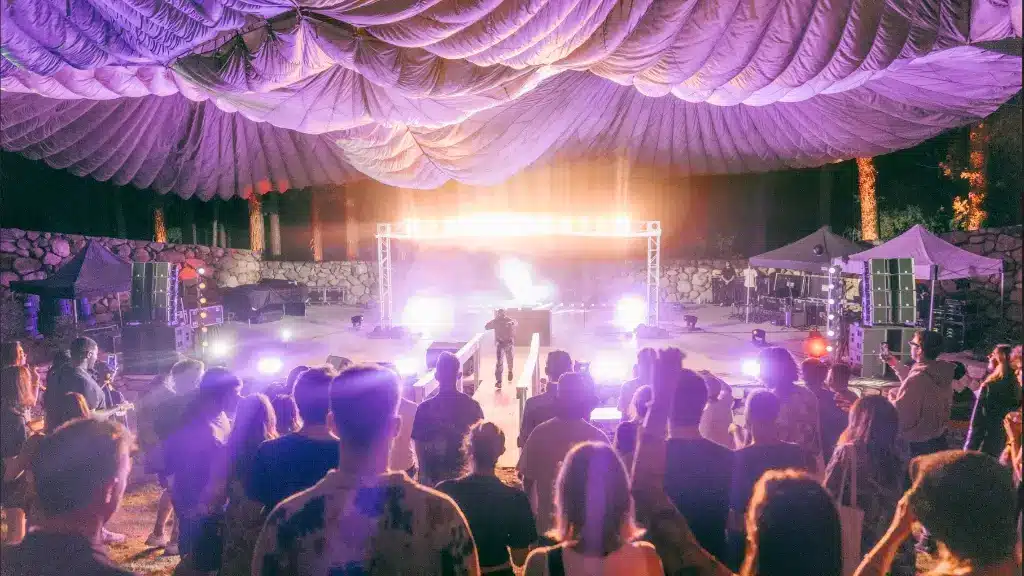
For example, the festival held in the summer of 2023 was open to members as well as a group of ticket holders (the ticket price was $399). The festival program included a diverse selection of speakers from technology to art. The event included a cinema, free generative art workshops organized by the NFT platform Highlight.xyz, yoga classes, DJ gigs, and a tennis tournament, where many participants dressed in all-white tennis attire. The educational speeches focused mainly on internet culture and in particular on the use of artificial intelligence in creative projects. In addition to the festival itself, the key benefit was a network of people interested in similar things, living as virtual and, at times, physical communities.
Through DAOs, fan participation can lead to deeper engagement and financial benefits for both fans and artists. Fans are given the opportunity to influence the direction of artists’ careers and financial success, and also to build activities that, in addition to inspiring content, promote networking and support the development of the creative industry.
Only need 1,000 fans?
In 2008, Wired magazine editor-in-chief Kevin Kelly introduced the idea of “1,000 True Fans,” which states that an artist only needs 1,000 dedicated fans to succeed. Since then, Kelly’s essay has been extensively updated and translated into many languages.
The starting point of the idea is that if fans spend $100 per year on the products of the artist they admire, the artist would achieve an annual income of $100,000. This amount was therefore thought to be transferred more or less directly from fan to artist. However, in reality, complex production chains and professionals from different fields challenge the 1,000 fan theory.
More and more artists can share their creations with the world at the touch of a button, enabling them to reach an ever-wider audience. They are drawn to the content, but also to the opportunity to interact with the creators of the creative content on a whole new level. But could the theory be reversed in the era of limitless digital communication, fueled by Web3? Could the reduction of intermediaries generate greater income for artists, or will the intermediaries simply change their roles while still receiving compensation for their professional contribution?
Web3 may bring the 1,000 real fans theory closer to reality. Cutting out middlemen and engaging fans can increase an artist’s earnings, but they don’t eliminate the need for brand building, community management, and marketing. While blockchain and tokens bring new opportunities, they don’t automatically make an artist successful – it still requires audience engagement and ongoing interaction. The future will show how well Web3 delivers on its promise for the creative industries: is it a revolution or just another development in the digital economy?
SOURCES
Borg, J. (2024). Superfans: Why They’re Vital for Artists in the Algorithm Era. Amplify World Resources 18.1.2024. https://amplifyyou.amplify.link/2024/01/music-superfans/
Fenton, W. (2023). What is Web3 for music & how is it changing the industry? Midder. The Future of Music News 24.11.2023. https://middermusic.com/web3-for-music/?utm_source=chatgpt.com
Fernandes, M.P. (2023). Crypto Clubs Throwing Summer Parties: Inside The Friends With Benefits DAO Festival. Forbes 10.8.2023. https://www.forbes.com/sites/digital-assets/2023/08/10/crypto-clubs-throwing-summer-parties-inside-the-friends-with-benefits-dao-festival/
fi.music396.com. Fanien sitoutumisstrategioiden mukauttaminen digitaalisiin alustoihin ja kulutustrendien muuttaminen (n.d.).https://fi.music396.com/topic/adapting-fan-engagement-strategies-to-digital-platforms-and-changing-consumption-trends/167277
Gottsegen, W. (2021). How Emily Segal Crowdfunded Her New Novel with Crypto. Deepdive Crypto profiles 24.2.2021. https://decrypt.co/68981/emily-segal-novel-crowdfund
Marco J.D. (2022). The Musician’s Guide to Web3. Mega Labs Article 6.7.2022. https://www.thelab.report/the-musicians-guide-to-web3/?utm_source=chatgpt.com
Nittolo, T. (2024). A Peek Into The Tipper Community. Audius blogit 21.11.2024. https://blog.audius.co/article/a-peek-into-the-tipper-community
Palmer, J. (2021). Using an Ethereum NFT to Crowdfund my Writing. Mirror.xyz 26.1.2021. https://j.mirror.xyz/OgVaYso25gEqxn7N4RyPnPbMO9pbNQJZQKEUvV9pxv8
Umana, D. (2024). Jack Harlow, Palaye Royale, and other music artists are using blockchain to connect with fans — and build profitable online communities. Business Insider TECH 16.2.2024. https://www.businessinsider.com/music-platforms-blockchain-artist-create-fan-clubs-communities
Katri Halonen (Metropolia University of Applied Sciences) works as a project manager in the LUME – Creatives in the web3 era project, co-funded by the European Union, which focuses on new revenue models in the creative industry.










Comments
No comments