
Avainsana: Sharing economy
Older employees open up a new horizon in service work

Where to get help with children and house work, if you are a busy professional? Who to ask for help? Where to get reliable help? Where one can offer own help, if there is a wish to help others? - These questions were at the center of many student projects in “Service design” course held at the Summer Business School-2019 at Metropolia UAS. A Finnish service enterprise, Onnexi, was invited to the course as a successful example of an enterprise solving this puzzle. Challenges of a busy professional This summer Master’s students participated in “Service Design” course where student teams conceptualized own ideas for new or improved services. Not surprisingly, most of the students - who work as employees for companies and study alongside full-time work - were keen to explore and design daily services that they urgently need yet missing in their own lives. Young mothers proposed a service concept for a platform to contact other mothers for exchange of free babysitting services. Parents of school children proposed improvements to WILMA. Those who experienced long queues in hospitals proposed improvements to emergency visit notifications and queuing. The project that found most interest, however, was an imaginary service of “Buying & selling time”. The proposal was to launch a service platform where clients can ask for and find almost any services that a family may need - starting from organizing a children’s birthday, looking after a child or an elderly person, and up to lawn mowing, or carpenter work. Busy professionals admit that this type of service is highly needed yet missing in their lives! To address this interest, a special guest, Onnexi Oy, was invited to the course and share their know-how in this service area. Onnexi.fi - a Finnish example of solving a “busy professional” problem When looking for a real example of such a “buying and selling time” service, one can be surprised that it is almost missing or extremely scarce in Finland. This also struck attention of Ulla-Maija Soininen, now CEO of Onnexi Oy, when she herself was in search of a similar service. Ulla-Maija, not long ago an employee of KONE and a specialist in industrial process development, was in search of helping hands to look after her lonely mother who lived in Northern Finland, a long way away from Hyvinkää. No one in the family lived in the North anymore, and no search for a reliable aid could help Ulla-Maija to solve this puzzle. Ulla-Maija, with her background in process development, invested a great deal of her time to conduct a systemic search only to discover that there is no one to help her. It soon became evident that, if she wanted to get help, she would need to organize such a service herself. After some deep thinking and attending short-time entrepreneurial courses, Ulla-Maija decided to bravely try and start her own service enterprise, firstly in small steps, alongside her main work. As many other entrepreneurs, Ulla-Maija soon discovered that her project takes much more time that she expected, but it also started becoming more and more important to her as her true heart was put into the job. Knowing the global trends for ageing population (1), and the Finnish trend for more unemployment in the older groups (2), Ulla-Maija decided to match the needs with the demand - and base her service on the most reliable employee group, the older people themselves. Services by older employees As she tells herself, Ulla-Maija never previously suspected that there are so many active, motivated, physically well-fit retirees, who are looking for a meaningful job, which they can do excellently. Being a busy professional herself, she was on the other side of the puzzle for most of her life. Now, when she discovered her own new meaning in life, Ulla-Maija decided to focus fully on her service idea. She finds great joy in helping to match the right people - those who are full of energy, experience and motivation to help, with those who are in need of help and have multiple tasks at their hands. As for the client base, the picture has turned out to be not so black and white as it was initially expected. The older age groups also make a big client segment themselves - for the household routines, cheering-up visits, help with IT and use of tools, and nowadays even for professional medical services by the older nurses! This latest demand came as a surprise for Ulla-Maija as a client organization turned to Onnexi for help. Onnexi was able to provide them with older nurses. Following this success, more and more organizations are now turning for help to Onnexi’s older workers. Currently, Onnexi, a Finnish enterprise that operates in Kanta-Häme, Turku, Pori and Tampere, offers services provided by the older age groups to families and other elderly. In other words, Ulla-Maija was able to realize her dream and successfully launched a new service, where the support is provided only by the older-aged workers. The service offerings are now growing fast, and Onnexi started arriving also to other Finnish regions. Social entrepreneurship as a trend The trend for social entrepreneurship and business with meaning has grown visibly since early 2000s. It has become a popular topic in business literature, and the “social value” of business is now discussed by big business names such as Michael Porter (3). Business with a social meaning is now a well-recognized trend, and as an entrepreneurial activity it is often defined as “an innovative use of resources to explore and exploit opportunities that meet a social need in a sustainable manner” (Sud et al. 2009) (4). Social media and internet often serve as the main channels for promoting and selling such services, getting the word-of-mouth across, as well as for immediately publishing feedback and reviews, and thus providing a platform for both finding and offering social services. The business model by Onnexi seems to offer something that is yet new in Finland but somewhat familiar in other countries (such as a famous example of “German grandmothers”). In the case of Onnexi, the service seem to tap those sectors that previously were not considered for service work - the older workers domain, even for traditionally “younger” employment sectors such as nursing jobs. In addition to social entrepreneurship, this service idea can be considered from the perspective of Sharing economy, since it places the use of untapped resources at the heart. Offering better than Sharing economy: “Service Design” lessons of Master’s students Sharing economy is generally defined as a model to use the underused resources. “Sharing economy is the product of a new age where underutilized assets become peer-to-peer services for hire, enabled by the internet and smartphones”. (5) Thus, key ingredients in Sharing economy are: (a) identifying and creatively re-thinking the available resources for sharing, (b) use of service platforms. A though-provoking example from Onnexi shows how “the puzzle of a busy professional” can be approached via sharing of under-used resources. Moreover, another learning from Onnexi comes from solving “the Sharing economy puzzle”. (The Sharing economy puzzle is created by its two biggest concerns, trust and taxes, that come as a result of direct peer-to-peer sharing, and they bother potential customers very much). In both respects, Onnexi sets a unique example of solving these concerns and provider important learning for others in this sector. For Master’s students, the biggest learning came from inspiring deep reflection on the role of service design for conceiving successful services. While students in their imaginary projects had challenges in providing security for a free-access “Buying & selling time” service, Ulla-Maija approaches trust and security as the corner-stones of her service idea. Her service is designed in such a way that all workers at Onnexi are full-time employees, not volunteers. They make an indispensable part of the enterprise, all of them are well-known in Onnexi, and thus the clients can trust them. Ulla-Maija invests a lot of her time matching the talents and interests of her employees with the needs of the clients, with the aim of building long-lasting ties between the families and their aids. In other words, the sharing problems get solved! Regarding other learnings, this year’s service design projects showed a shift in student interest from developing industrial services towards testing out own service ideas, especially in social and shared services. As such, their service design projects focused on exploring the opportunities how to launch new service platforms, exchange baby-sitting services, make WILMA user-friendly, spent less times in hospital or hotel queues, and - especially frequently - how to get & offer reliable and safe help for homes and families. In Metropolitan area UAS universities, this growing trend has been recognized and recently turned into a new learning module “Sharing economy” based on 3AMK cooperation between Metropolia, Haaga-Helia and Laurea. (6) The learning journey will continue into a new, inspiring direction! ========================== About the authors Ulla-Maija Soininen is a CEO of Onnexi Oy that she founded to address a growing need for finding reliable help. Zinaida Grabovskaia is Metropolia’s instructor in Service Design and Head of Master’s programme in Business Informatics, who is welcoming innovative service businesses to share ideas with the students and learn together. References Bughin, J. and Woetzel, J (2019). Navigating a World of Disruption. McKinsey Online. Yle uutiset, Lahti, 28.8.2019. Väestö ikääntyy ja työttömyys kasvaa – Lahdessa huollettavien osuus väestöstä lisääntyy. Driver, M. (2012). An Interview with Michael Porter: Social Entrepreneurship and the Transformation of Capitalism. Academy of Management Learning & Education, Vol. 11, No. 3, 421–431. Sud, M., Van Sandt,C.V., and Baugous, A. (2009). Social Entrepreneurship: The Role of Institutions. Journal of Business Ethics, 85: 201-216. Paajanen, S. (2016). Business-to-Business Resource Sharing: White Paper. VTT: Business Innovation & Foresight. - Definitions of Sharing Economy. A New Learning Lane: Circular Economy for Sustainable Growth 15 credits (5.11.2019). Onnexi Oy Facebook LinkedIn Metropolia’s Summer Business School
We are in sharing business for 35 years already
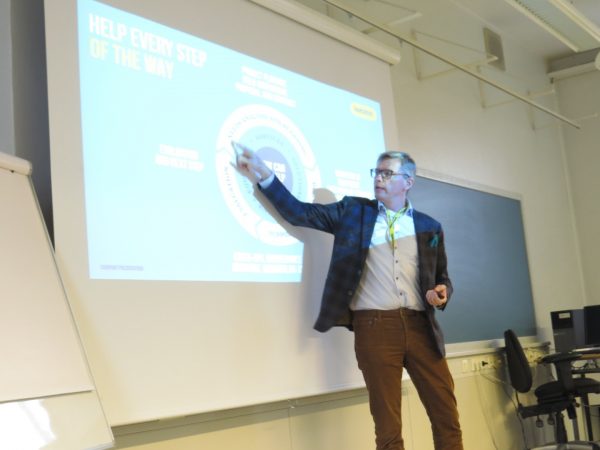
By Mikael Kämpe & Zinaida Grabovskaia Sharing economy gets more and more popular today. Sharing of assets safes money and frees the capital to concentrate on core competences of businesses and people. RAMIRENT is one of biggest and oldest Finnish companies that focuses on machinery and equipment, and rental of professional equipment. Nowadays, Ramirent is also famous for multiple services related to construction, industry and even to big events! Mikael Kämpe, Executive Vice-President of Ramirent Finland, visited the Industrial Management Master’s program and talked to students about the art and craft of providing services. Our business is making a safe construction place Ramirent, a leading Finnish company that is now also very visible in Europe, was established in 1955. In 2017, annual net sales reached 191,5 MEUR in Finland (Group 724M€). Ramirent is a market leader in Finland, Baltics, Norway, Poland, Czech and Slovakia, except in Sweden and Denmark. The main customer of the company is construction business, as well as the companies and sites that resemble construction, for example, shipyards and big events. Our main business is to make a safe construction place. But we are not a building company. We provide equipment, know-how, services, and customized services for construction sites. In services, our core focus is on a wide range of equipment rentals. In Finland, appr. 40% of our business relate to services, and we tend to focus more on services combined with our equipments. We have developed a ‘One-stop-shop’ offering for machines and equipment. This includes renting the light machinery, heavy machinery, and also more complicated rental services - safety equipment, scaffolding, tower cranes (here, we are second in Finland), hoists, power and heating, lifts, renting modules for construction workers, etc. In addition, our services include planning for temporary sites, site services, training, logistics, and fuel services. These services make appr. 40% of our business in Finland. One example of Ramirent’s recent projects is Tripla in Pasila. We are a ‘one-stop-shop’ supplier and partly run the site logistics for this project. We also provide a lot of temporary solutions, such as scaffolding and weather protection services (heating, moisture protection, etc), since we have very challenging weather in Finland. Under our scaffolding system that covers the building, the workers can do their work even in rain and snow. Currently, construction is booming. The growth is visible especially in the capitals and big university cities. There is also a rising number of small construction companies. As a result, the competition is getting tighter. Also, the demand for equipment is changing quite fast. European regulations always tighten the level of safety and emissions and thus tell us what equipment to use. As a result, construction sites become more and more complex, especially for big companies. Focus on people as the biggest asset To help our customers to run a construction site, we start with (a) the needs analysis and planning, continue to (b) delivery and support, and end with (c) evaluation when the equipment comes back. Upon the machinery return, we check, refill, clean it, and also fix it, if necessary. For fixing, we send the equipment to specialized hubs. We have currently 58 customer centers across Finland and specializing hubs for different types of equipment. Based on our experience, it helps if maintenance is centralized. Another reason for the hub structure is the logistics of spare parts, and having all similar equipment in one place. Whatever we do, we always focus on people as the biggest asset. And the general trend is that we take better and better care of people. Interestingly, equipment rental business is a unique area where Finnish companies are the biggest in Europe. In addition to rental services, we also developed a digital platform RAMISMART. Länsimetro, for example, uses this system. One part of it is ‘Time and Attendance’ which tell how many people are on the site, and to the tax office which workers and companies are working. After having this system for a couple of years, we started thinking what else we can do with it and launched ‘RAMISMART Machine Control’. With this system, we can follow who is using the machine and authorize the access to it. The big data is not yet utilized, equipment is not yet speaking with each other, but this is definitely the future. Big events as a new service area Finally, big events has recently become a customer for our services. As big events require temporary infrastructure - quite like a big construction site - we started providing rental services for big events. For example, we built the infrastructure, temporary stores and shops, change rooms, fences, scaffolding, etc. for such events as Flow Festival, Tall Ships Race and Helsinki Ice Challenge in Kaisaniemi. In 2018, appr. 150 events have been conducted this year only. This service started as a marginal activity but now has grown into a larger business. Thus, do not be surprised seeing Ramirent when going to a festival. This is not a coincidence but a new service area for a company that has know-how and competences in managing equipment, logistics and services for big sites. The text is based on Mikael Kämpe’s presentation materials written by Zinaida Grabovskaia. Mikael Kämpe Executive Vice-President of RAMIRENT Finland Oy and a guest speaker on developing service business in Industrial Management Master’s studies Zinaida Grabovskaia Senior lecture, Head of Master’s program in Industrial Management, Metropolia. The program specializes in service business especially for big industrial players.

The editorial team will provide the content of the Masterminds blog before publication.
The editorial team started its work at the beginning of 2022.
Pia Koirikivi, chief editor in Masterminds blog, Pedagogical Specialist
Minna Kaihovirta, Manager of Dialog
Iira Lankinen, Principal Lecturer
Riikka Wallin, Publications Specialist
Zinaida Grabovskaia, Senior Lecturer
Salla Kivelä, Principal Lecturer
asiantuntija yamk business informatics Business Informatics Master’s Program CERN Bootcamp Construction Business hankinnat hankintastrategia hankintatoimi ilmastonmuutos Industrial Management Industrial Management Master’s program johtaminen koulutus kulttuurituotanto Marjatta Kelo master Master's Thesis masterminds Masterminds blog Master of Engineering Master’s degree Metropolia Metropolia AMK Metropolia Master's Metropolia UAS metropolia YAMK opinnäytetyö osaaminen service design Sharing economy sosiaali-ja terveysala sosiaaliala study trip Sustainability talotekniikka terveyden edistäminen terveydenhuolto työhyvinvointi ura yamk YAMK-tutkinto YAMK opinnäytetyö ylempi AMK ylempi ammattikorkeakoulututkinto Zinaida Grabovskaia
