
Miten johtaa luovasti? Oivalluksia Mahdollisuuksien maisemia -tapahtumasta, osa 2.
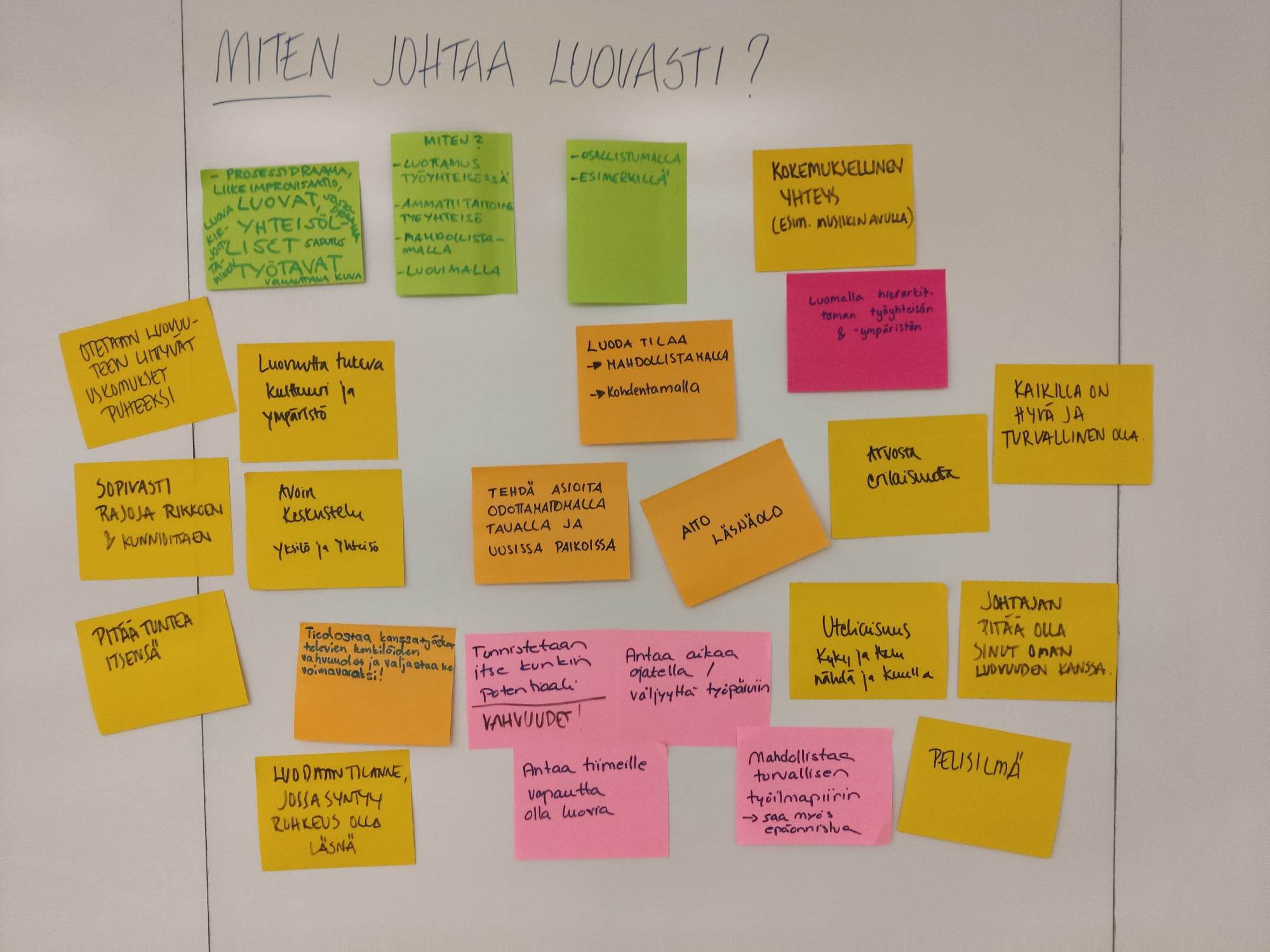
Tulevaisuus tuo eteemme tilanteita, joissa emme ole aiemmin olleet. Näiden meille täysin uusien ongelmien ratkaisuun tarvitsemme ihmisiä, jotka osaavat ajatella eri tavalla, luovasti. Kun emme pysty työhön ryhtyessämme kuvittelemaan lopputulosta kovin tarkasti, olemme luovan työn äärellä. (Pölönen 2019) Miten voimme johtamistyössä toimia luovasti niin, että haasteisiin löydettäisiin uusia, toimivia ratkaisuja? Metropolia Ammattikorkeakoulun järjestämässä Mahdollisuuksien maisemia -tapahtumassa kokoonnuimme pohtimaan yhdessä monialaisen opiskelijajoukon sekä työelämän edustajien kanssa kahta kysymystä: mitä on luova johtaminen ja miten johtaa luovasti? Tässä kirjoituksessa koostamme ajatuksia työpajan jälkimmäiseen kysymykseen siitä, miten johtaa luovasti. Voit lukea siitä, mitä on luova johtaminen blogikirjoituksen osasta yksi. Työpajaan osallistuneiden mukaan luova johtaminen edellyttää johtajan omaa itsereflektiota ja itsetuntemusta, organisaation luovuuden esteiden ja mahdollisuuksien tunnistamista ja muokkaamista sekä luovuutta tukevien rutiinien ja resurssien viljelyä organisaation arjessa. Luovuus vahvistuu johtajan itsereflektiosta Kouluissa oppimamme oikean ja väärän vastauksen ajatusmalli tukahduttaa ajattelua, ja siten myös luovuutta. Kun palkitaan oikeasta vastauksesta, siirtyy tavoite oikean vastauksen löytämiseen ratkaisun löytämisprosessin sijaan. Kuitenkin tulevaisuuden haasteiden ratkomisessa tarvitaan improvisointia ja nimenomaan keskittymistä luomisprosessiin, sillä ratkaisuja ei vielä tiedä kukaan. (Pölönen 2019) Luova organisaation johtaminen edellyttää siis kriittistä ajattelua. Myös työpajan osallistujat toivat esiin tarvetta ravistella erilaisia uskomuksia luovuuden rattaista. Erityisesti nostettiin esiin johtajan omaa itsereflektiota luovuuteen liittyvistä ajatusmalleista. On tärkeää, että johtaja itse on sinut oman luovuutensa kanssa ja toisaalta malttaa myös kuunnella muiden ajatuksia, olla niille utelias. Se, että johtaja tuntee itsensä ja aidosti arvostaa ja hyödyntää organisaatiosta löytyvää erilaisuutta, on luovuuden reunaehto. Osallistujat toivat esiin myös johtajan kykyä nähdä luovuutta ympärillään, sillä se, mihin kiinnitetään huomiota, vahvistuu. Johtajan omat vuorovaikutustaidot ja “pelisilmä” ovat luovan organisaation ytimessä, sillä luovuuttakin tulisi johtaa esimerkillä. Luovasti johtavan tulee sietää epämukavuutta, siksi keskustelua itsensä kanssa on hyvä käydä myös esimerkiksi omasta epävarmuuden sietokyvystä, taidosta “luovia ja kulkea reunalla”. Luovasti johtava on läsnä, samaan aikaan rento ja skarppi. Hän on valmentava johtaja, joka ei pelkää tehdä virheitä myös itse. Luovasti johtavan oma mieli on joustava ja hänen kontrollin tarpeensa ei tukahduta organisaation luovuutta. Johtaja voi edistää tai estää luovuutta Tulevaisuudessa niin työpaikkojen kuin koulujenkin tulisi olla luovuuden katalysaattoreita. Yksilön luovuuden tulisi olla vahvempaa työ- tai kouluputken lopussa kuin mitä se oli sen alkaessa. (Pölönen 2019) Lisäksi organisaatiot, jotka keskittyvät olemassa olevien tuotteiden muokkaamiseen uuden luomisen sijaan näyttäisivät pitkällä tähtäimellä häviävän niille organisaatioille, jotka pystyvät tuottamaan kokonaan uutta ja ennen näkemättömiä ratkaisuja (Fernandez-Pol ja Harvie, 2020) Siksi ei ole yhdentekevää, miten luovuutta tuetaan ja johdetaan organisaatiossa esimerkiksi rakenteilla ja resurssien kohdentamisella. Luovuus edellyttää vapautta ja autonomiaa, mutta myös tukea (Liikanen, 2022). Työpajoissa organisaation luovuutta tukeva, tai tuhoava, kulttuuri nousi esiin monissa kommenteissa. Johtajan tehtävänä on suojella luovuutta ja edistää sen asemaa sekä organisaation kirjoitetuissa että kirjoittamattomissa säännöissä. Luovasti johtava kykenee ottamaan puheeksi luovuutta estäviä uskomuksia sekä muita “jäävuoren pinnan alla” olevia luovuuden esteitä. Luovuus vaatii myös oikeanlaista ilmapiiriä: avoimuutta, luottamusta ja turvallisuutta. Luovan johtajan keinovalikoimaan kuuluu siis myös turvallisuutta luovat, riittävän matalat organisaation rakenteet ja vaikkapa kyky fasilitoida turvallisia kohtaamisia yhteisten ongelmien äärellä. Luovuus syttyy kunnioituksesta ja arvostuksesta. Luovasti johtava valtuuttaa tiimit ponnistelemaan, mutta ei jätä heitä yksin. Organisaation rakenteiden tulee tukea riittävää autonomiaa ja vapautta. Mikromanagerointi, tiukka kontrolli ja etäiseksi jäävä johtaminen tukahduttavat luovuuden. Organisaatiossa tulee olla ymmärrys siitä, että ilman virheitä ei synny uutta. Siksi sinnikkäistä ratkaisuyrityksistä tulisi saada kiitosta, vaikka tulos olisi vielä epävarma. Osallistujat kannustivat organisaatioita yhdessä määrittelemään, mitä luovuus tarkoittaa juuri meidän organisaatiossamme. Mitä sillä tavoitellaan ja miten sitä edistetään? Luovuutta tukevat ratkaisut ja resurssit tulee tuoda jokaisen yksilön arkeen saakka. Jos vaikkapa työaika on täynnä kiireellisiä tehtäviä, ei luovalle ajattelulle jää aikaa tai energiaa. Luova johtaja rakentaa myös rutiineja ja tarjoaa välineitä Jokainen meistä on luova, mutta toiset kokevat itsensä vähemmän luoviksi. Luovuus on loppujen lopuksi kykyä tehdä valintoja, taitoa valita tuhansien ratkaisuvaihtoehtojen joukosta ne parhaat. Tähän tarvitaan intuitiota. (Pölönen 2019) Kääntäen voisikin ajatella, että luovasti johdetussa organisaatiossa ongelmanratkaisuprosessi tuottaa Pölösen mainitsemat ratkaisuvaihtoehdot ja varmistaa, että niistä seulotaan parhaat. Silloin keskiöön voisivat nousta rutiinit, joilla ratkaisuvaihtoehtoja tuotetaan rikastavasti ja ennakkoluulottomasti. Ja toisaalta ne työkalut, joilla päätöksiä tehdään intuitiota sekä ongelmanratkaisun reunaehtoja kuunnellen. Luovuus nimittäin aktivoituu silloin, kun välineet, resurssit ja aika ovat rajalliset (Pölönen 2019). Tiukoissa aikaraameissakin voi olla luova (Liikanen, 2022). Työpajan osallistujat toivat esiin runsaasti erilaisia luovuutta tukevia resursseja, menetelmiä, välineitä ja rutiineja. Todettiin, että luovuus vaatii aikaa ajatella ja väljyyttä myös johtajan työpäivissä. Luovuutta tukee, kun asioita päästään pohtimaan yhteisöllisesti, vaikkapa erilaisten osallistavien menetelmien kautta. Ripaus taidelähtöisyyttä tuotiin myös johtamistyön avuksi luovuutta ruokkiviin kohtaamisiin: sosiodraamaa, musiikkia, voimavaraistavia kuvia, luovaa kirjoittamista. Osallistujat muistuttivat myös, että välillä myös ympäristön vaihtaminen voi toimia luovuuspurskeena ja, että toisinaan kannattaa johonkin tilanteeseen tai prosessiin soveltaa odottamattomia tapoja. Luovuus syttyy innostavista yllätyksistä. Luovasti johtava tekee tietoisia valintoja Työpajojen pohjalta nousee mieleen erityisesti yksi kiteytys: Luova johtaja tekee tietoisia valintoja niin, että luovuus mahdollistuu ja vahvistuu organisaatiossa sekä sen yksilöissä. Tämä on tärkeää paitsi yksilöiden hyvinvoinnin kannalta, myös organisaation menestymisen näkökulmasta. Reaktiivinen haastavien ongelmien ratkaisu vaatii luovuutta, mutta todellinen happotesti organisaation luovuudelle on vaikeasti ennakoitavien tulevaisuuden tilanteiden hallinta – ja toisaalta hyödyntäminen. Luovasti johtavalla näyttäisi olevan eväitä tarttua näihin kaikkiin. Mitä yhteisessä keskustelussa opimmekaan? Työpajojen pohjalta syntyi vahva ymmärrys siitä, että luovuutta johdetaan esimerkin kautta. Luovuuden esteitä poistetaan tarkastelemalla sekä omaa että organisaation ajattelua, asenteita ja toimintaa kriittisesti. Rakenteet, rutiinit ja työkalut tukevat luovaa johtamista silloin, kun ne on valittu tietoisesti juuri luomisprosessia silmällä pitäen. Luovasti johtava osaa myös ajoittain yllättää ja haastaa organisaatiota. Kirjoittajat Raisa Varsta (KTM, työnohjaaja, opinto-ohjaaja) toimii Metropolian tutkinto- ja tiimivastaavana sekä kouluttaa ja kirjoittaa oppimisen ja työelämän moninaisista teemoista. Heidi Stenberg (KM, Tuotekehittäjä EAT, Th) on Metropolian projektipäällikkönä ja lehtorina toimiva johtamisen kehittäjä, koulutusalan moniottelija ja terveyden edistäjä. Lähteitä ja luettavaa Fernandez-Pol Jorge Eduardo ja Harvie Charles, 2020. Understanding the Creative Economy and the Future of Employment. Springer Singapore. Liikanen Minna, 2022. Miten organisaatioissa voidaan edistää luovuutta? Boardman. Blogi Viitattu 11.11.2022. Pölönen Perttu, 2019. Tulevaisuuden lukujärjestys. Otava.
“Looking people in the eye & recognizing myself in them”

In healthcare, professional interaction skills are needed not only in patient contacts but also when working in interprofessional teams. Team members have different backgrounds, and they might have different understanding of how to work together. This underlines the importance of clear communication and teamwork. (Schmutz, Meier & Manser 2019.) Communication plays an important part in developing collaboration in teams and in the development of interprofessional empathetic relationships (Adamson et al. 2018). Already from the beginning of the studies, Metropolia UAS`s Degree Programme in Nursing Curricula (Metropolia UAS 2022) requires the student to grow their understanding about the significance of ethics and professional interaction, and consider patient’s needs for psychosocial support. The students also need to practice working methods considering patient safety and the significance of professional interaction. As a Metropolia master`s student in the Creativity and Arts in Social and Health Fields degree programme, I had an opportunity to instruct a teamwork and communication workshop using drama-based exercises. Drama-based exercises and games may be used to warm up, introduce and practice new skills, improve concentration and have fun. A recent literature review by Jeffries et al. (2021) brings out the ways how drama can support student learning and professional development. Drama-based working methods can enhance empathy, emotional engagement, and empowerment, also increase understanding of one’s own professional identity, self-awareness, self-reflection and improve communication skills. In addition, using drama can develop reflective skills. There is strong evidence of the positive role of the arts in improving health and wellbeing. A review conducted by the World Health Organization summarizes evidence from more than 900 such studies (Fancourt & Finn 2019). Drama-based workshop The three-hour drama-based workshop was conducted with international students in the advanced phase of the Degree program in Nursing, with two Metropolia nursing lecturers observing. The workshop consisted of exercises and reflective discussions. The discussion topics included teamwork interaction, communication skills and presence as key factors related to patient safety behaviour and empathy in healthcare. Students experienced the workshop as very important and useful, fun, stress relieving and they got their minds rested. They felt the atmosphere was safe and it was meaningful to hear others` thoughts, have good discussions and to connect with fellow classmates. As they expressed it, the workshop gave them: “Awareness of yourself and others”, “What wasn`t said with words was felt”, “Thank you for making me feel better”, “I feel relieved and fresh”, “The workshop was really great and it is one way to connect with our fellow classmate and hopefully it will be the same in the future”, “It helped me get comfortable with my classmates”, “Engagement between teacher and other classmates”. As take-home messages, elements taken into studies and work, the students mentioned the need for practicing good listening and acknowledgement skills in conversations with colleagues and patients: “Closed-loop-conversations with colleagues & patients”, “Communication is a key to have on successful outcome of the situation”, “It`s about how I focus”, “Repeating messages & hearing to confirm”, “Importance of communication (effective), importance of listening to self and others, trust”. The importance of eye contact and touch in human connection were mentioned several times as very meaningful techniques in communication: “The importance of human connection and touch”, “Eye to eye contact seems so simple but gives connection to someone”, “That human contact holds more importance than I thought originally”. In addition, the students found tips for releasing stress and better concentration. As they expressed it: “There is a touch that makes us feel that today is gonna be okay so just breathe and relax”, “Staying calm and staying focused”. Based on feedback this workshop was well accepted and beneficial. The exercises seemed to foster teamwork and communication skills and evoked thoughts about empathy. The students wished the workshop to be regular. However, it is important to keep in mind, that this kind of activity may not be comfortable for everyone. Interaction and teamwork exercises are beneficial Two Metropolia nursing lecturers were observing the workshop. “During the workshop, the students threw themselves into the exercises and learning seemed to be both fun and relaxing, but at the same time thought-provoking and insightful. We see the importance of interaction and teamwork exercises when studying to become a nurse. Our students are in the graduation phase, so the timing was suitable for this kind of exercise. The workshop sparked a lot of discussion among the students and based on the feedback given to us, they found the exercises very useful. Minna-Maria had a calm but at the same time inspiring and encouraging way of guiding the workshop, and the students clearly liked the experiential learning method.” The workshop also became a significant learning experience for the organizers, and they were glad that their activity was well received and appreciated. It made a milestone also for them as future professionals. References & interesting readings Adamson, K., Loomis, C., Cadell, S., & Verweel, L.C. 2018. Interprofessional empathy: A four-stage model for a new understanding of teamwork. Journal of Interprofessional Care. 2018 Nov; 32(6), 752-761 Metropolia UAS 2022. Degree Programme in Nursing, Curricula 2022-2013. Study guide. https://opinto-opas.metropolia.fi/88094/en/108/70308?lang=en Dehnavi, M., Estebsari, F., Kandi, Z.R.K., Milani, A.S., Hemmati, M., Nasab, A.F., & Mostafaie, D. 2022. The correlation between emotional intelligence and clinical competence in nurses working in special care units: A cross-sectional study. Nurse education today 2022, Vol.116, p.105453-105453 Fancourt, D. & Finn, S. 2019. What is the evidence on the role of the arts in improving health and well-being? A scoping review. Health Evidence Network synthesis report 67, WHO. https://www.euro.who.int/en/publications/abstracts/what-is-the-evidence-on-the-role-of-the-arts-in-improving-health-and-well-being-a-scoping-review-2019 Jefferies, D., Glew, P. Karhani, Z., McNally, S. & Ramjan, L.M. 2021. The educational benefits of drama in nursing education: A critical literature review. Nurse Education Today Volume 98, March 2021, 104669 Raatikainen, E., Rauhala, L. A., & Mäenpää, S. 2017. Qualified Empathy. A key element for an empowerment professional. Sosiaalipedagoginen aikakauskirja, 18, 113–21 Schmutz, J.B., Meier, L.L. & Manser, T. 2019. How effective is teamwork really? The relationship between teamwork and performance in healthcare teams: a systematic review and meta-analysis. BMJ Open. https://bmjopen.bmj.com/content/9/9/e028280 Writer Minna-Maria Mattila, Metropolia master`s degree student I work at medical students` skill lab at University of Helsinki Faculty of Medicine. I also work as part-time entrepreneur in arts-based workshops. I have a degree in nursing (RN, BN) and I have studied drama education to support arts-based activities. I have a long experience and studies in the field of performing arts. Students and lecturers have given permission to use comments and quotes. The Master's degree in Creativity and Arts in Social and Health Fields (CRASH) provides strong competences to act as a developer, innovator, expert, and leader in using creativity and arts in various operating environments in social and health fields. It also gives competences to work in expert positions in the social and health sector. Creativity and different ways to express it, as well as cultural activities and arts related experiences, belong to all people as part of a good and meaningful life. The aim of CRASH is to strengthen the professional competences needed when promoting health, well-being, inclusion, and a sense of community in society through creativity and arts. You can read more about the programme here
Going for a semester abroad to Finland

My name is Lorena, and I am a 2nd year Master´s student at Stuttgart Technology University of Applied Sciences, Germany (HFT Stuttgart, 2022), studying Business Psychology on the Master´s level. I will share my experience from last winter when doing my exchange semester at Metropolia University of Applied Sciences in Helsinki, Finland. In this blog, I will tell about my semester abroad and give my insights about the preparations. How I decided When starting my Master´s studies in 2020, I already decided I wanted to go abroad for one semester and study in a foreign country. Luckily, my university has many partners all over the world, - with Metropolia University of Applied Sciences being one of them, - and it made the whole process of going for an exchange semester here quite easy. The main reasons for choosing Finland and Helsinki as my destination were three: 1) I wanted to study in English and in a relatively big city 2) I wanted to study at one of the partner universities to avoid study costs via the European Erasmus+ program (The European Erasmus+ program, 2022) 3) I wanted to move to a country and get to know a culture where I have never visited before, and that was Finland! So, I started the preparations. First, I applied for an exchange at my home university. When the acceptance e-mail arrived, I was the happiest person and felt like I could start my semester abroad right away. But as with every big change in one´s life, a move to another country takes time and good preparation, so I started to organize myself. Preparations before departure The most important aspects were probably the accommodation and the correct course enrollments at the Finish university, as well as the procedure with everything you leave behind when leaving for six months. The first decision for me was the one about the housing: Do I want to have my own apartment, or would it be fun to share a flat with other students? Is it important for me to live in the city center or do I want to find a cheap accommodation in the outskirts? Those were the main questions to think about before applying for any kind of housing. In the end, I decided to use the easy and affordable option of applying for a room in a shared flat from HOAS, and I was surprised and happy how easy this process was. Now, after more than three months here in Finland, I am sure that choosing to live in a HOAS apartment was the right choice for me. I really enjoy living with other students and get in touch with internationals from all over the world. Additionally, I appreciate the short distance to the campus and the opportunity to book the sauna for free! The second issue I had to think about was the handling of my room at home. I had to decide whether I want to sub-rent my room in Stuttgart or cancel the rental agreement completely. In any case, I needed to make sure that all my belongings were stored safely during the six months I would not be home. Luckily, I could sub-rent my room with all the furniture and store my other belongings in my mom´s place, so that I didn´t have to rent a storage. Another matter I had to keep in mind was my status at my home university. At my home university, I needed to pay the semester fee, and everything went on as usual. But in any way, I recommend checking the regulations carefully to always make the correct enrollment at home uni. As I am doing my semester abroad within EU, I can benefit from a lot of privileges I have as an EU citizen. For example, I do not need to worry about my visa, my health insurance, or my phone contract, as I can just use all my German contracts and they work in Finland without any additional costs. Meeting other students from all over the world showed me how much extra work many students from non-EU member states had in comparison to EU citizens. So, if you plan to leave Europe (or come to Europe from another continent), you should start very early with various preparations. Another important topic was the selection of the courses I wanted to attend in Finland. I was able to choose from a selection on the exchange website (I needed to attend at least 5 courses). This is not a trifle matter in a country where the language of tuition can be something else than English (in my case Finnish), and I had to take special care to not mess up the course lists. Ending up in a class taught in Finnish would have been a big surprise for me! My approach for choosing courses was then reading closely the course descriptions and making a list of minimum 8 courses and topics I liked the most. Having 2-3 courses more than I actually needed on my list, made my life significantly easier when it came to changes in the schedule and overlapping of timetables. But even if your home university or your study coordinators give you strict guidelines which courses you are allowed to attend and which not, the best tip I can share with you is to stay calm and try to arrange everything with both study coordinators, from both universities. They will help! My experience showed that in the end almost everything worked out somehow and even with a lot of regulations regarding possible courses, we were all able to find a suitable solution for everybody. My arrival in Finland After telling about all the preparations and organizational matters, I also want to give some insights to my student life here in Finland and differences I experienced in comparison to my home university. In the first weeks, all the lecturers explained their schedule and the rules of the class. In general, I found my way into the courses easily, and I really liked the atmosphere. The courses I attended were mostly based on a lot of group works and project-based assignments. In the end, I did not have a single class where I have to write an exam, all my assignments are either group projects, presentations or individual written assignments. This approach of teaching made it very easy to get in touch with other students and to stay on the ball with the tasks. But it might be a different experience for students who are used to teacher-centered classes. A difference with my home university, that I was a bit afraid of, were the long lecture hours. For example, I have one course that officially lasts from 12am to 4pm in the afternoon, which first sounded quite long and exhausting for me. It turned out that all lecturers are very caring and think about enough breaks, from little coffee breaks to longer lunch breaks, just as what we felt necessary. Before my stay I was a bit afraid that the courses would be very difficult and challenging, especially with the fully English teaching. But this worry luckily turned out to be unnecessary and the workload is really feasible. One more positive insight I want to share is the cafeteria. Lunch at campus is really delicious, varied and healthy and with only about 3-5€ for students, extremely cheap. In this aspect, the Finnish university surpasses my home university by far. This might be related to the Finnish food culture, where lunch seems to be the most important meal of the day. Tips and insights I want to finish this blog with some tips that are close to my heart and might help some students that are planning their own exchange semester. My first and most important suggestion is simple: Keep calm and take it easy! Moving to a different country with a different language and a different culture is not easy for anybody. Arriving in Finland in the beginning of January meant arriving to a very cold and dark place. When I left the airplane, it was 3:30 in the afternoon, almost completely dark and around -18°C. Falling into stress and already thinking about all the differences to home would have been counterproductive. In my experience, it was the best to do everything step by step and avoid worrying about everything at once. For me it turned out to be a very good decision to arrive in Finland a couple of days before the orientation days started. By choosing this approach, I had enough time to settle, arrange my apartment, have some orientation, and get over the first excitement. Another recommendation is very basic and easy as well: take your time! Studying abroad, especially at a university which welcomes a lot of foreign students for an exchange semester, means meeting a lot of new people and making hundreds of new connections and friends. At Metropolia, we even had some WhatsApp groups with all the incoming exchange students already before the semester started. It helped to connect and meet other exchange students, although our semester and all the lectures started completely online (due to the pandemic in winter 2021). Having the need for making new friends in the first days and weeks can be extremely stressful. After going to that whole process, I can ensure that there is no need for feeling pressure at all. If you want to meet people and make new friends, your semester abroad is one of the best opportunities you will ever have! At the same time, be ready to feel a bit overwhelmed and strained by so many social contacts, that is completely fine as well! You really don´t need to meet everybody in the first few days. In my experience, exchange students are extremely outgoing and open minded and always look for new people, no matter when you meet them. Take as much time as you need to settle and get along with the new life and start meeting people and making friends as soon as you feel ready. There are plenty of opportunities – from strolling through a park to shopping in the city center, or partying in a club – I was always able to find some people who were up to join some activities. Just be yourself and do whatever you like to do. You will find many new friends! Al in all, I can just encourage everybody to use this great opportunity of moving to a foreign country and gaining thousands of new experiences. I went back home with countless amazing memories, new impressions of Finland and its neighboring countries, great travel experiences, and improved English. Most importantly, I got many really good new friends from all over the world! Writer Lorena, 2nd year Master´s student at Stuttgart Technology University of Applied Sciences, Germany (HFT Stuttgart, 2022), studying Business Psychology on the Master´s level. References: HFT Stuttgart, Stuttgart Technology University of Applied Sciences. https://www.hft-stuttgart.com/ HOAS (2022). Homes for Students. https://hoas.fi/en/ The European Erasmus+ program (2022). Studying Abroad: https://erasmus-plus.ec.europa.eu/opportunities/opportunities-for-individuals/students/studying-abroad *********************************************************************************************** Greetings from the Metropolia International Relations Officer: How to get started with your exchange studies abroad? If you would be interested in Metropolia as your exchange destination, please check if your home university has a partnership agreement with Metropolia. If yes, please check the academic offering and further information concerning the exchange possibilities at Metropolia at https://www.metropolia.fi/en/international-relations/exchange If you are Metropolia student and would like to go abroad as exchange student, please refer the possibilities and application in OMA: https://opiskelija.oma.metropolia.fi/group/pakki/opiskelijan-opas/palvelut/kansainvalisyys/opiskelijavaihto If you have further questions, do not hesitate contact the International Relations Adviser: mbs_exchange@metropolia.fi (lisää…)

The editorial team will provide the content of the Masterminds blog before publication.
The editorial team started its work at the beginning of 2022.
Pia Koirikivi, chief editor in Masterminds blog, Pedagogical Specialist
Minna Kaihovirta, Manager of Dialog
Iira Lankinen, Principal Lecturer
Riikka Wallin, Publications Specialist
Zinaida Grabovskaia, Senior Lecturer
Salla Kivelä, Principal Lecturer
asiantuntija yamk business informatics Business Informatics Master’s Program CERN Bootcamp Construction Business hankinnat hankintastrategia hankintatoimi ilmastonmuutos Industrial Management Industrial Management Master’s program johtaminen koulutus kulttuurituotanto Marjatta Kelo master Master's Thesis masterminds Masterminds blog Master of Engineering Master’s degree Metropolia Metropolia AMK Metropolia Master's Metropolia UAS metropolia YAMK opinnäytetyö osaaminen service design Sharing economy sosiaali-ja terveysala sosiaaliala study trip Sustainability talotekniikka terveyden edistäminen terveydenhuolto työhyvinvointi ura yamk YAMK-tutkinto YAMK opinnäytetyö ylempi AMK ylempi ammattikorkeakoulututkinto Zinaida Grabovskaia
