Avainsana: future
Strengthening youth’s trust in the future

According to OECD (2021), Finland is a high-trust society, ranking among the top performers among the OECD countries. In other words, trust is a meaningful phenomenon in Finnish society. What is trust? Trust can be seen as a simple, but also a complex phenomenon. Trust can be an approach, like an emotion, attitude, cognitive choice or even an unconscious issue, depending on theories. Thus, trust is based on individuals’ emotions, experiences, thoughts and attitudes; it can also be explored from a wider perspective, like from its relational character. There is evidence that Finnish people trust their families (as an institution) more than other institutions (1). In addition, young people also trust most people who are close to them. Trust in non-family members must be earned (2). However, there is evidence that if people just blindly trust anyone, it is likely that no one probably trusts them (3). Trust and youth guidance Improving youth’s trust in the future is important because trust has many positive consequences. It can strengthen young people's self-confidence in their own abilities, but also improve the ability to trust others. The Finnish Government (4, 5) considers guidance to be very important. It has been pointed out that there is a special need for guidance for those groups who are currently underrepresented in the participation in continuous education. Further, people must be able to trust in the future and their own opportunities, and feel to be part of the environment as a meaningful resource. (6) For example, some studies of adolescents' trust experiences (7) suggest that ‘Relationship Education’ programs can make a difference. They can enhance young people's understanding of and willingness to trust. In other words, trust can be learned, and it is never too late to learn to trust, even if it can be, in some cases, challenging. For example, Zitting (8) has pointed out that without peoples’ trust in public administration it is difficult to trust other people. This shows that ‘trust’ has its ‘to come full circle' effect. We cannot approach it from only one perspective, when a wider understanding of it is needed. Who am I? What am I able to do? What am I capable of achieving? These are the three main questions in the dialogue and guidance with young people in the FUTU project. Those questions are based on the theoretical understanding of the Social Pedagogical Approach to improve participation, agency and life management skills in everyday life practice. There is also an understanding of ‘future research' behind FUTU -projects’ understand of pedagogical guidance. Trust is one of the key elements, also to make the guidance relationship between a young person and an adult stronger. Successful guidance can empower and support participation and the feeling of meaningful belonging. In the FUTU project, we will improve future-oriented guidance to support the young people to see alternative ways to build a positive and realistic future. The aim is to see one’s own future as something that includes positive options and is worth striving. Additionally, we promote and support youth’s active participation. The pessimistic shortsightedness will be transformed into aims, inspiration and encouragement regarding the future. The young people will be empowered to plan their own future. According to some experts who took part in the FUTU project’s (9) digital training and workshops, trust as a part of youth guidance can be defined as follows: “...If the future feels scary ...the facilitator can set goals that can be achieved for the future and make a “plan” to achieve them step by step. The higher the probability that a young person achieves even a small part of the set goal, the more likely it is to build confidence in their own skills and help them achieve even bigger goals in the future.” “For example, ...do not promise uncertain things. Create a communal, supporting and open atmosphere.” “Time is actively and regularly allocated to conversations, rather than leaving the client to ‘separately hope for conversation time’." “Trust in the future can be increased in many different ways. If it is a matter of a young person's disbelief in themselves and their own actions, one can extract successes from the young person's own past and reflect them on the current situation: how have you succeeded in the past? What kind of things has it demanded?” To sum up, according to the Youth Act (10) the aim is to promote young people’s skills and capabilities to function in society, support their growth, independence and sense of community, and support young people’s growth and living conditions. Nevertheless, studies have found (11) that realization of inclusion of children and young people requires special skills and attitudes from service professionals. Even though there are a lot of experts and professionals with a big heart and strong empathy skills, this challenge cannot be bypassed. Professionals need to have an understanding of trust as an important element of supportive guidance relationships, as well as an empowerment element in youth’s life - ‘trust resource’. How Finnish society can support young people’s trust in the future? A successful restructuring of services needs a stronger climate of dialogue and trust between state, regional and local actors. (4, 5, 6). Additionally, OECD (12) supports Finland paying more attention to people who are at risk for ‘feeling left behind’. OECD encourages Finland to understand the expectations and perceptions of different groups of society with respect to transparency and participation. By understanding trust and its diverse nature, as well as the empowering nature of it, it can be utilized in guidance work to support young people in finding their own trust resources. By supporting young persons’ self-confidence, they can become more visible to themselves. It can make a difference while fighting giving up, hopelessness and pessimism in life. (2). In the best case, trust can increase trust and improve young people's hope for the future. Trust is a serious element to take into consideration, while developing, designing and creating new services, methods and tools for youth well-being, participation and their quality of life. References Simola J., Westinen J., Pitkänen V. & Heikkilä, A. (2021) Luottamusta ilmassa, mutta kuinka paljon? Tutkimus eri sukupolvien luottamuksesta yhteiskunnan instituutioihin. Raatikainen, E. & Poikolainen, J. (2020) Young men’s experiences of trust and distrust as a framework for their future. The Finnish Journal of Youth Research (“Nuorisotutkimus”) Vol 38, (2), 37–51. Frowen, I. (2005) Professional Trust. British Journal of Educational Studies 53(1), 34–53. Finnish Government (2020), 3.6 Fair, equal and inclusive Finland Government Programme, Finnish Government, Helsinki, 3.6 Fair, equal and inclusive Finland (valtioneuvosto.fi) Finnish Government (2020), 3.7 Finland that promotes competence, education, culture and innovation, Government Programme, Finnish Government, Helsinki, 3.7 Finland that promotes competence, education, culture and innovation (valtioneuvosto.fi) McElroy-Heltzel, S.E., Jordan, T.R., Futris, T.G., Barton W.A., Landor, A.K. & Sheats, K.J. (2019) Sources of socialization for interpersonal trust: an exploration of low-income Black adolescents’ experiences, Journal of Youth Studies, 22:1, 124-137 Zitting, J. (2021) Luottamusta voi edistää parantamalla sosiaalista osallisuutta (DIAK.fi). Creating Positive Future - FUTU project. Creating Positive Future - FUTU | Metropolia UAS Youth Act (2017). Legislation - OKM - Ministry of Education and Culture, Finland Peltola, M. & Moisio, M. (2020) Ääniä ja äänettömyyttä palvelukentillä. Katsaus lasten ja nuorten palvelukokemuksia koskevaan tietoon. Nuorisotutkimusverkosto. OECD (2021) Drivers of Trust in Public Institutions in Finland. OECD Publishing, Paris. Creating Positive Future - FUTU | Metropolia UAS Means to achieve the project goal are promotion of future-oriented positive thinking, life management skills and ability to take action. In addition, the project can support the young people into further vocational training and transition into the job market.
Augmenting the participation in urban planning with XR technologies
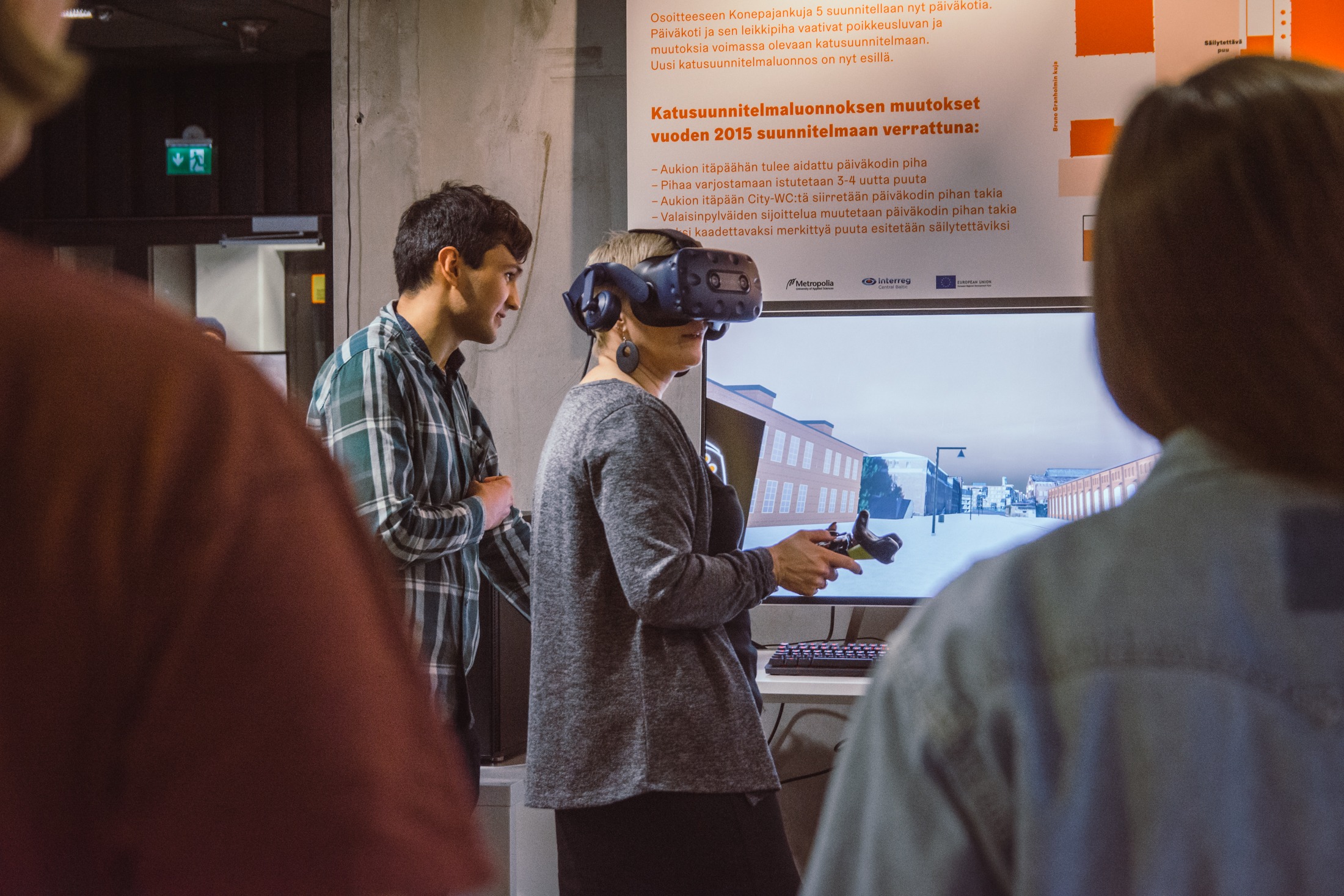
Cities are driven by a myriad of different interests, opinions, and desires. While urban areas are home to the majority of people in the world today, they are also ecologically important. Cities simultaneously shape and are largely affected by the changes in climate and biodiversity, the two key components of Earth system. Although cities cover just 3% of the Earth’s surface, they account for 75% of all carbon emissions. How we plan cities is crucial for the future of humanity and our planet. To build cities that are sustainable and can adapt to sudden changes we need collaboration across and beyond professional borders. But this is more easily said than done. Planning urban environments is a long-term process. The future does not yet exist, only visualisations and simulations of an envisioned future. They are not often legible for those of us who are not urban planners by trade. As we extend the scope of participation to include a more diverse group of people, we need better communication tools so that everyone involved understands the topics and proposals similarly. Technologies broaden the perception of urban space Immersive technologies or extended reality (XR) is an umbrella term for technologies that create, augment and merge digital elements with physical space. While it represents only a small segment of the digitalisation of the urban planning processes, what makes it special, is the potential connection point to us humans an interface to present urban data and facilitate participation. Extended reality allows us to virtually visit and experience urban spaces, be they already existing or still future visions. This opportunity can help bringing the aspects of spatial experience into consideration in different stages of the planning process e. g. in planning meetings workshops when collecting inputs from stakeholders via online platforms. As compared to regular architectural visualisations, VR immerses the viewer into the planned space offering a more vivid perception of how it will look and feel when implemented. XR also can also broaden the perception of urban space. Being able to view, for example, historical layers within a neighbourhood illustrates that the urban environment is not fixed, but ever shifting with the decisions that we make today. While augmented reality (AR) can draw attention to those aspects that are invisible or hard to notice within an existing space, virtual reality (VR) immerses the user in the perspectives presented. VR's capacity to elicit empathy is a growing research field. With VR, we can essentially step into the shoes of someone else. This can be as simple as viewing the city from a different height and getting a feel of the elements in the urban space from that perspective. Or listening to other people's experiences of the space as you stand immersed in it. Human-centred approach to data-driven decision-making Extended reality is essentially an experience and as such, can be powerful. Compared to reading through scientific materials, seeing urban areas and their changes in VR or AR are deep and rich experiences. That power comes with great responsibility. We need carefully think, how to select the data sources visually represent the data be transparent about those decisions. This also requires a lot of balancing on how to translate complex science into audio-visual experience that speaks to the viewer. The opportunities that come with extended realities knit tightly into the broader spectrum of the digitalising urban planning processes. Many cities are now producing digital twins, virtual copies of the urban environment and system. By including huge amounts of information, these aim at building a better understanding of the cities: their past events their current state what actions should be taken for the future. The question is, how do we use such models and their rich data to strengthen democratic decision-making? XR enters the picture as one potential interface for accessing and reviewing urban data. But also, as a tool that we can use for designing urban future together, in co-creation processes based on utilising the availability of increasingly rich data. With the on-going climate and biodiversity crisis, cities are facing increasingly complex challenges that call for broad collaboration. While not a silver bullet, XR technology can offer us the means to make future scenarios more understandable for a wider group of people, and help collecting their ideas on pathways into the future. Augmented Urbans in Helsinki -video During the past three years, the project Augmented Urbans has explored ways for extended reality technologies to support integrated urban planning in seven cities and municipalities around the Baltic Sea. The local project activities in Finland support the strategic objective of the City of Helsinki to build a better city together—with as many diverse voices as possible. The embedded video (on Youtube) captures the different tools and methods tested to enhance public participation in the context of Teollisuuskatu area development during 2019-2020. Author Päivi Keränen (MA) combines an educational background in New Media Design and Creative Sustainability with practical experience of working with the cities on design-based participatory urban development supported by new technologies. Working as a Project Manager at Metropolia UAS, she currently leads the project Augmented Urbans; a joint EU-funded initiative (Central Baltic Interreg) with seven cities and municipalities and university partners to explore the nexus of sustainable urban development, participatory planning and XR technologies. See also: Augmented Urbans website.
Tikissä on Metropolian tutkimus-, kehittämis- ja innovaatiotoiminnan (TKI) blogi. Bloggaajat ovat ammattikorkeakoulun henkilöstöä sekä muita TKI-toiminnan asiantuntijoita. Jos haluat kirjoittaa blogiin, ota yhteyttä toimituskuntaan.
Milla Åman Kyyrö, päätoimittaja
Viestinnän asiantuntija, TKI-hankkeet ja kehittäminen
p. 050 342 0341
milla.amankyyro@metropolia.fi
Päivi Keränen
Projektipäällikkö, Muotoilu
p. 040 184 1952
paivi.keranen@metropolia.fi
Jussi Linkola
Projektisuunnittelija, Hankeviestintä- ja julkaisupalvelut
p. 040 184 2448
jussi.linkola@metropolia.fi
Toimituskunta toimittaa Tikissä-blogin sisällöt ennen julkaisua.









3AMK ammattikorkeakoulu asiantuntija Dallaten FUTU hanke hankeviestintä hankkeet hyvinvointi innovaatio innovaatio-opinnot innovaatiot Innovation johtaminen Katse tulevaisuuteen kehittäminen keksintö kestävä kehitys koulutus metropolia minno nuoret Oona-hanke opiskelijat oppiminen osaaminen osaamisen kehittäminen resilienssi service design sosiaali- ja terveysala tekoäly tki TKI-toiminta tulevaisuus tuottavuus tutkimus työelämä työhyvinvointi työllistyminen viestintä vuorovaikutus yhteiskehittäminen yrittäjyys yritystoiminta yritysyhteistyö

Ideoimme, rikastamme ja kehitämme käytäntöön uusia ratkaisuja yhteistyössä yritysten, julkisen sektorin, järjestöjen ja asukkaiden kanssa.