According to the World Health Organization (1) there is a shared understanding that most health workers have to be prepared to use digital health technologies in their work. According, (2) digital capacity-building must be tailored to individual and national circumstances. The Student-run Interdisciplinary Allied Health Digital Practice Centre (3) project was a groundbreaking initiative aimed at revolutionizing the digital learning landscape in Kosovo. With a primary focus on enhancing interdisciplinary and transdisciplinary co-creation and education, the project carved out a new path for developing skills and knowledge in the fields of eHealth and eRehabilitation, particularly within the allied health sciences. The goal was to equip Kosovo’s higher education institutions (HEIs) with innovative tools and frameworks to enhance the virtual and digital practice-oriented education in allied health sciences through lifelong-learning (LLL) for both students and academic staff.
Co-creation was main development method in the project. Especially, importance of co-creating value for users was in focus (4), as well as co-creation and testing: engaging stakeholders from academia, industry and healthcare to co-create and iteratively test new digital platforms and solutions.
Co-Creation as a Driving Force for Development
One of the standout features of the SIAHDPC project was its dedication to co-creation as a central development method. Co-creation, which emphasizes value creation through collaboration with end-users, was demonstrated in practice during a pivotal moment at Metropolia University in Helsinki. Here, occupational therapy students played a crucial role in the project by planning and organizing its final evaluation using co-creative methods. This hands-on experience highlighted the importance of involving end-users – such as students, staff, and healthcare professionals – in the development of new educational tools and frameworks.
A Pioneering digital learning framework and platforms in Kosovo
The SIAHDPC project was to establish a pioneering digital learning framework and platforms in Kosovo, targeting the enhancement of interdisciplinary and transdisciplinary co-creation and education, particularly within the domains of eHealth and eRehabilitation in allied health sciences. Additionally, the project aimed to develop evidence-informed practice competences through training and learning materials for the Kosovo HEI staff and students, primarily. The project also contributed to the development and updating the relevant curricula in education with the interdisciplinarity as the key point. A concrete example of co-development was experienced at Metropolia in Helsinki, where occupational therapy students planned and organized a final evaluation for the project using the methods of co-creation.
Especially, importance of co-creating value for users was in focus (3). Even there were other relevant approaches as well, such as
Interdisciplinary and transdisciplinary learning: ensuring a holistic co-creation approach.
Digital tools and simulation: implementation of advanced digital tools, including remote simulations and to replicate authentic healthcare scenarios.
Another vital component of the SIAHDPC project was its emphasis on leveraging cutting-edge digital tools. These tools, including simulation technologies, are designed to replicate authentic healthcare scenarios, allowing students to gain practical experience in a controlled, virtual environment. Remote simulations further enable students to collaborate and practice real-world skills, even when physical presence is not possible. This is especially relevant in the context of eHealth, where digital healthcare solutions are becoming increasingly integrated into everyday practice.
Digital platforms for teaching purposes
As a part of the result of the project, it has strengthened the capacity of the operators to develop and integrate new types of digital platforms as part of teaching. Students involvement, collaboration between different disciplines and overall co-development approach was important in such RDI processes. The main results of the project can be divided into five categories as follows.
Developed comprehensive digital platforms to support the educational needs of students, professionals, and businesses in allied health.
Co-created, developed and testednew digital tools, products and services in a simulated and authentic environment. Platforms were co-designed and -created.
Facilitated continuous professional development through access to the latest digital technologies.
Enhanced learning experiences. Promoted the growth of knowledge, practical skills, digital literacy and competences in eHealth and eRehabilitation.
Improved participants’ abilities to develop complex and user-centered digital services.
During the project education in Kosovo has been promoted by integrating innovative digital solutions and fostering a collaborative environment for learning and development. Additionally, the project also contributes to the development and updating the relevant curricula in health education with the interdisciplinarity as the key point. The SIAHDPC project stands as a significant step forward in the modernization of Kosovo’s higher education system. By fostering an environment of interdisciplinary learning, integrating digital tools, and promoting co-creation, the project was not only enhancing healthcare education but also laying the groundwork for sustainable, long-term improvements in the country’s health and education sectors.
Authors
Eija Raatikainen Principal Lecturer, An Associate professor (UEF), Project Manager at Metropolia University of Applied Sciences
Panu Karhinen Team Leader, Senior Lecturer, Project Manager at Metropolia UAS
Anna Kaipainen Physiotherapist, Master of Rehabilitation, Project Manager in Metropolia UAS
Ari-Pekka Åker Master of Health Care, Senior Lecturer in Emergency Care, Head of Simulation Learning environment, Metropolia UAS.
Tikissä on Metropolian tutkimus-, kehittämis- ja innovaatiotoiminnan (TKI) blogi. Bloggaajat ovat ammattikorkeakoulun henkilöstöä sekä muita TKI-toiminnan asiantuntijoita. Jos haluat kirjoittaa blogiin, ota yhteyttä toimituskuntaan.
Milla Åman Kyyrö, päätoimittaja Viestinnän asiantuntija, TKI-hankkeet ja kehittäminen p. 050 342 0341 milla.amankyyro@metropolia.fi
Päivi Keränen Projektipäällikkö, Muotoilu p. 040 184 1952 paivi.keranen@metropolia.fi
Jussi Linkola Projektisuunnittelija, Hankeviestintä- ja julkaisupalvelut p. 040 184 2448 jussi.linkola@metropolia.fi
Toimituskunta toimittaa Tikissä-blogin sisällöt ennen julkaisua.
Ulla Vehkaperä
on perehtynyt Metropoliassa innovaatiotoimintaan ja -pedagogiikkaan. Hän innostuu työelämän ja opiskelijoiden kanssa yhteistoiminnassa toteutettavista opintojaksoista ja projekteista. Koulutukseltaan Ulla on toimintaterapeutti, terveystieteen maisteri, työnohjaaja ja toiminnallisten ryhmien ohjaaja. Hyvinvointialan yrittäjyys ja uusien palveluiden kehittäminen vievät hänet mennessään. Vapaa-ajalla Ullan voi löytää tilkkutöiden ja ystävien parista. Ota yhteyttä
Katri Myllylä
työskentelee Metropoliassa viestinnän lehtorina median osaamisalueella. Hän on koulutukseltaan kasvatustieteiden maisteri ja taiteen kandidaatti. Lisäksi Katri on pätevöitynyt ammatilliseksi erityisopettajaksi ja opinto-ohjaajaksi. Viestinnän ja median teoriaopetusten lisäksi hän työskentelee opinnäytetöihin ja opiskelijoiden ohjaukseen liittyvien moninaisten työtehtävien parissa. Katri toimii myös viestinnän tutkinto-ohjelmassa graafisen suunnittelun tutkintovastaavana. Muutaman vuoden ajan Katri on pendelöinyt kotoaan Tampereelta Metropolian eri toimipisteisiin, nykyisin ensisijaisesti Arabian kampukselle. Ota yhteyttä
Elina Ala-Nikkola
on osallistuvan ja luovan työotteen, ekosysteemisten työtapojen, viestinnän ja kulttuurihyvinvoinnin edistämisen kehittäjä Metropoliassa. Hän innostuu uuden äärellä olemisesta, eri alojen asiantuntijoiden kohtaamisesta ja osaamisen kehittämisestä yhdessä oppien. Hän on kulttuurituottaja (ylempi AMK), joka vapaa-ajallaan muun muassa lukee, hiihtää, kiertää museoita, kutoo islantilaisia paitoja ja nauttii musiikista. Ota yhteyttä
Johanna Holvikivi
työskentelee Metropoliassa hyvinvoinnin ja kuntoutuksen alueella opetus- ja kehittämistehtävissä. Hän on toiminut pitkään esimiehenä ja kehittänyt korkeakoulun opetusta ja laadukasta oppimista. Johanna on kiinnostunut erityisesti osaamisen johtamisesta, coachingistä ja työnohjauksesta. Hän pitää yhdessä tekemisestä ja uskoo yhteisöllisyyden voimaan. Hänen harrastuksiinsa lukeutuvat intohimoinen kirjojen lukeminen, pyöräily ja veneily. Ota yhteyttä
Jarmo Tuppurainen
työskentelee Metropolian sovelletun elektroniikan tutkimus- ja kehitysyksikkö Electriassa teknologiapäällikkönä. Pääosa hänen työtään on hankkeiden vetäminen. Julkaisutoiminnassa Jarmoa kiinnostaa erityisesti tieteen ja tekniikan kansantajuistaminen. Vapaa-aika Jarmolla kuluu perheen parissa ja aktiivisen liikunnan merkeissä. Ota yhteyttä
Kati Forsman
työskentelee Metropoliassa TKI-viestinnän parissa. Hän aikoi ensin ammattikorkeakoulun lehtoriksi, mutta viestintäasiat veivät hänet mennessään. Metropolian monialaisesta ilmapiiristä Kati nostaa innostavia sisältöjä ja tapahtumia muiden ihmeteltäväksi ja ihailtavaksi. Opiskelijoiden uudet innovaatioprojektit yllättävät Katin positiivisesti kerta toisensa jälkeen. Vapaa-ajasta Kati nauttii koiran kanssa lenkkeillen sekä tytärten taitoluisteluharrastuksen, mökkeilyn ja puutarhanhoidon parissa. Ota yhteyttä
Carita Hand
työskentelee lehtorina Metropolian terveysalalla vastuullaan gerontologisen hoitotyön sekä johtamisen opinnot. Peruskoulutukseltaan hän on sairaanhoitaja ja terveystieteiden maisteri. Näiden lisäksi hänellä on johtamisen ja tuotekehittäjän erikoisammattitutkinnot sekä muistihoitajan koulutus. Hänen ydinosaamistaan ovat muistisairaiden hoitotyö, lähiesimiestyö ja työhyvinvointi. Carita on intohimoinen uuden tiedon etsijä ja kokeilija, joka ei halua unohtaa heikommassa ja haavoittuvammassa asemassa olevia. Hän voimaantuu luonnossa. Ota yhteyttä
Pirjo Koski
työskentelee Metropoliassa hoitotyön lehtorina terveyspalveluiden osaamisalueella. Hän on koulutukseltaan terveystieteiden tohtori ja taustaltaan erikoissairaanhoitaja, kätilö ja opettaja. Pirjo opettaa Metropoliassa tutkimus- ja kehitystyön menetelmiä ja terveyden edistämistä sekä ohjaa opiskelijoiden opinnäytetöitä ja innovaatioprojekteja sekä osallistuu hankkeiden suunnitteluun. Pirjolla on pitkä oman alansa kansainvälinen työkokemus. Hän asuu puolisonsa kanssa Helsingissä ja viettää vapaa-aikaansa huvilallaan Keski-Suomessa liikkuen ja kirjoittaen. Hänen mottonsa kuuluu: "Ne jotka ovat tarpeeksi hulluja uskoakseen, että voivat muuttaa maailman, vielä tekevät sen.” — Steve Jobs. Ota yhteyttä
Milla Åman Kyyrö
on työskennellyt Metropoliassa vuodesta 2006. Hän on erikoistunut tutkimus-, kehittämis- ja innovaatiohankkeiden viestintään. Tikissä-blogin päätoimittajana Milla aloitti vuonna 2018. Hän työskentelee viestinnän asiantuntijana ja Hankeviestintä- ja julkaisupalvelut -tiimin esihenkilönä. Koulutukseltaan Milla on Master of Media Management (MA) ja kulttuurituottaja (YAMK). Ota yhteyttä
Eija Raatikainen
työskentelee yliopettajana Metropolian sosiaalisen hyvinvoinnin osaamisalueella. Työnkuvaan kuuluu kansallinen ja kansainvälinen hanketyö projektityöntekijänä ja projektipäällikkönä. Eija toimii teemavastaavana (Osallisuuden ja toimijuuden vahvistaminen) Asiakaslähtöiset hyvinvointi- ja terveyspalvelut innovaatiokeskittymässä. Eija on Sosiaalipedagogisen aikakauskirjan apulaispäätoimittaja. Ota yhteyttä
Anna-Maria Vilkuna
aloitti Metropolian TKI-toiminnasta vastaavana johtajana alkuvuodesta 2016. Ammattikorkeakoulun TKI-toimintaa hän on kehittänyt eri tehtävissä yli kymmenen vuoden ajan, ja tähän työhön häntä motivoivat lahjakkaat opiskelijat, ammattitaitoiset kollegat ja monipuoliset yhteistyökumppanit. Koulutukseltaan Anna-Maria on Suomen myöhäiskeskiajasta väitellyt historian tutkija, mikä selittänee kiinnostuksen ottaa haltuun erilaisia ilmiöitä ja tarkastella niitä niin historiallisesti kuin tulevaisuusorientoituneesti. Työn, perheen ja ystävien lisäksi elämään sisältöä antavat luontoretket patikoiden, pyöräillen ja veneillen. Ota yhteyttä
Jussi Linkola
on työskennellyt tutkimus-, kehtys- ja innovaatiohankkeiden parissa eri rooleissa. Hän on suunnittellut ja toteuttanut hankkeita, toiminut viestintäsuunnittelijana, projektipäällikkönä ja viimeksi media-alan asiantuntijalehtorina. Jussi tavoittelee selkeää, täsmällistä ja saavutettavaa viestintää. Ota yhteyttä
Olen saanut kirjoittaa Tikissä-blogiin vuodesta 2018 lähtien. Matka on ollut antoisa. Koska Tikissä on nykymuodossaan vähitellen lähdössä viettämään blogialustojen hyvin ansaittuja eläkepäiviä, ajattelin kertoa hieman omien asiantuntijatekstieni kirjoittamisesta. Miksi innovaatioista kirjoittaminen on niin tärkeää?
Mistä aiheet tulevat?
TV-mainokseen asti päätynyt kirjailija Jörn Donnerin lausahdus, lukeminen kannattaa aina, pätee ainakin omalla kohdallani myös asiantuntijablogien kirjoittamiseen. Moni aihe on kummunnut siitä, että olen lukenut työhön tai harrastuksiini liittyvää kirjallisuutta, muita julkaisuja, lehtiä tai katsonut dokumentteja, teknologiasta, historiasta, startup-kehittämisestä tai vaikkapa muotoilusta. Olen jostakin niistä huomannut uuden, käsittelemättömän näkökulman tai mielestäni kiintoisan aiheen ja halunnut kirkastaa sen blogitekstiksi. Tämä ei tarkoita, että olisin suoraan referoinut jotakin aiemmin lukemaani tai näkemääni. Päinvastoin, asiantuntijablogiartikkelin kirjottamiseen saa ja täytyy käyttää aikaa. Ideasta on monta kertaa ollut pitkä matka lopulliseen tekstiin. Tietojen pitää olla oikein ja lähteiden saatavilla, jotta lukija halutessaan voi mennä syvemmälle aiheeseen. Ja erityisen haasteellista on, että kaikki pitää voida esittää tiiviissä paketissa.
Eikö innovaatioista ole kirjoitettu ja touhotettu jo ihan liikaa?
Innovaatio on käsite, jota säännöllisesti käytetään tiedotusvälineissä, kun halutaan korostaa, että talouden ja yhteiskunnan on kehityttävä. Kaupallisten innovaatioiden merkitystä korostetaan myös tämänhetkisen hallituksen ohjelmassa. Kukin tietenkin käyttäköön arkipuheissaan innovaatio-sanaa, kuten muitakin sanoja, haluamallaan tavalla. Mutta ilman yhteistä ymmärrystä siitä, että innovaatio ei ole vain hyvä idea, vaan ideasta kirkastunut keksinnöllinen tulos, jolle on hyödyntämisväylä, on vaikea kuvitella toimivaa ja tuloksellista suunnittelu- ja kehitystyötä.
Kolme toistuvaa teemaa
Pääsääntöisesti olen käsitellyt kolmea eri teemaa. Ensinnäkin innovaatioiden tunnistamiseen, niiden luomiseen ja hyödyntämiseen kuuluvia asioita: mitä tulee ottaa huomioon, kun olettaa tehneensä keksinnön, mikä innovaatio oikeasti on, mistä saa tukea ja apua, kun haluaa hyödyntää luomaansa tulosta? Toiseksi esimerkkejä muotoilun ja teknologian historiasta. Miten aikoinaan tehdyt innovaatiot usein tietämättämme vaikuttavat edelleen arkeemme ja nykypäiväämme. Ja kolmantena, alkavaa yrittäjyyttä ja edellytyksiä, joiden avulla se on mahdollista. Toisinaan olen pohtinut näiden kaikkien kolmen yhtymäkohtia. Näitä samoja teemoja olen aikeissa käsitellä jatkossakin.
Blogikirjoitusteni pyrkimys on ollut tuottaa lukijalle pieniä oivalluksia. Miten jokin innovaatioasia voi yllättävällä tavalla liittyä johonkin toiseen, näennäisesti täysin eri asiaan.
Haluan myös luoda positiivista ajattelua, että kuka vain voi olla innovaattori. Ideoida uutta, kehittää, ja tunnistaa tekemästään työstä keksinnöllisiä asioita, jotka voivat parhaimmassa tapauksessa johtaa taloudelliseen hyödyntymiseen, esimerkiksi yritystoiminnan kautta. Ja, että hän ei ole yksin ponnisteluidensa kanssa. Päinvastoin, muotoilun, teknologian ja kulttuurin innovaatioiden historia on täynnä tarinoita. Hämmästyttäviä yhteensattumia. Tekijöiden kohtaamisia, jotka muuttivat kaiken. Onnistumisia. Ja traagisia tai surkuhupaisia epäonnistumisia, vaikka tavoitteena on ollut luoda jotakin hyvää ja hyödyllistä. Värikästä yritteliäisyyttä. Hyvässä ja pahassa. Uskon, että näiden aiheiden avaaminen ja niistä kertominen kannattaa jatkossakin. Vaikka historia ei toistakaan itseään, voimme ainakin oppia jotakin edellisten innovaattoreiden onnistumisista ja eritoten, virheistä.
Tässä yhteydessä on syytä myös kiittää blogin toimituskuntaa, erityisesti päätoimittaja Milla Åman Kyyröä, jonka kanssa on ollut ilo tehdä yhteistyötä. Ilman Millan oivaltavia kommentteja ja korjausehdotuksia monet tekstini olisivat voineet olla huomattavasti turpeampia ja moniselitteisempiä.
Tämä on viimeinen blogini Tikissä-alustalla, mutta blogiseikkailuni jatkuvat - mikäli päätoimittajat niin sallivat - vuoden 2025 puolella tulossa olevilla Metropolian uusilla upeilla julkaisualustoilla. Siihen asti toivotan kaikille Tikissä-blogeja lukeville luovuuden hetkiä ja kekseliästä loppuvuotta 2024!
Kirjoittaja
Juha Järvinen työskentelee innovaatioasiantuntijana Metropolian TKI-palveluissa. Hän on koulutukseltaan taiteen tohtori ja teollinen muotoilija. Uusien innovatiivisten ratkaisujen, oivallusten ja toimintamallien löytäminen ja edistäminen innostavat häntä. Paremman tulevaisuuden kehittämiseen tähyävän päivätyön vastapainona hän harrastaa menneisyyteen liittyviä asioita, kuten sukututkimusta, keräilyä ja vanhoja autoja.
Työpaikan saamisessa tarvitaan avuksi työkaluja ja menetelmiä. Mutta miten valita toimivimmat? Tässä artikkelissa on muutamia ajatuksia työnhakuun sopivista tukikeinoista projektinhallinnan näkökulmasta. Tekoälykin on otettu avuksi.
Eikö työllistyminen olekaan projekti?
Työllistyminen voisi pintapuolisesti tarkastellen olla projekti: se vaatii työtä, yksi kerta riittää ja siinä on selkeä tavoite. Onnistuneen projektin tueksi tarvitaan SMART-menetelmää, sen tiedän kokeneena projektipäällikkönä. SMART-menetelmää käytetään projektinhallinnassa yleisesti tarkistuslistana projektin tavoitteiden kuvaamisessa. Siispä olisi hyvä tehdä työpaikkaa etsiville ohje siitä, kuinka SMART-menetelmää voi käyttää työllistymisessä.
Työllistymisprojektissa ensimmäisenä mieleeni tuleva tavoitteenasettelu on tämä: töihin pitäisi päästä, mahdollisimman nopeasti ja mahdollisimman hyvällä palkalla. Kivaa täytyy olla ja hyvä porukka. Tämä on SMART-mallin näkökulmasta hyvä tavoite sikäli, että työllistyminen on konkreettinen (Specific) ja mitattavissa oleva (Measurable) tavoite. Lisäksi vastuuhenkilökin on selvillä (Assignable). Mutta tässä tavoitteen muotoilussa olevat aikataulu-, palkka- ja laatutavoitteet ovat epämääräisiä. Ne eivät ole konkreettisia ja vaikka esimerkiksi palkka on numeroilla mitattava, ei tavoitetta ole asetettu lukuna. Siksi nämä tavoitteen osat eivät ole välttämättä realistisia (Realistic) ja tietyssä ajassa toteutettavia (Time-bound).
Tässä vaiheessa olen entistä vakuuttuneempi siitä, että SMART-mallin soveltamisesta työnhaussa on syytä tehdä ohje.
Kokeilen, kuinka pitkälle ohjeen laatimisessa pääsee tekoälyn avulla. ChatGPT 3.5 vinkkaa seuraavaa: “sen sijaan että asettaisit tavoitteen ‘haluan olla parempi kitaransoittaja’, voit tehdä sen SMART-periaatteen mukaisesti: ‘haluan oppia soittamaan kolme uutta kitarakappaletta kuukauden sisällä, käyttäen päivittäin vähintään tunti harjoitteluun’.
Mielestäni tekoälyn suosittelema esimerkki on enemmänkin toimintasuunnitelma kuin projektimääritelmä. Laatutason määrittely puuttuu ja tarvittava työmäärä on esitetty muodossa “vähintään”, kun sen pitäisi yleensä olla muotoa “enintään”.
SMART-mallin soveltaminen työllistymiseen ei siis ole ihan suoraviivainen asia, ainakaan tekoälyllä tehtynä. Joudun näin ollen toteamaan, että ohjeen laatimisesta ei selviä ilman omaa pohdintaa ja työpanosta.
Työnhaku on kaikkea paitsi yksinkertaista
Työpaikan hankkiminen ei itse asiassa sovi kovin hyvin projektiajatteluun. Erityisesti kun työpaikan saaminen osoittautuu vaikeaksi ja pitkittyy, muuttuu hakeminen prosessinomaiseksi. Samat työvaiheet toistuvat kulloiseenkin tilanteeseen sovitettuina.
Jatkuva itselle sopiva työllistyminen on lähes elämänmittainen prosessi, johon kannattaa panostaa vaikka olisikin töissä. Niin sanottuja varmoja eläkevirkoja ei enää juuri ole.
Projektinhallinnan menetelmät pyrkivät varmistamaan, että projektin toteutus onnistuu. Tärkeää onnistumiselle on projektin tavoitteen hyvä määrittely ja tässä SMART-menetelmä on erinomainen apu. Mutta projektinhallinnan menetelmien menestyksekäs hyödyntäminen edellyttää myös sitä, että lähtötilanne tunnetaan hyvin ja että ulkoisia epävarmuuksia ja riskejä voidaan hallita. Työpaikan haussa näin ei ole, sillä työmarkkinatilanne muuttuu koko ajan työpaikkojen avautuessa ja sulkeutuessa. Tähän ei työnhakija pysty käytännössä mitenkään vaikuttamaan eikä myöskään kilpailuun. Samoja työpaikkoja hakee moni muukin. Yksittäinen henkilö ei myöskään pysty tekemään työnhakua määräänsä enempää eli työnhaku on huomattavasti sekä aikataulu- että resurssirajoitteista.
Työnantajien kannalta tarkasteltuna tyypilliset rekrytointiprosessit koostuvat varsin vakiintuneista vaiheista, joilla rajataan harkittavien työnhakijoiden joukkoa. Työnhakijan on selvittävä kaikista vaiheista eteenpäin ja viimeisestä vaiheesta selvittyään hän saa työpaikan.
Työpaikan hakemiseen ja saamiseen työnhakijalle kuuluvat vaiheet voivat olla prosessinomaisia, kuten esimerkiksi kulloinkin avoinna olevien työpaikkojen etsintä ja verkostoituminen. Toiset vaiheet ovat projektinomaisia, kuten esimerkiksi hakemuksen tekeminen tiettyyn avoinna olevaan työpaikkaan.
Menetelmät ja työkalut on valittava tehtävän luonteen mukaan
Työnhakijat voivat parantaa mahdollisuuksiaan selvitä rekrytoinnin vaiheista eteenpäin sekä panostamalla yksittäiseen vaiheeseen, kun se on ajankohtainen, että investoimalla aikaansa omien valmiuksien kehittämiseen. Näitä valmiuksia ovat työnhakuun tarvittavien dokumenttien, portfolion ja sosiaalisen median sisältöjen laatu sekä kyky muokata ansioluetteloa ja hakukirjettä kunkin haettavan työpaikan vaatimuksia vastaavalla tavalla. Myös työnhaun prosessin eri vaiheiden osaaminen on tällainen valmius.
Paremmat valmiudet kasvattavat todennäköisyyttä menestyä rekrytointiprosessissa ja mahdollistavat osallistumisen useampiin rekrytointiprosesseihin samaan aikaan.
Olen oivaltanut, että työnhakijalle olisi hyödyllistä tarkastella omia työllistymisvalmiuksiaan kypsyysmalliajattelun avulla. Näin erityisesti, jos työnhaku pitkittyy. Itse asiassa myös jokaisen töissä olevan olisi hyödyllistä tarkastella työllistymisvalmiuksiaan kypsyysmallin avulla varautumistoimena ja oman uranhallinnan osana.
Nyt kun ymmärrän, mitä oikeastaan haluan, löytyvät oikeat kysymykset tekoälylle helpommin. ChatGPT:n tekstiä tiivistäen: kypsyysmalli on kehys tai työkalu, joka auttaa organisaatioita, yrityksiä tai prosesseja arvioimaan tai mittaamaan niiden nykyistä suorituskykyä tai kehitysvaihetta tietyllä alueella.
SMART- ja kypsyysmallin työnhakuun soveltuva vertailu tekoälyllä
Lopulta pääsen tekoälyn kanssa asiaan eli sanoittamaan tätä tekstiä varten vertailua SMART-mallin ja kypsyysmallin soveltuvuudesta työllistymisvalmiuksien kehittämiseen: SMART-malli soveltuu hyvin konkreettisten tavoitteiden asettamiseen ja seurantaan. Työllistymisvalmiuksien kehittämisessä se voisi auttaa yksilöä asettamaan selkeitä ja mitattavia tavoitteita, kuten hankkimaan uusia taitoja tietyllä aikataululla tai saavuttamaan tietyn tason osaamisessa.
Kypsyysmalli voi auttaa yksilöä hahmottamaan, missä vaiheessa hänen työllistymisvalmiutensa ovat ja mitä askelia tarvitaan kehittymiseen. Se voi tarjota laajemman viitekehyksen eri osa-alueiden kehittämiseen, kuten ammatillisiin taitoihin, pehmeisiin taitoihin tai verkostoitumiseen.
Hyödyllistä olisi yhdistää molemmat lähestymistavat: asettaa SMART-tavoitteita osana suurempaa kypsyysmallia, jolloin yksilö voi seurata konkreettista edistymistään samalla kun hän hakee laajempaa kehitystä työllistymisvalmiuksissaan.
Johtopäätöksenä totean, että työllistymistä tukevassa Uraohjain+-hankkeessa tehdään siis opastus sekä SMART-menetelmän että kypsyysmallin hyödyntämisestä työnhaussa. Ja tekoälyn.
Kirjoittaja
Tapani Martti (DI, AmO) on lehtori Metropoliassa ja toimii työllistymistä tukevaa palvelua kehittävässä, EU:n osarahoittamassa Uraohjain+-hankkeessa Metropolian osuuden projektipäällikkönä ja it-alan asiantuntijana.
Mistä lähtökohdista voisi yhdistää hanketoiminnan, yritysyhteistyön ja yrittäjyyshengen ammattikorkeakoulussa uudella tavalla, parantamaan hanketoiminnan tuloksellisuutta?
Olemme miettineet tätä yhdessä Metropolia Ammattikorkeakoulun Turbiini-kampusinkubaattorin ja puhtaat ja kestävät ratkaisut innovaatiokeskittymän toimijoiden kesken, käytyämme kesällä 2023 koulutuksen, jossa pääroolissa oli Ash Mauryan kehittämä Lean Canvas ja sen toteuttamiseen tarvittavat toimintatavat. Sen tarkoitus on tarjota malleja ja toimintatapoja, jotka mahdollistavat startup-yritysten kasvua ja toimintaa. Kesän kuumina iltoina jäimme miettimään, että olisiko tässä jotain sellaista, jota voisi käyttää myös hanketoiminnassa ja tukemaan yrittäjämäisen toimintatavan ja ajattelumallin leviämistä kampusinkubaattorista laajemmin Metropolian tutkimus-, kehittämis-, innovaatio- ja oppimistoimintaan (TKIO).
Hankkeiden ja startuppien yhdistävät ja erottavat tekijät
Monessa kohtaa hanketoiminnalla ja startupilla on yllättävän paljon samankaltaisia piirteitä, vaikka se voi kauempaa tarkastellen tuntua yllättävältä. Samankaltaisuuksia on rahoituksessa ja sen kestossa, tiimin koossa, tarpeessa ymmärtää kohdeyritysten tarve, tuntemattomien muuttujien määrässä ja tehtävien priorisoinnissa.
Toki on myös selkeitä eroja, kuten meidän tapauksessamme hanketoiminta osana isoa korkeakoulua ja tästä tuleva turvallisuuden taso, onnistumisen mittaamisen ja siitä tulevien seurausten ero ja hankerahoituksen viranomaishallinnasta tulevat erityispiirteet.
Käymme seuraavaksi nämä tarkemmin läpi ja tarjoamme lopuksi ideamme siitä, kuinka Lean Canvasta voisi käyttää tukemaan tuloksellista hanketoimintaa.
Rahoitus on onnistumisen edellytys
Startup-toiminnassa käytetään usein kiitoradan käsitettä, jossa lasketaan aikaa siihen, että olemassa oleva rahoitus loppuu tiedossa olevalla menorakenteella. Tästä tulee pisin mahdollinen toiminta-aika, jonka sisällä yrityksen on joko löydettävä riittävästi maksavia asiakkaita tai saatava lisärahoitusta. Hankkeet taas rahoitetaan tietyllä summalla tietyksi ajaksi ja tässä on yleensä heikosti neuvotteluvaraa. Näin syntyy yhteneväinen aikajänne, tyypillisesti pari vuotta, ja aikataulupaine saada tuloksia aikaan.
Startupin tavoite on usein ensimmäisten vuosien aikana löytää paikkansa markkinoilta sekä rakentaa siihen sopiva liiketoimintamalli. Tämän kautta yrityksen seuraava rahoituskierros mahdollistuu ja toiminta jatkaa. Hanke pyrkii siihen, että sen kehittämät toimenpiteet jäisivät elämään ja että sen tekemän kehityksen pohjalta voidaan rakentaa seuraava hanke. Ei hankkeen itsensä vuoksi, vaan ennen kaikkea sen löytämän tiedon tai osaamisen jatkojalostamiseen eteenpäin.
Työroolit ja tehtävien laaja-alaisuus
Usein hanketiimi ja startup-tiimi ovat samaa kokoluokkaa, muutamia henkilöitä, joilla on omat tehtävänsä ja osaamisensa, mitä he tuovat projektin palvelukseen. Johtuen kireästä aikataulusta ja tarpeen epäselvästä määrittelystä, tiimit joutuvat usein tekemään tehtäviä ristiin ja projektipäällikkö joutuu ottamaan saman roolin kuin toimitusjohtaja, eli tekemään tarvittaessa kaikkien tehtäviä ja myös niitä tehtäviä, joita kukaan muu ei tee, mutta tulee saada tehtyksi.
Toimiva startup tarvitsee selkeän ymmärryksen tuottamastaan palvelusta ja sen lisäarvosta asiakkaalleen saadakseen myyntiä. Toimiva hanke tarvitsee ymmärryksen tuottamastaan lisäarvosta hankkeen kohteena oleville yrityksille voidakseen onnistua saavuttamaan tavoitteet, jotka rahoittajalle on luvattu. Molemmat toimivat suuren epävarmuuden ja muuttujien keskellä.
Niin yritystä aloittaessa kuin hanketta kirjoittaessa on alustava käsitys siitä, mitä tavoitellaan ja miten. Nämä seikat ovat taipuvaisia muuttumaan, kun hankkeen käytännön toteutus alkaa. Muutokset voivat johtua toimintaympäristön muutoksista, henkilöstövaihdoksista, väärinarvioidusta tarpeesta tai teknisistä muutoksista. Tämä vaatii kykyä reagoida nopeasti muuttuviin tilanteisiin ja toimintaympäristöön.
Työsuunnitelman ositus ja tehtävien priorisointi
Molemmissa toiminnoissa on myös olennaista tehdä priorisointia tehtävien suorittamisen ja suoritusjärjestyksen suhteen. On tehtäviä, jotka tulee tehdä mahdollisimman nopeasti. Osan tehtävistä joutuu välttämättä resurssipulan takia siirtämään ajassa eteenpäin.
Eroja, onko niitä?
Metropolian kontekstissa toimittaessa meillä on varmuus siitä, että hanke pyörii annetun ajan, palkat tulevat ajallaan, toimitilat ovat tarkoituksenmukaiset ja saamme toiminnallemme Metropolian mainehyödyn. Aloittavalla yrityksellä on riskinsä kaikissa näissä osa-alueissa.
Onnistumisen mittaamisessa hankkeen ja yritystoiminnan kohdalla on eroja. Yritys mittaa onnistumista euroilla, myynnillä ja tuloksella. Mutta jos otetaan tarkasteluun Mauryan esittelemä käsite friction, joka voidaan ymmärtää kiinnostuksella, tällöin tavoitteet ovat lähempänä toisiaan.
Hanketoiminnasta ei ole tehtävissä liiketoimintakauppoja tai arvoaan kasvattaneen yrityksen myyntiä.
On kuitenkin nähtävissä, että onnistuneista hankkeista olisi mahdollista lähteä kehittämään myös yritystoimintaa, kun onnistutaan tunnistamaan tuotteen tai palvelun tarve, ja kehittämään siihen riittävän hyvin toimiva ratkaisu. Tai palvelu hanketoimintaa tekevän korkeakoulun palveluvalikoimaan. Uskomme, että tämä on mahdollisuutena kiinnostava.
Sarjan aiemmissa kirjoituksissa on esitelty Running lean -kirjasta otettuja työkaluja ja ajatusmalleja, kuten
lean canvas
UVP eli ainutkertainen arvolupaus
traction eli kiinnostus kohdeyritysten parissa
hissipuhe
90 päivän sykli.
Näiden pohjalta on mahdollista luoda ja rakentaa paremmin toimivia, enemmän yhteistyökumppaneiden tavoitteisiin osuvia hankkeita tukemaan ammattikorkeakoulun TKIO-toimintaa.
Kirjoittaja
Timo Nykopp toimii TKI-Tiimipäällikkönä Metropolian Puhtaat ja kestävät ratkaisut innovaatiokeskittymässä. Koulutukseltaan hän on Restonomi (AMK) ja kauppatieteiden maisteri.
Lähde
Ash Maurya: Running Lean: Iterate from Plan A to a Plan That Works. 3rd edition (2022), O’Reilly media.
In healthcare, professional interaction skills are needed not only in patient contacts but also when working in interprofessional teams. Team members have different backgrounds, and they might have different understanding of how to work together. This underlines the importance of clear communication and teamwork. (Schmutz, Meier & Manser 2019.) Communication plays an important part in developing collaboration in teams and in the development of interprofessional empathetic relationships (Adamson et al. 2018).
Already from the beginning of the studies, Metropolia UAS`s Degree Programme in Nursing Curricula (Metropolia UAS 2022) requires the student to grow their understanding about the significance of ethics and professional interaction, and consider patient’s needs for psychosocial support. The students also need to practice working methods considering patient safety and the significance of professional interaction.
As a Metropolia master`s student in the Creativity and Arts in Social and Health Fields degree programme, I had an opportunity to instruct a teamwork and communication workshop using drama-based exercises. Drama-based exercises and games may be used to warm up, introduce and practice new skills, improve concentration and have fun. A recent literature review by Jeffries et al. (2021) brings out the ways how drama can support student learning and professional development. Drama-based working methods can enhance empathy, emotional engagement, and empowerment, also increase understanding of one’s own professional identity, self-awareness, self-reflection and improve communication skills. In addition, using drama can develop reflective skills. There is strong evidence of the positive role of the arts in improving health and wellbeing. A review conducted by the World Health Organization summarizes evidence from more than 900 such studies (Fancourt & Finn 2019).
Drama-based workshop
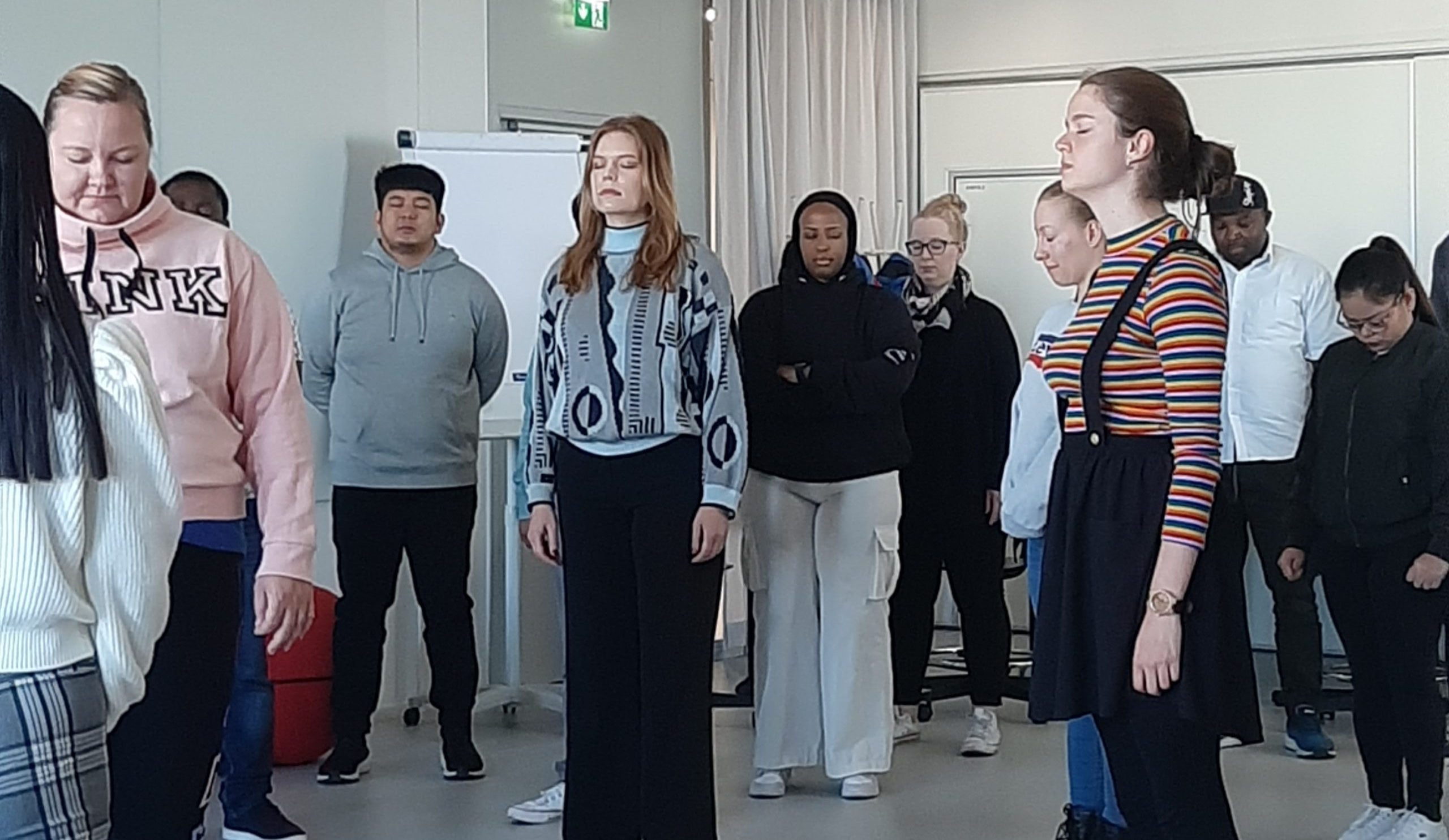
The three-hour drama-based workshop was conducted with international students in the advanced phase of the Degree program in Nursing, with two Metropolia nursing lecturers observing. The workshop consisted of exercises and reflective discussions. The discussion topics included teamwork interaction, communication skills and presence as key factors related to patient safety behaviour and empathy in healthcare.
Students experienced the workshop as very important and useful, fun, stress relieving and they got their minds rested. They felt the atmosphere was safe and it was meaningful to hear others` thoughts, have good discussions and to connect with fellow classmates. As they expressed it, the workshop gave them:
“Awareness of yourself and others”, “What wasn`t said with words was felt”, “Thank you for making me feel better”, “I feel relieved and fresh”, “The workshop was really great and it is one way to connect with our fellow classmate and hopefully it will be the same in the future”, “It helped me get comfortable with my classmates”, “Engagement between teacher and other classmates”.
As take-home messages, elements taken into studies and work, the students mentioned the need for practicing good listening and acknowledgement skills in conversations with colleagues and patients:
“Closed-loop-conversations with colleagues & patients”, “Communication is a key to have on successful outcome of the situation”, “It`s about how I focus”, “Repeating messages & hearing to confirm”, “Importance of communication (effective), importance of listening to self and others, trust”.
The importance of eye contact and touch in human connection were mentioned several times as very meaningful techniques in communication:
“The importance of human connection and touch”, “Eye to eye contact seems so simple but gives connection to someone”, “That human contact holds more importance than I thought originally”.
In addition, the students found tips for releasing stress and better concentration. As they expressed it:
“There is a touch that makes us feel that today is gonna be okay so just breathe and relax”, “Staying calm and staying focused”.
Based on feedback this workshop was well accepted and beneficial. The exercises seemed to foster teamwork and communication skills and evoked thoughts about empathy. The students wished the workshop to be regular. However, it is important to keep in mind, that this kind of activity may not be comfortable for everyone.
Interaction and teamwork exercises are beneficial
Two Metropolia nursing lecturers were observing the workshop.
“During the workshop, the students threw themselves into the exercises and learning seemed to be both fun and relaxing, but at the same time thought-provoking and insightful. We see the importance of interaction and teamwork exercises when studying to become a nurse. Our students are in the graduation phase, so the timing was suitable for this kind of exercise. The workshop sparked a lot of discussion among the students and based on the feedback given to us, they found the exercises very useful. Minna-Maria had a calm but at the same time inspiring and encouraging way of guiding the workshop, and the students clearly liked the experiential learning method.”
The workshop also became a significant learning experience for the organizers, and they were glad that their activity was well received and appreciated. It made a milestone also for them as future professionals.
References & interesting readings
Adamson, K., Loomis, C., Cadell, S., & Verweel, L.C. 2018. Interprofessional empathy: A four-stage model for a new understanding of teamwork. Journal of Interprofessional Care. 2018 Nov; 32(6), 752-761
Metropolia UAS 2022. Degree Programme in Nursing, Curricula 2022-2013. Study guide. https://opinto-opas.metropolia.fi/88094/en/108/70308?lang=en
Dehnavi, M., Estebsari, F., Kandi, Z.R.K., Milani, A.S., Hemmati, M., Nasab, A.F., & Mostafaie, D. 2022. The correlation between emotional intelligence and clinical competence in nurses working in special care units: A cross-sectional study. Nurse education today 2022, Vol.116, p.105453-105453
Fancourt, D. & Finn, S. 2019. What is the evidence on the role of the arts in improving health and well-being? A scoping review. Health Evidence Network synthesis report 67, WHO. https://www.euro.who.int/en/publications/abstracts/what-is-the-evidence-on-the-role-of-the-arts-in-improving-health-and-well-being-a-scoping-review-2019
Jefferies, D., Glew, P. Karhani, Z., McNally, S. & Ramjan, L.M. 2021. The educational benefits of drama in nursing education: A critical literature review. Nurse Education Today Volume 98, March 2021, 104669
Raatikainen, E., Rauhala, L. A., & Mäenpää, S. 2017. Qualified Empathy. A key element for an empowerment professional. Sosiaalipedagoginen aikakauskirja, 18, 113–21
Schmutz, J.B., Meier, L.L. & Manser, T. 2019. How effective is teamwork really? The relationship between teamwork and performance in healthcare teams: a systematic review and meta-analysis. BMJ Open. https://bmjopen.bmj.com/content/9/9/e028280
Writer
Minna-Maria Mattila, Metropolia master`s degree student
I work at medical students` skill lab at University of Helsinki Faculty of Medicine. I also work as part-time entrepreneur in arts-based workshops. I have a degree in nursing (RN, BN) and I have studied drama education to support arts-based activities. I have a long experience and studies in the field of performing arts.
Students and lecturers have given permission to use comments and quotes.
The Master's degree in Creativity and Arts in Social and Health Fields (CRASH) provides strong competences to act as a developer, innovator, expert, and leader in using creativity and arts in various operating environments in social and health fields. It also gives competences to work in expert positions in the social and health sector. Creativity and different ways to express it, as well as cultural activities and arts related experiences, belong to all people as part of a good and meaningful life. The aim of CRASH is to strengthen the professional competences needed when promoting health, well-being, inclusion, and a sense of community in society through creativity and arts. You can read more about the programme here
Empathy has traditionally been taught through:
Informal learning opportunities, like Service Learning projects (Engaged scholarship) (Trad 2013).
Movie review reflections (Briggs, Fox & Abell 2012).
Literature and poetry readings (Shapiro, Morrison & Boker 2004)
Learning communication skills (Winefield & Chur-Hansen 2000)
Self-assessments: different types of empathy self-evaluation measures (e.g. The Empathy Scale for Social Workers, ESSW) (King, S. & Holosko, MJ 2011).
What if, instead of focusing on the verbal, oral or written reflection of learning, holistic experiences would be emphasized when teaching critically important empathy skills? In this blog text, we introduce a way of teaching empathy through aesthetic learning by using creative, multisensory methods. Austring and Sørensen (2012) have shown that aesthetic methods are particularly efficient for expressing and interpreting emotions. When working with our first year Bachelor’s students, we gave them a series of versatile and inspiring visualization and visual art tasks through which they could develop an experiential understanding of empathy.
How did we practically implement the Teaching and Learning of Empathy in the Social Services Degree Programme at Metropolia UAS?
The idea behind our project on qualified empathy was to facilitate students in taking their learning from a cognitive and discursive level to an experiential understanding, as if they were the client, in order to develop a better understanding of the client’s ”experiential” world. ‘Qualified Empathy’ is defined as the ability to reflectively and emotionally separate oneself from the other and to understand the context; then in an intentional process, focus on understanding the other person’s viewpoint both cognitively and emotionally (Raatikainen, Rauhala & Mäenpää, 2017). The following are key phrases used to express our movement through the process of developing our qualified empathy skill:
The qualified empathy learning process took place in a sixteen-calendar week timeframe during the first-year studies. The participants were students (n=47) from the Social Services degree programme (2015- 2017*). Two study modules were included: 1) Individual and Community Counselling (5 cu) and 2) Supporting Daily Lives through Social Pedagogical Work and the first internship (15 cu) (Metropolia Degree Programme Curriculum, 2016).
Figure: Three ways of Learning
During the Individual and Community Counselling course, the students were guided through the three ways of learning and introduced to the theoretical underpinnings of empathy as well sensory activation exercises such as visualization and reflection (discursive and aesthetic learning). Students took part in a storytelling/visualization exercise focusing on refugees fleeing to Europe. As this topic has been very prominent in the media and public discussion, we wanted to help the students get in touch with the emotional dimension that the refugees themselves might be experiencing.
Images and sounds were used in the background as students were instructed to close their eyes and listen to the story while visualizing in their heads the thoughts and emotions a young refugee boy travelling with his younger siblings might be experiencing while crossing a storm-tossed sea in an overloaded boat.
Afterwards, students were asked to ponder on their experience and then share and reflect with the group what emotions and thoughts they had. We then discussed the different understandings they had from reading and learning the factual information about the refugee crisis (discursive learning) and the more experiential understanding after the visualization and reflection exercise (aesthetic learning). This was then reflected back onto the previously explored theoretical framework of empathy as discussed by Gerdes and Segal (2009) regarding the components of empathy (cognitive processing, affective response and conscious decision-making).
‘How do I feel, when I feel empathy?’
During the Supporting Daily Lives and Internship module, students used visual arts as the method of exploration. They used gouache paints as a medium to express their understanding of how they ‘feel’ when they feel empathy, and then expressed it through color choices and use of paint. Some groups decided not to communicate verbally while they were working. Giving meanings to different colors, brush movements and simultaneously mirroring other group members’ body gestures and reactions helped them when trying to describe and express their own understanding of their feelings of empathy towards others and other’s perspectives on the matter. The core questions in teaching empathy by using aesthetic methods were: ‘How do I feel, when I feel empathy?’, ‘How do I understand another person’s experience’ and later ‘How do I refine the feeling of empathy to qualified empathy towards the client and what does it mean?’.
So…how did the students experience the process?
During the one-semester long process, starting from the counselling course and ending with the internship, the students moved from defining the concept as “the skill of stepping into another’s shoes” and were verbalizing it in more “qualified” terminology such as “Qualified Empathy means supportive rather than reactive actions to client situations”. By this, they meant to say that the social services provider is not solely reacting according to their own feelings but is rather reflecting on and transforming their own feelings into actions that support the clients. The quotes and pictures below show how students reflected verbally and through art on their own learning. This process helped them to concretize their learning because they had to explain it to someone else.
”Using the concept of ”qualified empathy”, it was way easier to understand the kids and deal with the problems they were facing…I stopped judging misbehaving kids and came to understand the reasons behind their behavior.” (DR)
The ”qualified empathy” part was the most difficult for me. I didn’t quite grasp the difference between ”normal” empathy and ”qualified” empathy during the lectures and I had to re-read some of the material. Now I think I understand the concept better, but it is still hard to connect it to practice.” (HP)
”Qualified empathy” helped me to get into his shoes and to feel his concerns and worries in order to prevent situation(s) where he would feel insecure.” (AP)
Where do we go from here?
Although the process of teaching empathy skills has traditionally focused on the verbal, oral or written reflection of learning, research has not systematically reviewed holistic ways of learning empathy in the literature. We feel that it is vital to raise awareness about how important aesthetic methods can be in helping students to understand and experience the development of their empathy skills in a safe and creative environment. If we expect the people we serve to engage with us in an authentic manner, is it not important that we teach our students to engage authentically in the learning process themselves? Aesthetic methods give us an efficient method to access the often-unexplored territory of the individual’s perceived experience. For social and healthcare providers, we think it is also essential to raise the student’s awareness of their own emotional capacity and ability to use their empathy skills so that they can protect themselves from compassion fatigue and burnout.
We would like to leave the reader with the following thought: while the social and healthcare fields have a great need for practitioners to be able to access and ethically use their empathy skills when working with vulnerable populations there is the larger question of the importance of people working humanely and empathically in other fields which have human interaction as part of their process. Those readers living their adventure in other contexts such as business, engineering, IT, and education we would love to hear your thoughts and ideas in the comments section. How could your field benefit from learning empathy skills?
*NORDPLUS PROJECT QUALIFIED EMPATHY (2015-2017)
Writers
Writers are lecturers in the Social Services Degree Programme at Metropolia UAS.
Leigh Anne Rauhala (MSW, LCSW) teaches social work/pedagogy courses in the English Language Degree Programme in Social Services (Sosionomi AMK) and works internationally in the Social Work in Urban Areas joint programme.
Eija Raatikainen, PhD, is Senior lecturer in University of Applied Sciences of Metropolia in Social Service programme. Her academic focus in “Trust” as a phenomena in different field, as like in social work and educational practice. She also worked as the Vocational teacher educator in University of Applied of Sciences of HAAGA-HELIA in the teacher education programme. In addition, she has a five years’ experience as an academic coordinator in multicultural and multiprofessional Erasmus Intensive Programme(Poverty and Social Exclusion (2011-2013) and Combating Risk behavior Among Youngster (2014-2015). She has also worked in other projects (Matti, MOTIIVI, Tutu, SOCRE).
Seija Mäenpää has a Master’s Degree in Art Education and currently works for Metropolia University of Applied Sciences in the Social Wellbeing Unit. She specializes in combining a social pedagogical approach with visual arts in working with different people in social work sector. Visual arts education is one focus of her collaboration projects in early childhood education. She is a founding member of the INECS network (International Network for Creative Professionals in Education of Social Pedagogical Work http://blog.han.nl/inecs). Her vocation is to make visual arts activities and visual culture accessible for everyone.
Sources
Austring, B. D & Sørensen, C. M. 2012. A Scandinavian View on the Aesthetics as Learning Media. Journal of Modern Education Review 2 (2) 90–101.
Briggs, C. L., Fox, L. & Abell, C.H. 2012. The Influence of Film on the Empathy Rating of Nursing students. International Journal for Human Caring. Vol.16, 2. 59-63.
Gerdes, Karen & Segal, Elizabeth. 2011. Importance of Empathy for Social Work Practice: Integrating New Science. Social Work 56 (2), 141-147.
King, S. & Holosko, M.J. 2011. The Development and Initial Validation of the Empathy Scale for Social Workers. Research on Social Work Practice 22(2) 174-185.
Metropolia Curriculum (2016). http://opinto-opas-ops.metropolia.fi/index.php/en/88094/en/70321/SXG16S1/year/2016
Raatikainen E., Rauhala L., Mäenpää S.2017.Qualified Empathy- a Key Element for an Empowerment Professional.Sosiaalipedagoginen aikakausikirja, vuosikirja 2017,vol18.
Shapiro, J., Morrison, E.H. & Boker, J.R. 2004. Teaching Empathy to First Year Medical Students: Evaluation of an Elective Literature and Medicine Course. Educational for Health, Volume 17, 1. 73-84.
Trad, M. 2013. Teaching Communication Skill and Empathy through Engaged Sholarship. Radiation therapist, Volume 22, 1. 21-31.
Winefield, H.R. & Chur-Hansen, A. 2000. Evaluating the outcome of communication skill teaching for entry-level medical students: does knowledge of empathy increases? Medical Education, 34: 90-94
Article picture: www.pixabay.com, Gordon Johnson (CC0)
Originally published on the blog Hiiltä ja timanttia: Qualified Empathy – the new superpower! Can using aesthetic methods help you flourish?
Empathy has traditionally been taught through:
Informal learning opportunities, like Service Learning projects (Engaged scholarship) (Trad 2013).
Movie review reflections (Briggs, Fox & Abell 2012).
Literature and poetry readings (Shapiro, Morrison & Boker 2004)
Learning communication skills (Winefield & Chur-Hansen 2000)
Self-assessments: different types of empathy self-evaluation measures (e.g. The Empathy Scale for Social Workers, ESSW) (King, S. & Holosko, MJ 2011).
What if, instead of focusing on the verbal, oral or written reflection of learning, holistic experiences would be emphasized when teaching critically important empathy skills? In this blog text, we introduce a way of teaching empathy through aesthetic learning by using creative, multisensory methods. Austring and Sørensen (2012) have shown that aesthetic methods are particularly efficient for expressing and interpreting emotions. When working with our first year Bachelor’s students, we gave them a series of versatile and inspiring visualization and visual art tasks through which they could develop an experiential understanding of empathy.
How did we practically implement the Teaching and Learning of Empathy in the Social Services Degree Programme at Metropolia UAS?
The idea behind our project on qualified empathy was to facilitate students in taking their learning from a cognitive and discursive level to an experiential understanding, as if they were the client, in order to develop a better understanding of the client’s ”experiential” world. ‘Qualified Empathy’ is defined as the ability to reflectively and emotionally separate oneself from the other and to understand the context; then in an intentional process, focus on understanding the other person’s viewpoint both cognitively and emotionally (Raatikainen, Rauhala & Mäenpää, 2017). The following are key phrases used to express our movement through the process of developing our qualified empathy skill:
The qualified empathy learning process took place in a sixteen-calendar week timeframe during the first-year studies. The participants were students (n=47) from the Social Services degree programme (2015- 2017*). Two study modules were included: 1) Individual and Community Counselling (5 cu) and 2) Supporting Daily Lives through Social Pedagogical Work and the first internship (15 cu) (Metropolia Degree Programme Curriculum, 2016).
[caption id="attachment_1415" align="alignnone" width="480"] Figure: Three ways of Learning[/caption]
During the Individual and Community Counselling course, the students were guided through the three ways of learning and introduced to the theoretical underpinnings of empathy as well sensory activation exercises such as visualization and reflection (discursive and aesthetic learning). Students took part in a storytelling/visualization exercise focusing on refugees fleeing to Europe. As this topic has been very prominent in the media and public discussion, we wanted to help the students get in touch with the emotional dimension that the refugees themselves might be experiencing.
Images and sounds were used in the background as students were instructed to close their eyes and listen to the story while visualizing in their heads the thoughts and emotions a young refugee boy travelling with his younger siblings might be experiencing while crossing a storm-tossed sea in an overloaded boat.
Afterwards, students were asked to ponder on their experience and then share and reflect with the group what emotions and thoughts they had. We then discussed the different understandings they had from reading and learning the factual information about the refugee crisis (discursive learning) and the more experiential understanding after the visualization and reflection exercise (aesthetic learning). This was then reflected back onto the previously explored theoretical framework of empathy as discussed by Gerdes and Segal (2009) regarding the components of empathy (cognitive processing, affective response and conscious decision-making).
‘How do I feel, when I feel empathy?’
During the Supporting Daily Lives and Internship module, students used visual arts as the method of exploration. They used gouache paints as a medium to express their understanding of how they ‘feel’ when they feel empathy, and then expressed it through color choices and use of paint. Some groups decided not to communicate verbally while they were working. Giving meanings to different colors, brush movements and simultaneously mirroring other group members’ body gestures and reactions helped them when trying to describe and express their own understanding of their feelings of empathy towards others and other’s perspectives on the matter. The core questions in teaching empathy by using aesthetic methods were: ‘How do I feel, when I feel empathy?’, ‘How do I understand another person’s experience’ and later ‘How do I refine the feeling of empathy to qualified empathy towards the client and what does it mean?’.
So…how did the students experience the process?
During the one-semester long process, starting from the counselling course and ending with the internship, the students moved from defining the concept as “the skill of stepping into another’s shoes” and were verbalizing it in more “qualified” terminology such as “Qualified Empathy means supportive rather than reactive actions to client situations”. By this, they meant to say that the social services provider is not solely reacting according to their own feelings but is rather reflecting on and transforming their own feelings into actions that support the clients. The quotes and pictures below show how students reflected verbally and through art on their own learning. This process helped them to concretize their learning because they had to explain it to someone else.
”Using the concept of ”qualified empathy”, it was way easier to understand the kids and deal with the problems they were facing…I stopped judging misbehaving kids and came to understand the reasons behind their behavior.” (DR)
The ”qualified empathy” part was the most difficult for me. I didn’t quite grasp the difference between ”normal” empathy and ”qualified” empathy during the lectures and I had to re-read some of the material. Now I think I understand the concept better, but it is still hard to connect it to practice.” (HP)
”Qualified empathy” helped me to get into his shoes and to feel his concerns and worries in order to prevent situation(s) where he would feel insecure.” (AP)
Where do we go from here?
Although the process of teaching empathy skills has traditionally focused on the verbal, oral or written reflection of learning, research has not systematically reviewed holistic ways of learning empathy in the literature. We feel that it is vital to raise awareness about how important aesthetic methods can be in helping students to understand and experience the development of their empathy skills in a safe and creative environment. If we expect the people we serve to engage with us in an authentic manner, is it not important that we teach our students to engage authentically in the learning process themselves? Aesthetic methods give us an efficient method to access the often-unexplored territory of the individual’s perceived experience. For social and healthcare providers, we think it is also essential to raise the student’s awareness of their own emotional capacity and ability to use their empathy skills so that they can protect themselves from compassion fatigue and burnout.
We would like to leave the reader with the following thought: while the social and healthcare fields have a great need for practitioners to be able to access and ethically use their empathy skills when working with vulnerable populations there is the larger question of the importance of people working humanely and empathically in other fields which have human interaction as part of their process. Those readers living their adventure in other contexts such as business, engineering, IT, and education we would love to hear your thoughts and ideas in the comments section. How could your field benefit from learning empathy skills?
*NORDPLUS PROJECT QUALIFIED EMPATHY (2015-2017)
Writers
Writers are lecturers in the Social Services Degree Programme at Metropolia UAS.
Leigh Anne Rauhala (MSW, LCSW) teaches social work/pedagogy courses in the English Language Degree Programme in Social Services (Sosionomi AMK) and works internationally in the Social Work in Urban Areas joint programme.
Eija Raatikainen, PhD, is Senior lecturer in University of Applied Sciences of Metropolia in Social Service programme. Her academic focus in “Trust” as a phenomena in different field, as like in social work and educational practice. She also worked as the Vocational teacher educator in University of Applied of Sciences of HAAGA-HELIA in the teacher education programme. In addition, she has a five years’ experience as an academic coordinator in multicultural and multiprofessional Erasmus Intensive Programme(Poverty and Social Exclusion (2011-2013) and Combating Risk behavior Among Youngster (2014-2015). She has also worked in other projects (Matti, MOTIIVI, Tutu, SOCRE).
Seija Mäenpää has a Master’s Degree in Art Education and currently works for Metropolia University of Applied Sciences in the Social Wellbeing Unit. She specializes in combining a social pedagogical approach with visual arts in working with different people in social work sector. Visual arts education is one focus of her collaboration projects in early childhood education. She is a founding member of the INECS network (International Network for Creative Professionals in Education of Social Pedagogical Work http://blog.han.nl/inecs). Her vocation is to make visual arts activities and visual culture accessible for everyone.
Sources
Austring, B. D & Sørensen, C. M. 2012. A Scandinavian View on the Aesthetics as Learning Media. Journal of Modern Education Review 2 (2) 90–101.
Briggs, C. L., Fox, L. & Abell, C.H. 2012. The Influence of Film on the Empathy Rating of Nursing students. International Journal for Human Caring. Vol.16, 2. 59-63.
Gerdes, Karen & Segal, Elizabeth. 2011. Importance of Empathy for Social Work Practice: Integrating New Science. Social Work 56 (2), 141-147.
King, S. & Holosko, M.J. 2011. The Development and Initial Validation of the Empathy Scale for Social Workers. Research on Social Work Practice 22(2) 174-185.
Metropolia Curriculum (2016). http://opinto-opas-ops.metropolia.fi/index.php/en/88094/en/70321/SXG16S1/year/2016
Raatikainen E., Rauhala L., Mäenpää S.2017.Qualified Empathy- a Key Element for an Empowerment Professional.Sosiaalipedagoginen aikakausikirja, vuosikirja 2017,vol18.
Shapiro, J., Morrison, E.H. & Boker, J.R. 2004. Teaching Empathy to First Year Medical Students: Evaluation of an Elective Literature and Medicine Course. Educational for Health, Volume 17, 1. 73-84.
Trad, M. 2013. Teaching Communication Skill and Empathy through Engaged Sholarship. Radiation therapist, Volume 22, 1. 21-31.
Winefield, H.R. & Chur-Hansen, A. 2000. Evaluating the outcome of communication skill teaching for entry-level medical students: does knowledge of empathy increases? Medical Education, 34: 90-94
Article picture: www.pixabay.com, Gordon Johnson (CC0)

















Kommentit
Ei kommentteja