
Avainsana: 10 days 100 challenges
Using Open Innovation to Support Local Companies

Open innovation is when a company works in conjunction with an external group by opening up their business practices and data to create new solutions to business issues. In 2021, the Helsinki Region was designated as a European Entrepreneurial Region (EER) and with this, Metropolia University of Applied Sciences took the opportunity to redesign one of their open innovation programmes to make it accessible by Small and Medium-sized Enterprises (SMEs). I came on board this project as a service design expert for two reasons, one to design the project according to service design methods, and two to provide the content expertise on the subjects - service design and the design sprint. Facilitating open innovations in various forms At Metropolia, one open innovation programme, 10 Days 100 Challenges (10D100C), has been running since 2018. The first three years of the 10 Days 100 Challenges event was designed as 10 full days with the learnings embedded in each day as the sprint progressed. The delivery of the event changed in 2020. It was transferred online, due to the Covid pandemic, and it was unfortunately canceled in 2021 at the last minute due to the same reason. The European Entrepreneurship Region designation gave the opportunity for a re-think for the 2022 version of 10 Days 100 Challenges programme. It was decided that Small and Medium-sized Enterprises would benefit from the content that was taught during the event, but we understood that many would not be able to fully participate in the full 10-day event. In order to make 10D100C programme accessible to the small and medium-sized companies, the teaching content was taken out of the event and made into an online course. By extracting the learnings, it makes them available to anyone who wants to learn about service design and improve their business development skills. This is why it has been built as a Massive Online Open Course (MOOC). Creating a course everyone can access A MOOC is a type of course that is created especially to be accessed by anyone who wishes to take it. That is the Massive and the Open part. Inevitably, to make it accessible to as many people as possible, it is also Online. In this course, we have made it accessible at any time, meaning that there are no start dates or end dates. Participants do it at their own pace, starting and ending when they want. This type of course also requires the participant to be persistent and to finish under their own direction. This can be hard for some, but perseverance pays off with a new understanding of how to tackle business problems in a different way. The development of the fully accessible course The first part of creating this course was interviewing the leaders of SMEs. We focused primarily on companies with 5-20 employees but also interviewed slightly larger company representatives and other stakeholders. This research was to find out how much people know about service design and the design sprint methodology. After the interviews, the first version of the course was created. It was from this Alpha version that we got internal feedback based on the content. From the feedback, there were some additions made to the content and further explanations made where it was necessary. The Beta version of the content was tested in conjunction with the 2022 10 Days 100 Challenges event that took place May 30th to June 7th. The course was set as a prerequisite to attend the event. To make sure that everyone attending had a similar foundation of understanding in these methods. The final version has been further developed on the feedback of the students who participated in the event. It has also been designed on the University of Helsinki MOOC Center’s platform. It will be officially launched and be open for anyone to take in April 2023. Companies participating in the course This course has been developed in a way that it is text-based, self-directed, and self-paced. This means that it there are no videos and one reason for this is that it is easy to update and respond to feedback. It is self-directed and self-paced because there is a deep understanding that those who are involved in small businesses or are entrepreneurs are very busy people. The local small and medium-sized companies are also the least likely to have the time and money to take traditional professional development or human resources (HR) departments, which would organise training. Author Pamela Spokes works as a Service Designer in Metropolia’s RDI team. Originally from Canada, Pamela has years of experience in university admin focusing on international recruitment, marketing, and the international student/staff experience. With a Bachelor’s from Canada, a Master’s degree from Sweden, an MBA in Service Innovation & Design from Laurea, and her AmO from Haaga-Helia, she is interested in purposefully designed experiences that are centred around the user. Don’t be surprised if she knocks on your door to talk about learning co-creation methods through intensive learning experiences.Pamela Spokes
Learning to Innovate Every Day – 10 Days 100 Challenges Event

Around the world, there is a lack of teaching innovation tools and methods in many subjects and we want to help bring innovation closer to anyone interested. In Helsinki capital region, the solution is 10 Days 100 Challenges. This isn’t just an ordinary innovation event where the outcome that you present only on the last day is important. The role of this event is to bring multi-faceted learning to each day. It's a place where you get to learn, make mistakes, regroup and get guidance at any point - all while working with real companies trying to solve real problems. The Innovation Process The participants and the participating companies go through a design process. The company’s role is to provide the participants with one or more real business challenges that they currently have. Challenges that they have not been able to solve in a traditional way or that they are not equipped to solve either because of a lack of time or human resource. The role of the participants is to use the skills they have learned to tackle those real business problems through a defined, understood, and tested process. For this event, we decided to follow a standard Stanford d.school design thinking process (Graphic 1). The process in 5 steps: EMPATHISE = research the customer through various methods; learn who they are and what they do DEFINE = distill what you learned about your customer and define the challenges/pain points they are having IDEATE = co-create possibilities together and have as many ideas as you can, then sift through them and find the good ones PROTOTYPE = take 1, 2, or 3 of those good ideas and build simple prototypes of them and see how they work in reality - iterate what doesn’t work, fail fast, move forward TEST= test the iterated, simple prototypes with real people and in real situations; change what doesn’t work and create something useful It was the job of the participants to follow these steps with the tools and methods they had been taught during the online course. The online course was also available as a resource for them to refer to during the process when/if needed. The visual below was created so that everyone could understand what their role was and how they were expected to be engaging in the process; whether they were participants or company partners. The central line describes the process to be undertaken while the top row explains the participant’s role: complete the online course interviews and review of company data explore real customer problems ideation and concepting building a testable prototype getting real feedback from users creating and delivering a solution pitch The bottom part of the visual is all about what the company partners are expected to do: provide necessary company data be available for questions and coaching the teams when needed listen to the pitches and give feedback Teams with mixed levels of knowledge and experience The event starts by bringing diverse groups of students together to learn these tools and methods. This diversity provides some of the first challenge for the students, creating a common language so they can work effectively. Diversity is important because you never know who will be inspired to solve difficult problems in the future. The participants are from Laurea, Haaga-Helia, and Metropolia Universities of Applied Sciences, and at different levels of knowledge and experience with this way of working and are purposefully mixed in their teams because of this. They are also mixed by their study level as some are Bachelor students and some are Master’s students. It is a challenging seven days where students' new knowledge is really put to the test. There are team dynamics to take into consideration, as we try to design the teams on 4 different points: field of study gender institution potential for already knowing the process. Trying to keep all these in balance makes sure that most people are working with people they probably have not worked with (or even know) before. Splitting the Event and the Learning The online course format allowed the students to learn at their own pace and it also allowed students who normally would not have courses in innovation included in their courses to learn and experience a way of working that is considered a life-wide skill. The course was opened on May 2nd The course had to be completed by May 26th On May 27th we could see who had finished the course We let everyone know who should arrive on May 30th. This worked really well and there were no participants that showed up without completing the course. We wanted to make sure that everyone had at least a basic idea of the process that they will be using for this event as there were students from many different faculties from three Universities of Applied Sciences (3UAS). There were two immediate positive outcomes of splitting the event and the learning: The students were able to refer back to the course whenever they needed to refresh their memory about what expected or possible at that stage of the process. We can open up the learning to anyone who wishes to learn about this process. We can also make the learning available to companies and individuals outside of this specific 3UAS collaboration. Developing the Event Concept The 2022 10 Days 100 Challenges Event already had 4 years of history to build on. 2018 - First year, in-person 2019 - Second year, in-person 2020 - Cancelled due to Covid 2021 - Third year, digital event 2022 - Fourth year, in-person Luckily 2022 allowed us to go back to the original concept and use the Helsinki XR Center as our venue. We made a conscious decision to not have a hybrid event as service design and design sprints are much harder to do when teams are split between online and in person. Another difference in 2022, we wanted to reduce the number of in-person days the event ran as 10 full days, in person can be difficult to maintain enthusiasm and also to fit into schedules where the students are potentially starting summer jobs. Especially, as we still are just coming out of the restrictions we have lived through the past 2 years. So, instead of learning and doing at the same time, we created an online course that gathered all the learnings together. This allowed us to reduce the event to seven days, Monday to Friday plus the following Monday and Tuesday. What the Teams Accomplished In the end, we had 13 teams giving final pitches for solutions to the companies that were all different and innovative in their own way. Some teams opted for simple ppt presentations, some used role play, and some incorporated their prototypes into their pitch. These different methods of presentation represented new skills the students had learned and also getting outside of their comfort zone. More challenges had been overcome. The beauty in innovation events like this, is that people are open to trying so many new things. As they battle through the 100 Challenges of the event, they get outside of their comfort zone every day. The event took place on May 30 - June 6 at Metropolia’s Helsinki XR Center - Arabia Campus. Read more on 10D100C website.
Innovation Events in Three Parts: Design Sprints

Author is a design thinking enthusiast and a service designer, who has designed, organised or taken part in three different types of innovation events: Hackathons, Service Jams, and Design Sprints. These topics are covered in the subsequent parts of this series, they can be read in any order. Find the introduction post, the first part Service Jams and the second part Hackathons on Tikissä. So, you may have wondered “what is the difference between a Hackathon, a Jam, and a Design Sprint?” These words swirl around with an assumption that people know what they are and what the difference is. All three of these events are what I would call innovative learning by doing events. They all require a new way of thinking and working and they will all have the participants learning at an intense rate. I am currently in the process of becoming a Design Sprint Master (their term, definitely not my choice) and I truly believe in this process as a design professional. In reality, not everyone has weeks or months to spend on research prior to development. With this in mind, let’s look at what DESIGN SPRINTS as an intensive learning by doing events can offer to participants. 5+ Days to Solution A Design Sprint is a methodology that was developed at Google and is a 5-day intensive event that is for the purpose of solving one defined, critical business problem. Their own website describes it as “... a proven methodology for solving problems through designing, prototyping, and testing ideas with users.”(1) These are, for the most part, used in workplaces and universities (to teach the methodology). They can also be extended if the participants need to continue doing other work but generally, it isn’t so useful to shrink them. Design Sprints are the longest of these three events taking 5 days. Over the 5 days, you are moved through a very specific process each day. These events are primarily used in two ways: in-house events focused on development or problem-solving or in educational institutions (where the timeline may be expanded to 10 days or more to allow for teaching and learning along the way). The concept of a Design Sprint was developed at Google Ventures (now just GV) (2) in the early 2010s. It seems that it was an organic change in work practice to see if they could get feedback on ideas/prototypes/beta versions of products/services out more quickly but also to cut pointless meetings off at the knees. Basically, from where I sit, it is to decrease the talking and increase the doing. The go-to book on this is Sprint by Jake Knapp, John Zeratsky, and Braden Kowitz. (3) How Design Sprints work? A Design Sprint is an intense 5-day process with a facilitator guiding the process. In a company Design Sprint, everyone is working on the same problem and only the people that need to be there are there. This is not an open process. This process requires the participants to clear their schedules for a full week in order to fully participate and not be distracted. The process follows the same 5 steps in a creative but controlled environment. step (Monday): making a map & choosing a target step (Tuesday): sketch competing solutions step (Wednesday): decide on the best with a testable hypothesis step (Thursday): build a realistic prototype step (Friday): test with real target customers. This is a process to allow a small group to make rapid progress in just 5 days. The process is similar in an educational setting, but in order to fully grasp the different elements and to analyse them from a learning perspective, these sprints are usually (sometimes), expanded as students aren’t always able to clear their schedule or have a fixed team that they always work with. This adds different dimensions to the process. What are the outcomes? The outcomes are very tangible. Your team will expand their entrepreneurial mindset, they will learn how to use innovative methods, they will learn the value of rapid prototyping in business/service/product development, and they will learn how to take these methods forward to use in the future and in other parts of their work and life. That tangible outcome mentioned above: a tested concept with real customer/user feedback. How teams are created? In companies, teams are chosen for the skills that are needed to take the process forward. One imperative is that there always needs to be a ‘Decider’, a real person who has the authority and the budget to make decisions to allow the group to move forward. Without this, the process is potentially a dud. Without a decision-maker, everything is guessing. In an educational setting, the teams are set by who and how many join the course. But it is still understood that diversity in skillset and experience is good to have. So many times, teams are not self-forming. What skills are needed? If this Design Sprint is taking place within a company, there will be a pre-defined problem that will be being solved. This means that specific skills and product/service knowledge are important to identify within the team that will be formed. As mentioned above, when it comes to an educational setting, it is maybe more important to come with an open mind. It is a learning process and some new skills will be taught along the way. What makes the best Design Sprint teams? The best teams for a Design Sprint are ones that don’t try to jump straight to solutions, who come with an open mind and a willingness to learn and try new things. A great team will also allow for everyone to have their voice heard and feel valued. It will also achieve a great outcome when everyone who was part of the team feels that they are part-owner of the outcome. What connections are made? Depending on the size of the organization, you may be able to connect with people from other parts of the organisation that you rarely or never work with. It can also be easier to connect with people who have been through a Design Sprint before (even one you didn’t attend) because of the shared experience. Seeking like-minded people may become important to you in your work. At an educational institution, you will meet new people and connect with other people interested in this type of development process. You will also probably continue to look for more of these kinds of experiences or even for companies who embrace this kind of thinking. So, this kind of experience can inspire you to attend events that you maybe wouldn’t have before. Where would you find a Design Sprint? Design Sprints are a great basis for a course. This is already used at Metropolia in the 10 Days 100 Challenges course that runs each May/June in collaboration with Laurea and Haaga-Helia in 3AMK. The 10 Days 100 Challenges is a 10-day design sprint with real businesses and real business challenges that earns students either 5 ECTS or 10 ECTS. This type of course is also used at Laurea also. So, there are very accessible educational use cases that you can investigate. Author Pamela Spokes works as a Service Designer in Metropolia’s RDI team. Originally from Canada, Pamela has years of experience in university admin focusing on international recruitment, marketing, and the international student/staff experience. With a Bachelor’s from Canada, a Master’s degree from Sweden, an MBA in Service Innovation & Design from Laurea, and her AmO from Haaga-Helia, she is interested in purposefully designed experiences that are centred around the user. Don’t be surprised if she knocks on your door to talk about learning co-creation methods through intensive learning experiences. Sources Design Sprint Kit with Google Google Ventures/GV Knapp, J., Zeratsky, J., & Kowitz, B. (2016). Sprint. Bantam Press
10 DAYS 100 CHALLENGES – syväsukellusta tulevaisuuden työelämätaitoihin
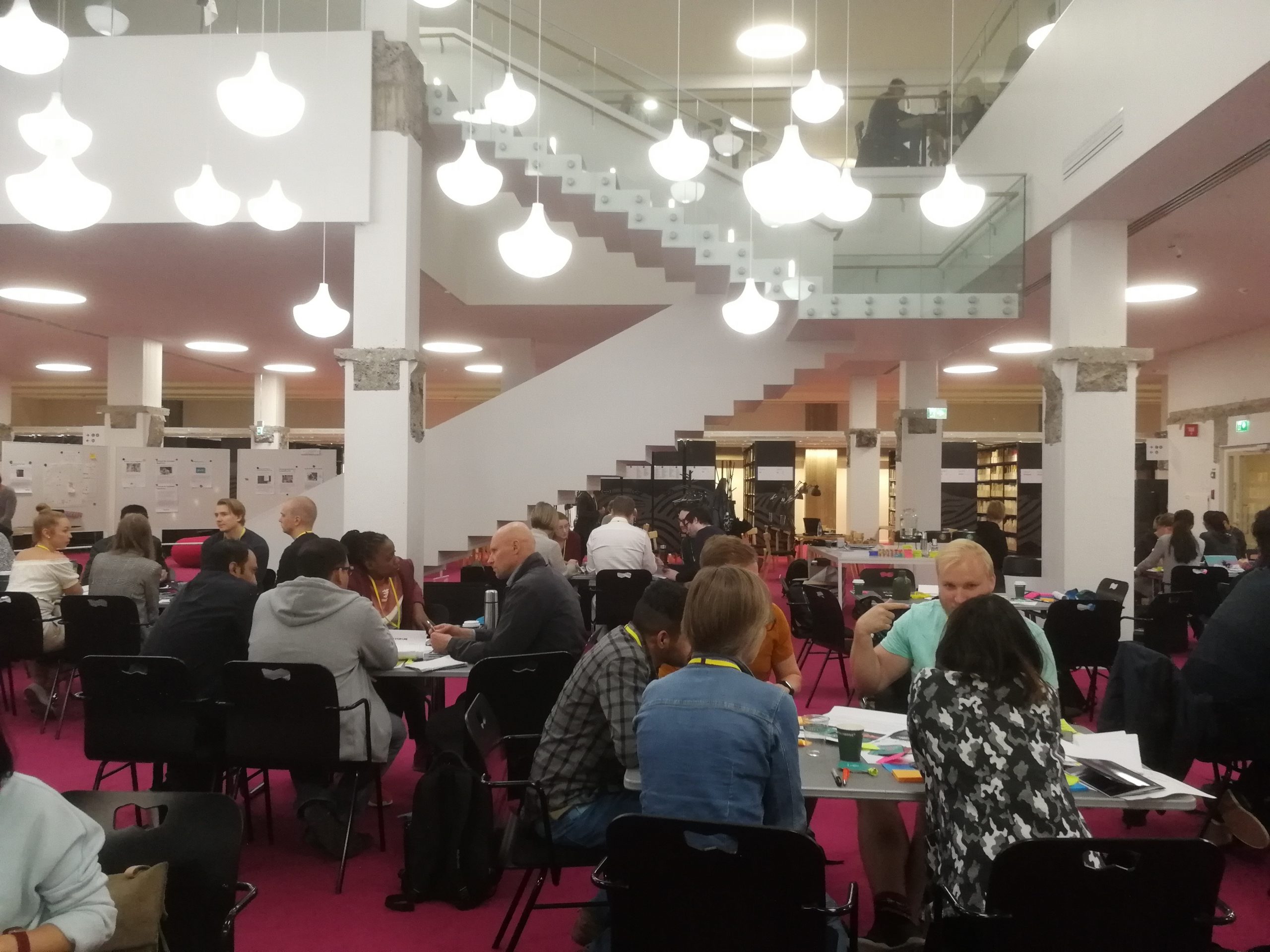
"Yksi intensiivisimmistä viikoista tämän vuoden aikana. Kaksi viikkoa täyttä tykitystä. Tuli validoitua itsestänikin monia ominaisuuksia ja huomasi missä itselläni on kehitettävää”, kiteytti eräs 10 Days 100 Challenges -ohjelman osallistuja kesäkuussa, kun ohjelman viimeinen päivä oli saatu päätökseen. Nyt toista kertaa järjestetyn ohjelman avoimuus teki siitä tälläkin kertaa ainutlaatuisen sulatusuunin, jossa kohtasivat eri kielet, kulttuurit, taustat ja koulutukset. Kuvittele, että työskentelet tiivisti ja paineen alla kaksi viikkoa, aamusta iltaan, uudessa tiimissä, jossa puhutaan montaa eri äidinkieltä ja tiimiläistesi koulutus vaihtelee kemian tohtorista automaatioon, ohjelmistokehitykseen ja bisnekseen. Lisäksi tiimisi osallistujilla on myös toisistaan hyvin poikkeavat työhistoriat ja kulttuuritaustat. Kuinka tiimissä, jossa erilaiset vahvuudet, osaamiset ja taustat kohtaavat, valjastetaan jokaisen taidot yhteisen tavoitteen eteen ja löydetään jokaiselle oma rooli? Kuinka opitaan toisilta ja luodaan yhdessä tapa jolla tiimi saa aikaan hyviä tuloksia? Työelämä muuttuu – mitä työntekijältä odotetaan? Seuraavan kymmenen vuoden aikana työelämässä korostuu teknologian käyttö, kyky sopeutua muutokseen ja jatkuva oman ammattitaidon kehittäminen, selviää vuonna 2017 Suomalaisen Työn Liiton teettämästä Made by Finland -tutkimuksesta. ”Tulevaisuuden työelämässä tarvitaan vastausten mukaan myös lisää kykyä toimia eri kulttuureissa, kykyä markkinoida osaamistaan sekä luovaa ajattelua. Työn tekemisen uudet muodot eivät ole ajasta tai paikasta kiinni, ja rutiinit siirtyvät enenevässä määrin roboteille vapauttaen aikaa ihmisten väliselle vuorovaikutukselle. Teknologia voidaan nähdä ihmisiä yhdistävänä ja inhimillistä vuorovaikutusta lisäävänä tekijänä virtuaalisen yhteydenpidon ohella”, sanoo tutkimuspäällikkö Jokke Eljala. Yhä kiihtyvä muutos liiketoimintaympäristössä ja teknologian kehittyminen vaatiikin työelämässä substanssiosaamisen lisäksi uusia työelämätaitoja ja rajat ylittävää osaamista. Olemme neljännen teollisen vallankumouksen kynnyksellä, joka haastaa perinteiset ammatit, mullistaa työelämää ja kyseenalaistaa perinteisen oppimisen mallit. Tutkintojen arvostus työllistymisen takaajana on jo laskussa, sen sijaan näytöt osaamisesta, kokemus ja kyky toimia verkostoissa kasvattavat merkitystään. Miten korkeakoulu vastaa muutokseen? Korkeakoulujen täytyy myös nopeuttaa reagointia työelämän tarpeisiin. 10 Days 100 Challenges -ohjelma on yksi malli, jossa näitä uusia taitoja opitaan, ja luodaan samalla tärkeitä verkostoja ja työelämäkontakteja. 10 Days 100 Challenges –ohjelma toteutuu 10 päivän aikana ja useassa eri tiimissä (tänä vuonna 18 tiimiä). Ketterät tiimit ja yksilöt luovat tulevaisuuden menestyksen, jolla kasvua rakennetaan. Tällaisen opettamisen mallin vahvuus onkin moninaisuus. Esimerkiksi tänä vuonna järjestetyn ohjelman osallistujista 70 % oli korkeakouluissa opiskelevia. He tulivat kahdeksasta eri korkeakoulusta ja edustivat kymmeniä eri koulutusohjelmia. Loput 30% osallistujista olivat korkeakoulutettuja maahanmuuttajia, työttömiä ja yrittäjiä. Mukana oli tänä vuonna mm. Nokian Polku -ohjelman osallistujia. Samalla monialainen tiimitoiminta asettaa opetukselle haasteen rakentaa oppilaista ja opiskelijoista vahvoja, ratkaisukeskeisiä, itsensä tuntevia yksilöitä, jotka hankkivat jatkuvasti uutta osaamista. He ovat uteliaita ja heillä on sosiaaliset taidot, joiden arvo näissä tiimeissä nousee monia muita taitoja tärkeämmiksi. Ohjelmassa korostetaankin avoimuutta, monialaisuutta ja yhdessä kehittämistä ja noudatetaan 'lean' metodia ja asiakaskeskeisiä ongelmanratkaisumenetelmiä. Lisäksi ohjelmaan osallistuvat yritykset sitoutuvat valmentamaan omia tiimejään ja tuomaan mukaan omia osaajiaan ja resurssejaan. 10 Days 100 Challenges ohjelma järjestettiin 3AMK-yhteistyönä (Metropolia, Haaga-Helia, Laurea) Otaniemessä, nyt toista kertaa, 4.-15.6.2018. Ohjelma on kehitetty ja toteutettu sekä 3AMK:n että Näyttämöt ja Kasvunpajat -hankkeen rahoituksella vuosina 2017-2018. Tänä vuonna teemana oli ”How AI is transforming the way we work and live”. Ohjelma oli opinnollistettu kaikille 3AMK opiskelijoille vaihtoehtoiseksi tavaksi suorittaa pakollisia aineopintoja. Metropolian opiskelijoilla oli mahdollisuus suorittaa kurssi 10 opintopisteen Minno-projektina tai valinnaisena 5 opintopisteen laajuisena kurssina. Linkki videoon (Youtubessa) Lähteet: The Fourth Industrial Revolution, 2017, Klaus Schwab, Economist, Founder and Executive Chairman of the World Economic Forum
Tikissä on Metropolian tutkimus-, kehittämis- ja innovaatiotoiminnan (TKI) blogi. Bloggaajat ovat ammattikorkeakoulun henkilöstöä sekä muita TKI-toiminnan asiantuntijoita. Jos haluat kirjoittaa blogiin, ota yhteyttä toimituskuntaan.
Milla Åman Kyyrö, päätoimittaja
Viestinnän asiantuntija, TKI-hankkeet ja kehittäminen
p. 050 342 0341
milla.amankyyro@metropolia.fi
Päivi Keränen
Projektipäällikkö, Muotoilu
p. 040 184 1952
paivi.keranen@metropolia.fi
Jussi Linkola
Projektisuunnittelija, Hankeviestintä- ja julkaisupalvelut
p. 040 184 2448
jussi.linkola@metropolia.fi
Toimituskunta toimittaa Tikissä-blogin sisällöt ennen julkaisua.












3AMK ammattikorkeakoulu asiantuntija Dallaten FUTU hanke hankeviestintä hankkeet hyvinvointi innovaatio innovaatio-opinnot innovaatiot Innovation johtaminen Katse tulevaisuuteen kehittäminen keksintö kestävä kehitys koulutus metropolia minno nuoret Oona-hanke opiskelijat oppiminen osaaminen osaamisen kehittäminen resilienssi service design sosiaali- ja terveysala tekoäly tki TKI-toiminta tulevaisuus tuottavuus tutkimus työelämä työhyvinvointi työllistyminen viestintä vuorovaikutus yhteiskehittäminen yrittäjyys yritystoiminta yritysyhteistyö

Ideoimme, rikastamme ja kehitämme käytäntöön uusia ratkaisuja yhteistyössä yritysten, julkisen sektorin, järjestöjen ja asukkaiden kanssa.