The Art of Networking – where to start if you don´t know anyone in Finland?
25.8.2022
Riia Hoppania
If you have ever been job hunting, I´m sure you have been told to network. If you have tried to find a job in Finland, you have probably heard that most jobs here are “hidden” and found via networks (1). You might even have first-hand experience that knowing someone has opened the doors for you. There is no doubt that networks are hugely important when looking for work. But where to find these important networks if you are new in the country and feel like you don´t know anyone?
When I talk about the importance of networks with my career coaching clients, I quite often face a belief that networking means contacting random people and asking them to help you, or even to give you a job. If this has been your method too, you have probably faced mainly silence in respond. Networks build on trust (2) and in general people are more willing to help someone they already know. If you are too direct with your requests for help, it can turn against you (3). Building personal networks that are based on trust takes time (4) and unfortunately, there are no shortcuts. However, there are ways to start, even from the scratch, and here are three steps for you to get started.
Step 1: Get involved
Even if your main goal for networking is finding a job, don´t be too focused on purely professional networks (or the lack of them). All personal networks matter, so get involved with people also in other areas of life. If you are new in the country, it can sometimes be easier to start with other social networks, than the professional ones. It´s good to remember that everyone you meet, new friends, neighbors, the girl from the Finnish class, the guy from the cooking class or football team, has their own personal and professional networks. You never know who they might be able to connect you with.
A study done by Rolle Alho showed that international students have formed important networks to the majority population for example by volunteering, attending networking events and meeting people in their hobbies (5). So, start with finding something meaningful to do, volunteer, study, find a hobby and participate social events.
As mentioned before, networks are built on trust and the key ingredients of social networking are trust and reciprocity (7). Instead of focusing on how others can help you, think about ways you could help others. What skills, knowledge, and expertise do you have that could be beneficial to someone else? Could you use your professional expertise to help someone? Helping others can also be a great way of getting references that you can use in your job search later. You may even find potential future customers! Volunteering for NGOs and other associations can also be a great way of networking (6).
I think we all agree that it feels quite nice when someone is showing genuine interest towards us. When they ask questions and pay attention to what we say. When they want to hear about our career stories or the tips or advice we can give. You just simply get a nice feeling about a person who is nice to you. When building networks, be that nice person! Pay attention to others and show interest. Instead of asking for direct help, ask how they did it. Listen and learn from the experiences of others. Whenever you have a chance, say something polite and encouraging. Forbes Councils Member Paul Schaut summarises it well in his blog post: The art of networking is about following the golden rule — treating others how you want to be treated. “
Alho, R. (2020). ‘You Need to Know Someone Who Knows Someone’: International Students’ Job Search Experiences: Array. Nordic Journal of Working Life Studies, 10(2). https://doi.org/10.18291/njwls.v10i2.120817
Alho, R. (2020). ‘You Need to Know Someone Who Knows Someone’: International Students’ Job Search Experiences: Array. Nordic Journal of Working Life Studies, 10(2). https://doi.org/10.18291/njwls.v10i2.120817
Riia Hoppania works as a Career Coach in Metropolia SIMHE services supporting highly educated immigrants with their employment and study paths in Finland. She is working in a collaboration project with the employment services of Helsinki, Espoo and Vantaa-Kerava to increase employment among international professionals in the Helsinki region.
Blog introduces information, tips and insights that help international talents with a higher education background to integrate and find their study and career paths in Finland. The blog is part of Metropolia’s #talentboost actions.
Outi Lemettinen (head editor) Riikka Wallin Anu Luoma Email addresses: firstname.surname@metropolia.fi Editorial Board handles all the publications of Various Variables blog before publishing.
Learning Finnish can significantly enhance the study experience and job opportunities for international students and employees at Metropolia UAS. Many international students choose not to stay in Finland after graduation. Research shows that limited Finnish language skills can hinder their sense of inclusion, affecting workplace well-being, integration, and long-term residency (1). Learning Finnish is crucial for those wishing to stay in Finland. Proficiency in Finnish positively impacts students’ inclusion, well-being, and adaptability (2).
In light of these findings, Metropolia has developed language guidelines emphasizing early Finnish language training in degree programmes (3). Even basic Finnish knowledge can be beneficial in daily life and leisure activities.
International students often face difficulties securing internships or jobs in Finland. Even in English-speaking environments, situations requiring Finnish can arise, leading to feelings of shame and inferiority. The goal of the language guidelines is not to create a monolingual (Finnish or English) environment but to foster a multilingual Metropolia that embraces evolving language skills: Finnish-speaking students are encouraged to use and practice English more frequently, while international students are supported in learning Finnish alongside their other studies — not just in Finnish language courses, but throughout all their studies.
A multilingual Metropolia: a place where everyone feels at home
Language-aware thinking takes a respectful and approving attitude towards different languages and forms of language (4). At Metropolia, we encourage lecturers of degree programmes to incorporate multiple languages into their teaching, allowing international students to hear simple, frequently occurring Finnish expressions and routine phrases as part of their teaching in English (e.g., huomenta kaikille, nyt pidetään tauko, haetaan vähän kahvia) and to become familiar with key course concepts in Finnish — and in other languages that exist in the group — as well. When the group translates important concepts into different languages based on the group's linguistic backgrounds, it often reveals various aspects and nuances of the concept and thus deepens the learning experience. For instance, various aspects of ”early childhood education” are illuminated for the students when they collaboratively reflect on the meanings and connotations of the term "education" in different languages, e.g. kasvatus, education, utbildning, educazione, onderwijs.
It is also important for international students to have opportunities to participate in language-supported internships and to engage with Finnish workplaces early in their language studies. This experience, supported by an internship pair and a language mentor, would greatly enhance their language acquisition.
If there are Finnish speakers within an English-speaking study group, it would be beneficial for them to take an active interest in the Finnish language learning of international students. By doing so, they could provide opportunities for these students to practice Finnish in everyday communication during lunch or coffee breaks.
Is it necessary to learn Finnish when everyone in Finland speaks English?
If the entire Metropolia community exclusively communicates in English with the language learner from the beginning, there is a risk that the institution itself may inadvertently limit the learner's opportunity to acquire Finnish through authentic interactions (5). By incorporating Finnish into safe, informal interactions, in addition to formal language courses, it becomes easier to gradually extend language use to internships and other professional settings. This approach allows the learner's language skills to develop first in informal, low-stakes situations.Many international professionals who have lived and worked in Finland for an extended period have emphasized that learning Finnish was the key to accessing Finnish culture and achieving true integration. Even when work is conducted smoothly in English, managing everyday life can be significantly more challenging without Finnish language proficiency (6).
Many international employees have emphasized that learning Finnish was the key to accessing Finnish culture and achieving true integration.
Metropolia plays a pivotal role in supporting language learning
The language guidelines highlight the crucial involvement of the higher education community in language learning process. A key aspect of developing language skills is Metropolia's provision of a safe and supportive environment for learners to use and practice Finnish. This is especially significant for students who are proficient in English, as they often face challenges in receiving support for learning Finnish: Finnish speakers tend to switch into English when they recognize that their interlocutor is a fluent English speaker or a language learner.
It is essential to provide international students and staff with ample opportunities to practice the language, and they must also seize these opportunities (7). Successful language learners typically exhibit the following traits: a desire to learn, a positive attitude towards the learning process, and the courage to make and learn from mistakes — language is most effectively acquired through active use.
Language is most effectively acquired through active use
To facilitate language learning outside the language courses, it is essential that the surrounding community provides opportunities for learners to engage in meaningful interactions in the target language. A significant obstacle to language acquisition, particularly in bachelor programmes, is the absence of meaningful interactional opportunities in Finnish. Also, an ideology that downplays the value of Finnish language often isolates international students in an English-speaking environment, hindering their Finnish language development (8).
Making student's language skills and goals visible
The language guidelines emphasize the importance of the Language PSP (Personal Study Plan), which is completed collaboratively by the student and their tutor or supervisor (9). This plan outlines the language aspirations and expectations of international students and brings to light the various factors that influence language learning. Finnish, while often regarded as challenging, is not inherently more difficult than many other languages. The primary challenge in acquiring Finnish appears to be the difficulty foreigners face in actively using the language, even within Finland.
The language courses, interaction opportunities, and support provided by higher education institutions alone are insufficient to ensure successful language acquisition. Learners themselves must engage with these opportunities, enroll in as many Finnish language courses as possible, and begin using Finnish, even if their proficiency is limited to a few phrases. It is also essential to dispel the myth of perfect language proficiency. None of us achieves perfection in any language; effective communication can occur even with an accent or minor errors. The essential goal is to be understood and to effectively convey one's message.
A language-aware Metropolia recognizes the crucial role of language skills in students' integration into Finland and their employment prospects. It is also important to understand that multiple languages can be utilized depending on the context. For instance, courses may be conducted bilingually, and it would be beneficial if, in group assignments, students had the option to submit their work in Finnish, English, or a combination of both.
A language-aware Metropolia acknowledges the value of diverse language skills and accepts that English and Finnish may be spoken with various accents and in different ways. Interaction with language learners may require Finnish speakers to slow down their speech and use gestures to facilitate understanding. Although this approach demands some adaptability from Finnish speakers, achieving mutual comprehension in Finnish can be greatly empowering for the language learner.
International student, embrace the opportunity to learn Finnish and enhance your life in Finland!
Three key considerations for international students learning Finnish:1. Proficiency in Finnish is crucial for securing employment and fully enjoying life in Finland.2. Begin speaking Finnish as early as possible, even if only using basic phrases. Start with routine greetings and simple inquiries to practice listening and speaking. Gradually incorporate more Finnish into your conversations as your skills improve.3. Enroll in as many Finnish language courses as possible and seek out internship opportunities where Finnish is the primary language. Actively request language support and mentors. Although learning Finnish requires considerable effort, it is a worthwhile investment that will yield significant benefits.Metropolia language guidelines in nutshell.More tips and ideas for planning and implementing multilingual situations and learning language in different kind of situations will soon be published on the Metropolia intranet. Stay tuned!
Author
Eveliina Korpela works as a senior lecturer at Metropolia UAS and as a researcher at the University of Helsinki in a project Multilingual Worklife and Means of Participation. She is currently developing multilingual practices and language learning at work also in Kielibuusti-project. She has co-published numerous Finnish language textbooks and, along with her research team, authored a Guide for a Multilingual Workplace (Monikielisen työyhteisön opas, Alma Talent, 2023).
Sources
Nikulin, M. 2019. Akateemisen maahanmuuttajan suomen kielen taidon tarve työssä ja arjessa. Lähivõrdlusi. Lähivertailuja, 29, 171–203. http://dx.doi.org/10.5128/LV29.06
Cf. Stilling, E. 2022. Med språket som strategiskt verktyg. Guide till ett språkutvecklande arbetssätt för chefer, HR-personal och beslutsfattare. Tukholma: Föreningen Vård- och omsorgscollege. https://vofront-files.vo-college.se/vofront_files/218c4845-cc38-4a38-84c0-8e88da116abe.p
Language guidelines in nutshell. https://www.metropolia.fi/en/about-us/language-guidelines
Kielibuusti-hankkeen sivut. (2024) https://www.kielibuusti.fi/en/employers/multilingual-workplace/steps-toward-language-awareness-in-the-workplace
Cf. Lønsmann, D. 2015. Language ideologies in a Danish company with English as a corporate language: ‘it has to be English’. Journal of Multilingual and Multicultural Development, 36 (4), 339–356.
Lehtimaja, I., Korpela, E., Komppa, J., Kotilainen, L. & Kurhila, S. 2023. Monikielisen työyhteisön opas. Helsinki: Alma Talent.
Kirilova, M., & Lønsmann, D. 2020. Dansk – nøglen til arbejde? Ideologier om sprogbrug og sproglæring i to arbejdskontekster i Danmark. Nordand – Nordisk tidsskrift for andrespråksforskning , 15 (1), 37–57. https://doi.org/10.18261/issn.2535-3381-2020-01-03
Intke-Hernandez, M. 2021. Kielenoppija tarvitsee tuekseen kielitietoisuutta ja yhteisiä tekoja. Kieli, koulutus ja yhteiskunta, 12 (6). https://www.kieliverkosto.fi/fi/journals/kieli-koulutus-ja-yhteiskunta-joulukuu-2021/kielenoppija-tarvitsee-tuekseen-kielitietoisuutta-ja-yhteisia-tekoja
Kielibuusti-hankkeen sivut. Kieli-HOPS. Language PSP. https://www.kielibuusti.fi/en/learn-swedish/language-learning-tips-and-resources/plan-your-language-learning-with-language-psp
No matter how long you spend in Finland, there will always be new experiences. It is a very similar situation for new entrepreneurs. New situations need new information and solutions. Having lived in Finland for almost 20 years, I know that there are still things that come up where I have absolutely no idea what to do. What I have learned in all these years, is where to start looking for the answer. In the information age, this is one of the most important skills you can have.
We don’t need to know all the information at once; in fact, we wouldn’t be able to process all the information even if we heard it. A lot of things are unnecessary until they are necessary. If you arrive in country as a single, independent student, you don’t need to understand the daycare system, and in entrepreneurship, understanding how to take a company internationally is not the first thing you will learn in your entrepreneurial journey. This is the same situation for immigrants and entrepreneurs all over the world.
Whole-life Events
Just like integration, entrepreneurship is a whole-life event. As an immigrant, no matter what you are doing to subsidise your life, this means two things:
You will be creating a whole life for you and your family – not just the hours you study at an institution or work at a job.
You will spend your whole life integrating.And in parallel, as an entrepreneur, your time is now not bought by an employer but can now take far more of your daily time to create. You are only stopped by the limits that you impose on yourself.
As every new challenge comes your way, you will need to figure out how to address it. Some of the challenges you might find yourself facing as an immigrant are:
finding housing
accessing healthcare services
searching for jobs
becoming an entrepreneur
finding ways to spend your leisure time
learning Finnish or Swedish
dealing with emergencies
finding and completing further education
understanding the primary education system
As an entrepreneur, you are seeking help with:
concepting an idea
testing your ideas
learning new software
learning how to understand your potential market and customers
building a customer base
designing and re-designing offers
building a website
understanding how to utilise different social media channels for selling and brand building
accounting
deciding which tasks to delegate and which services to buy from others
AS previously stated, no one resource will help you in all these situations, understanding where to find these resources that can help you with all of these questions is a very big step in the right direction.
Support During Studies
When you come to Finland as a student, there is a good chance that you have come alone, and you are ready for all kinds of adventures. You will also be lucky enough to have a general support system that the institution provides. This is great and it can really help you to settle in and find your feet.
Then you graduate, a celebratory event which also means big changes in your life. When you are a student there are many services that you do not need to seek outside the institution. It is possible that as an alumnus, you can access certain institutional services, so make sure that you check with your former institution to see what is still accessible for both your immigrant journey and your entrepreneurial one.
Staying in Finland After Studying
Once you have finished your education, you may be looking for a more permanent job (possibly different than the one you have done while at school if you have been working) or to expand on any entrepreneurial thoughts you may have had during your studies. These, again, are slightly different sets of skills and resources that you will need.
A good place to find both information about your new situation in life and even entrepreneurship is the Newcomer’s Guide (pdf) produced by the Cities of Helsinki, Espoo, and Vantaa. The label ‘Newcomer’ is too narrow, in my opinion, for the information that it contains. You definitely need some of this information when you first arrive, but it is helpful to refer to the guide at different stages of your life in Finland.
The Newcomer’s Guide also has advice on where to look for different kinds of employment, including entrepreneurship and a review of the startup ecosystem. Being gainfully employed is a huge part of many people’s integration. Sometimes that requires you to start your own company. There is a whole ecosystem in the capital area for this and the guide helps to explain it. In the near future, there will also be an online service that Metropolia UAS and the City of Helsinki are currently developing that will help aspiring or budding entrepreneurs to find the right path through their entrepreneurial journey.
In order to further your understanding of what is currently available to you as an entrepreneur, you can read my previous Various Variables blog post Entrepreneurship – Using Your Skills in Different Ways and this previous blog post by Vejay Nair & Marika Antikainen.
My own experience
For myself, I reflected on what contexts I have inhabited during these past 20 years in Finland. I have been:
a single exchange student (with no dependents)
a married person (to a Finn)
a degree student
a married parent
a divorced single parent
an unemployed spouse
an unemployed single parent
a full-time entrepreneur
a part-time entrepreneur
a temporary employee
a full-time employee.
It has been quite a journey, but it is one that has new challenges at every bullet point. This diversity and length of experience is also the reason that I feel that I have some insight that can help to guide people in finding the right resources at the right time. All of the situations above have taught me the value of being open and asking for help.
Continue To Be Open
The common skill that I have cultivated the most being an immigrant and an entrepreneur is to ask for help in order to understand new things. Life is full of things that do not make sense, are just outside of our current skill set, or we need a little time to learn. YouTube videos are a deep resource to anyone who wants to do something new. But outside of online resources, you can ask real people for help to find what you need. Not everyone will be able to help you, but every time you ask, you get a tiny bit closer to the answer. Even if it is just eliminating what is not the answer.
Employment may be difficult to find for some newcomers to Finland. One of the ways to make sure that your skills continue to develop or are utilised is to become an entrepreneur. There are different kinds of entrepreneurship in Finland. Many factors will determine if you want to try entrepreneurship, but it is always worth considering even if it is not your first choice.
As mentioned, there are different forms of entrepreneurship; the two most common forms are a sole entrepreneur (toiminimi in Finnish) or a limited company (Osakeyhtiö in Finnish). Other options exist as well such as becoming a light entrepreneur and a freelancer. Each have their own rules and regulations. For more specific information on these forms of entrepreneurship, you can visit the Uusyrityskeskus (New Business Centre) in your city, or you can check out more information in the yearly guidebook that the Uusyrityskeskus creates.
All of the initial information that you will need to consider becoming an entrepreneur is included in this comprehensive pdf guidebook. It is also available in Swedish and Finnish. The 2019 version of the guide is also available in Russian, Arabic, Chinese and French on the Uusyrityskeskus website. These will still be helpful because the information does not change too much year on year. Remember to always double check it – especially if it is about taxes, pensions, or anything that you need to pay. These numbers can change yearly.
What Will I Sell?
There are different ways to become an entrepreneur. In this section, we will look more closely at four different ways to become an entrepreneur. Your own situation and skillset will determine which route you take. You can have an idea that you have created yourself, you can decide to create a consultancy to sell the skills that you already have, or you can even purchase a business that already exists.
Consulting Others
A consultancy is when you take the skills and education that you already have and sell those to customers. A consultancy is a service business which means that you provide expert services for customers. Consultancies, in general, do not sell products.
Buying an Existing Business
As current entrepreneurs wish to retire, there are more and more businesses in Finland that require new owners. Purchasing an existing business is a solid way to become an entrepreneur if this is what you want. The companies already have customers and there is a defined market for them. It is also possible that a fresh pair of eyes will find new ways to make the business grow and modernise. This is sometimes referred to as Business Transfer or Business Acquisition
The Federation of Finnish Enterprises (Suomen Yrittäjät) has a unit dedicated to this specific way of becoming an entrepreneur. They even run some information sessions about it. You can see all the information that they have on this topic on their website.
Your Own Idea
You may even have your own idea of what you can do. This can be a café, an import/export business, selling crafts that you make, etc. The possibilities are endless. You can even decide if you want to do this entirely online or in a physical shop. Possibilities exist to do this by yourself or partnering with someone else. Often this kind of entrepreneur is called self-employed.
Create a Startup
A startup is a term that has been confused over the years and is sometimes used to describe starting any kind of company. But this would be incorrect. A startup is a company that is intended to be scaled pretty quickly. Most likely, this means that it is a tech-based company. Finland’s capital area, which includes Helsinki, Espoo, and Vantaa, is well known for its startup ecosystem and has produced quite a few tech startups.
Finding an Idea
There are many ways to find an idea for starting a business. Below I have listed five ways to begin exploring how to find your idea. The outcome of this brainstorming will fit into one of the four categories in the previous section about what to sell.
1. Let Go of Originality
There is a place for original ideas, but it is rare to have one. Someone somewhere will have thought of the same thing either in part or as a whole. That is ok. Having ‘competitors’ means that there is already a market for that service or product you are considering. Google was not the first browser and Apple was not the first phone maker.
2. Use Your Skillset
As mentioned above, you have a bunch of skills that can be utilised. You just need to thoroughly analyse them to identify how you might package them. What do you know well that others do not? What can you do easily that others need help with? These types of questions will help you to understand what your unique selling point is.
3. Solve a Problem or Identify Underserved Needs
We walk around every day being irritated by things that we feel do not work well or are not fit for purpose. Are any of these things fixable by you in a way that you could monetise? Use your irritation to create a sellable solution.
The same principle can be applied to underserved needs. Can you see that a certain product is missing that you have seen other places? As someone coming from outside the country, there are places where you can imagine a different way or product for doing something. Different cultures solve problems differently and this new perspective could help to find gap in the market. This gap may be filled using something that you know about that others do not. A great example of this is the Finnish astiankuivauskaappi (dish drying cabinet). It even has its own Wikipedia entry.
4. Build on Products or Services That Already Exist
Sometimes you see a product or service that could be extended or improved with an independent addition. When iPhones started coming out, independent retailers began to provide all kinds of covers for them. This was something that they could see that people would need since they were very expensive and needed protection, but it also allowed people to personalise their phone as a statement. You could be an expert in Excel spreadsheets and you could decide to sell courses in how to increase productivity with that tool, or you could create an e-book that has a glossary of ‘hacks’.
5. Ask Family and Friends
Asking family and friends what they think you do well or even analyse what it is that they ask for help in from you is a great place to start your exploration. Sure, you may help them for free because they are your family and friends, but would there be a market for turning those skills into something you can sell. Maybe you create simple websites for your friends so that they can display a portfolio or even for their business.
Support for Entrepreneurship
Once you have come up with your idea, it is time to start thinking seriously about testing your idea and figuring out how you will create your business. Some decisions will be about what kind of funding you will need to make it happen. In the beginning, it is a good idea to ‘bootstrap’ which means to try to make it with as little outside funding as possible. But that does not mean that everything should be done on your own.
The Startup Grant (StarttiRaha)
Even though the name seems that it is only for startups, the Startup Grant, can be used for almost all types of companies. There are some types of companies that they will not give the grant for, but you should check with the Uusyrityskeskus to find out if your company idea is eligible.
The Startup Grant is intended for helping new company owners cover basic needs during the starting up phase of the company. This means that if you receive it, it is approved for 6 months and then you are able to apply to have a second 6 months. It is important that you do not register your company before you are given approval for this grant.
Help to Become an Entrepreneur
There are many organisations out there that want to help entrepreneurs. Many times, the help is providing information, but it can also be with things such as:
Registering the company
Giving advice before and after you have started it
Industry specific advice
Mentoring
Idea development
and more
There are many organisations that can help:
Business Helsinki
Business Espoo
Yritys Vantaa
Suomen Yrittäjät
Startup Refugees
The Shortcut
Kiuas
For more information about organisations that can support your entrepreneurial development, you can check out this previous blog post by Vejay Nair & Marika Antikainen.
Becoming an Entrepreneur as a Student
There is even a way to get help if you are a student. At many universities and universities of applied sciences in Finland, you will find courses and units that focus on helping students to become entrepreneurs.
At Metropolia, this is the Turbiini pre-incubator programme. This course allows students to earn credits for developing their ideas and for learning the skills needed to become an entrepreneur. In 2023, 175 students went through the Turbiini course and already in 2024, there are 118 students signed up for the course in the first half of the year. The course is run in Finnish and in English. If you are not an official Metropolia student, then you can apply to take the course through Metropolia’s Open University.
Blogger
Pamela Spokes works as a Service Designer in Metropolia’s RDI team. Originally from Canada, Pamela has years of experience in university admin focusing on international recruitment, marketing, and the international student and staff experience. With a Bachelor’s degree from Canada, a Master’s degree from Sweden, an MBA in Service Innovation & Design from Laurea UAS, and her AmO from Haaga-Helia UAS, she is well-versed in being a global citizen. She has lived in Finland for more than 15 years and is also an entrepreneur.
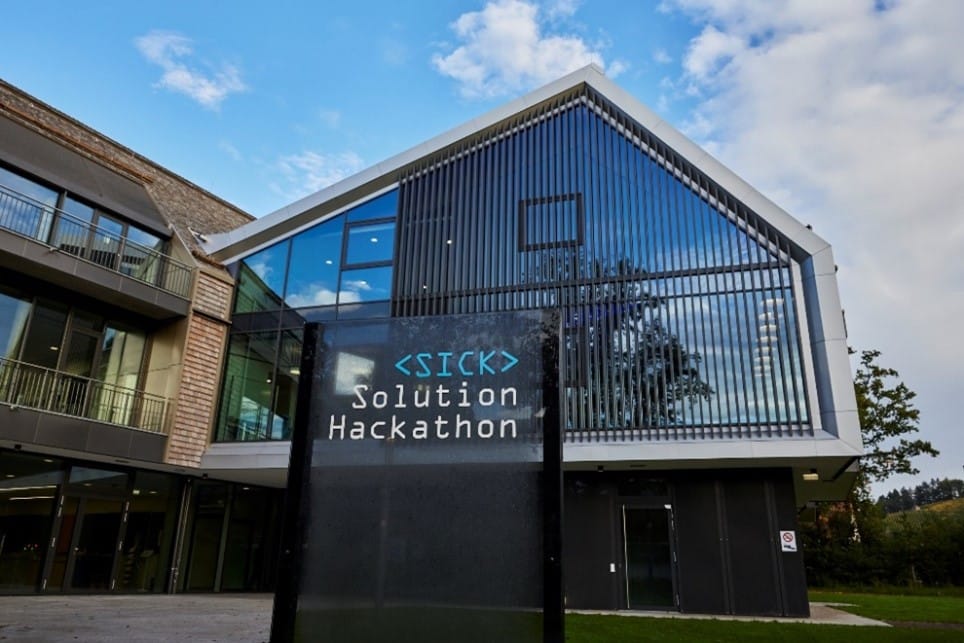
Being a student at Metropolia University of Applied Sciences is a unique experience that transcends traditional education. Metropolia encourages students to actively participate in various events and community initiatives, paving the way for personal growth, skill development, and the formation of invaluable connections. My recent experience with Jesse Bove, Samuli Ahokas, both students and Garage Club members, and Niilo Jaakola from the University of Tampere at the SICK Sensor Intelligence Hackathon in Germany showcased how these opportunities can lead to unforgettable life experiences.
Garage Club, Robo Garage, and AIoT Garage
Picture: Garage logo.
Garage Club is a social community created by students from different academic fields to work on their hobbies and participate in activities and competitions focused on autonomous robotics and technology, artificial intelligence and the Internet of Things (AI & IoT), indoor and outdoor mobile robotics, and drones. Garage Club also provides students with the chance to connect with companies and network with industry professionals through projects and collaboration activities.
Garage Club is part of Robo Garage and AIoT Garage, two of Metropolia’s collaboration platforms that focus on Robotics, IoT, AI, and machine learning technologies. For more information, visit the following links:
Garage Club: https://www.metropolia.fi/en/rdi/collaboration-platforms/garage/club
Garages: https://www.metropolia.fi/en/rdi/collaboration-platforms/garage
Skill Development Through Active Participation
Picture: Metroteam members working with other team members.
At Metropolia, students are provided with numerous opportunities to engage in hands-on learning experiences. From the Garage Club to collaboration platforms like Robo Garage and AIoT Garage, students can work on innovative projects that enhance their technical skills and creativity. These platforms allow students to work with cutting-edge technologies and apply theoretical knowledge to real-world problems.
During the SICK Hackathon, our team chose to develop a solution to improve road safety using SICK’s sensor technology. Although we faced many challenges, our previous experience with courses and SICK LiDAR sensors at Metropolia made it easier to set up our hardware and extract necessary data from the provided engineering software. This experience sharpened my problem-solving abilities and technical skills, fostering a practical understanding of our fields and preparing us for the workforce.
Networking with Global Professionals
Picture: Metroteam members discussing ideas with ABB robotics professional.
Metropolia's emphasis on international collaboration allows students to connect with peers and professionals from around the world. The SICK Hackathon brought together participants from diverse backgrounds, facilitating rich exchanges of ideas and perspectives. I made connections with fellow students and industry professionals, expanding my network and gaining insights into various fields.
These networking opportunities are invaluable. Metropolia hosts various events and initiatives that connect students with industry experts, enhancing our understanding of the job market and helping us prepare for future career paths. Garage Club also facilitates interactions with professionals, offering mentorship and guidance.
Creating Unforgettable Life Experiences
Picture: Metroteam members at SIA Academy during SICK Hacakthon.
The journey at Metropolia is about more than just academics; it’s about creating lasting memories and friendships. The connections formed during events like the SICK Hackathon often lead to collaborations and lifelong friendships. Being part of a community that values innovation, teamwork, and diversity enriches our educational experience.
Metropolia's international focus means students can participate in global events, further enhancing their cultural awareness and understanding. These experiences not only broaden our horizons but also instill a sense of adventure and curiosity that will serve us well in our careers.
Being a student and a staff member at Metropolia University of Applied Sciences means embracing opportunities for growth, learning, and connection. Through active participation in university events, students can develop vital skills, build confidence, network with professionals, and create unforgettable experiences. Initiatives like the Garage Club and partnerships with organizations such as SICK, ABB, and many more, show how Metropolia provides an environment where students can thrive and excel.
Picture: Metroteam and other participants from Finland.
Whether you're attending hackathons, joining innovative projects, or simply engaging with peers, Metropolia offers a wealth of opportunities that prepare students for the future. I am grateful for my experiences and excited to see where this journey will take me next!
Join us in Garage Club and connect with talented students, future clubmates, and industry professionals! Send us an email, and I would be more than happy to add you to our community!
Writer: Fayez BassalatElectronics Engineering StudentProject Assistant and Garage Club Hostfayez.bassalat@metropolia.fi











Comments
No comments