
Talent hubs in the making: collaborating for a Future Finland

Finland faces a challenging future with the declining birth rate and ageing population (1). The welfare state needs more education and work based immigration to survive (2). Frustration over international professionals’ struggle to land jobs in Finland increases (3). Requirements of fluency in Finnish is the number one barrier for employment (4). We are all growing familiar with these kinds of headlines. There is no way around it: Finland needs to invest more in international professionals — not only in attracting new talent to Finland, but also in solving the struggles with employment and inclusion. The long overdue change requires a shift in attitudes and practices as well as structural amendments across sectors and spheres of life. That change is now being pushed hard, and in more extensive collaboration than ever before. Are you already familiar with what is happening on the strategic and structural levels to solve the employment challenge? Or have you noticed how these strategies impact the services you get as an international professional? Holistic quality services across organisational boundaries ”The career coach I spoke to was very friendly and straightforward, paid attention to my needs and wishes and offered guidance based on those.” “The career coach does a great job and she is very empathetic and helpful. She got me a whole list of advice and possibilities where to find a job and studies in Finland.” What is your experience of valuable service? These customer quotes highlight the importance of matching opportunities with your needs, regardless of which organisation provides them. Indeed, according to research, efficient and holistic solutions for individuals are created in networks (5). And, even if Finland is no way near the ideal situation yet, the good news is that a lot is currently being done to make Finland more open and inclusive at all levels. Funding is targeted to steer operations towards the shared goals. New services and projects are popping up like swimmers by a lakeside on a hot summer day. With the increase in numbers, however, comes the challenge. How can you navigate in the jungle of services? How can you find the right ones for you and not fall between the cracks? Rather than everybody becoming Sherlock Holmes, Finnish service providers must commit to coordinated collaboration for smooth and knowledgeable services. Talent Boost and local government pilots on employment: joint efforts to increase access to job market Strategically speaking, changing the course of this country requires a shared goal as well as coordination and cooperation, both nationally and locally. Luckily, there is a genuine motivation to work in collaborative networks in Finland. And, this is how strategies slowly start dribbling down into the quality of services for you. On the national level, the cross-administrative Talent Boost programme was launched a few years ago to coordinate the wide variety of services and operators working with international professionals and students in Finland (6). The programme objectives are to make: Finland more attractive internationally, employers willing and able to recruit international talent and international professionals’ expertise to drive internationalisation and renewal of Finnish companies and organisations. Changes are taking place on the municipal level as well. The new local government pilots on employment are set to improve quality and coordination in employment services (7). The initiative brings about massive restructuring of responsibilities between the state, municipalities, public employment and business services (TE services) and other local actors. The pilot municipalities have taken charge of employment services for selected groups of unemployed jobseekers, including immigrants and foreign-language speakers. The goals of the pilots are ambitious: to increase employment, to create new solutions, to improve access to labour market and to develop services and service models in networks. Both initiatives are in line with the government programme towards a more sustainable and inclusive Finland, built on competence and skills (8). If one word were to be picked from all these policies and strategies, it would be together. Network collaboration becoming reality in the Helsinki region: through the lens of Metropolia Behind the scenes, a hub of networks is indeed buzzing in the Helsinki region. What does this mean in practice for you? A few concrete examples can be explored through the lens of Metropolia SIMHE services (Supporting Immigrants in Higher Education in Finland). Are you unemployed, live in the Helsinki region and have a higher education degree? If yes, you will have access to Metropolia’s guidance and education services to unemployed international professionals, developed in collaboration with the employment pilots of Helsinki, Espoo, Vantaa and Kerava (9). Your employment services perhaps guide you directly to the already well-established personal SIMHE guidance. You might join SIMHE group guidance, e.g. Guidance Generalia lectures and smaller group activities. In these services you get support in your study and/or career path from the SIMHE career coaches. They are specialised in guiding international professionals with a higher education degree or wishing to get one. Guidance is based on your needs, competences and career wishes, matching you with the right opportunities in the service networks of the area and Finland. Are you in a different life situation? Don’t worry, SIMHE guidance services are also available to you. You just need to explore our services and book an appointment yourself on our website. If your background matches, SIMHE career coaches will guide you to Metropolia’s new Career Boost programmes for unemployed jobseekers. The programmes run in the fields of automation business, business accounting, ICT, nursing and real estate and construction. In these programmes you get to develop and update your field-specific and Finnish language competence and get connected to local employers. A Metropolia expert of your field also maps and documents your competence to help Finnish employers better understand your expertise — and recruit you. You might also bump into a SIMHE career coach in activities of other organisations and associations, most recently with e.g. Luckan Integration, International Working Women of Finland ry and Nyyti ry, or in social media groups. Vice versa, in Metropolia’s SIMHE activities you can get insights and advice from specialised visiting speakers, e.g. EDUFI on recognition of qualifications, NewCo Helsinki on entrepreneurship or company representatives and international talents themselves on work-related topics such as professional networking or job seeking channels. In addition, you might end up participating in some of the services developed in the Talent Boost project International Talents Accelerating Growth, e.g. in recruitment events, a Spouse programme, public services of the further developed International House Helsinki or the EntryPoint mentoring programme (transitioning to the City of Espoo in the autumn 2021). If you are a student, maybe you are applying for a job through JobTeaser, a career and recruitment portal launched in collaboration with the higher education institutions in the region. A new Talent Helsinki project, together with similar ones in Espoo and Vantaa, will make sure to continue the coordinated work for more excellent services! And while looking for a job, did you know for example that companies can apply for Talent Explorer funding from Business Finland when recruiting international professionals for certain types of jobs? Or that they can get advice and counselling service on international recruitment from International House Helsinki? It is indeed a growing network of experts that are working together to make Finland work for you. Together towards a Finland 2.0 Certainly, no man is an island — neither is a service provider in a Finland 2.0. Improving employment opportunities for international professionals requires awareness raising and action at all layers of society, from individuals to companies and organisations and the government. This country can succeed only in collaborative networks. Customised, easily accessible, quality support for international talents is a must, and so is continuity to these services. Service providers as well as strategy makers need to re-think the way they operate and push further. Importantly, you need to have the opportunity to participate in developing the Future Finland. Yet, crucial to employment is naturally that more and more Finnish companies and organisations change their recruitment practices. Operations must be adjusted towards an inclusive work culture. Luckily, we have a growing number of forerunners showing their colleagues how to do it in a Finland 2.0. Also, the front of organisations helping employers find, recruit and support international professionals is becoming wider and wider. The road map is there. Let’s take a tiger leap towards the Future Finland together. Now. Interested in reading more on the topic? See the recent publication: Stenberg, H., Antikainen, M., Lintala, E. Roivas, M. 2021. Towards a Finland of talents together – insights on the SIMHE operations. Metropolia University of Applied Sciences, TAITO 70. Sources: Yle 2021. Consultancy: Foreign labour needed to combat population decline. Yle News. Viewed on 9 June 2021. Teivainen, A. 2021. Chamber of Commerce: Finland needs target of 30,000 for skills-based immigration. Helsinki Times. Viewed on 9 June 2021. Faye, N. 2021. "Brain waste" squanders potential and talent in Finland. Yle News. Viewed on 9 June 2021. Rask, S. 2021. The biggest problem internationals face on the Finnish job market – and 3 ways to solve it. Vieraskynä. Mothers in Business blog. Viewed on 9 June 2021. Rautvuori, M. & Jyrämä, A. 2015. Kaupungin kehitystyön kehittäminen - verkostonäkökulma. In Palvelumuotoilu saapuu verkostojen kaupunkiin: Verkosto- ja muotoilunäkökulmia kaupungin palvelujen kehittämiseen (pdf). 119-136. Aalto-yliopiston julkaisusarja. Viewed on 9 June 2021. Ministry of Economic Affairs and Employment of Finland. 2021. Talent Boost programme. Viewed on 9 June 2021. Ministry of Economic Affairs and Employment of Finland. 2021. Local government pilots on employment. Viewed on 9 June 2021. Government Programme. 2019. Inclusive and competent Finland – a socially, economically and ecologically sustainable society. Viewed on 9 June 2021. Metropolia. 2021. Metropolia promotes international professionals’ entry to local job market in collaboration with employment pilots. Viewed on 9 June 2021.
Find your way to become a Finnish speaker

According to the interesting Expat Insider 2021 survey (3), Finland is in the top 5 for quality of life, but even 50 % of expats are pessimistic about the local career opportunities. Surprising? Despite possibilities to communicate in English (75% of respondents agree that you can get by without speaking the local language), it is considered hard to get used to the local culture and make local friends. Also, even 71% struggle with learning the local language (vs. 42% globally). Good reasons to invest in language learning? Finnish workplaces are getting more and more international, but knowledge of the local language is still required in most organisations, for both finding employment and advancing in a career (2). Even if the working language is English, Finnish is often used in various communication situations (4). Requirements related to language skills naturally vary depending on the job description and the industry. According to a survey by the Helsinki Region Chamber of Commerce (2), already the beginners’ level A1 is of advantage to get at least an internship. The intermediate level B1 enhances remarkably the chances to get at least an internship (enough for 65% of the companies). Most of the companies (about 65%) require at least the independent level B2 in skilled worker positions and the advanced level C1-C2 in expert and management positions. On the whole, knowledge of the local language provides many benefits. Already presenting yourself, having simple small talk and understanding main points in everyday conversations make you feel more connected to the language community. By using the local language you show your interest and commitment in an efficient and convincing way. Language skills widen your career opportunities to the public sector, smaller local companies and entrepreneurship. At the same time, language skills increase your sense of control and well-being by enabling you to follow the information flow in your everyday living environment (4,6). Identify the motivating language learning strategies Are you one of those struggling with learning Finnish? If yes, you are not the only one! The structure and vocabulary do differ a lot from at least the Indo-European languages. Nevertheless, to learn any new language, you have to be exposed to it (a lot), and work on it (a lot). What you really need is to find and keep up your motivation. According to theories of functional language learning (1,7) the best way to learn the language is to integrate it into your everyday life in the ways that you like. There are lots of good language courses, books and online materials available, but the key is to recognise the opportunities to use the language and apply your skills in your environment. The super-talented language learner Brasilian Gustavo (Brassinyymi) has learned Finnish with the help of Finnish metal music, Fred Karlssons Grammar book and Uusi kielemme website. He listens to Yle news in Easy Finnish and chats in Omegle. Of course not everybody has to be able to do the same, but there are methods for everyone to make language learning easier, faster and funnier. First, focus on what is relevant to you. Second, keep your eyes, ears and mouth open. You need to listen a lot, make observations - and imitate. Start using the language straight from the beginning. There is no need to be fluent before starting! Also, don’t give up if the answer is in English (Finns are still very stubborn to switch into English instead of supporting Finnish language learning)! If you feel shy, you can speak first to your flowers or cats. After that, there is no limit for imagination. You can search for other language learners and set up a language club, find a language mate in Lango or join a language cafe. You can join a Facebook or a hobby group that are of your interest, watch films e.g. in Yle Kielikoulu or listen to music, sing along and write the missing words (lyrics training). In the learning process, instead of thinking about everything you cannot do, it is important to enjoy learning and feel good about all the situations you can already manage. After all... Language skills requirements seem to be sometimes even unnecessarily high, but there are also some positive signals in sight. Employers seem to be more and more willing to support the language learning process at work (8). This indeed is highly recommendable: professional language skills related to specific work can only be acquired in real-life work environments (5). Finland and Finnish organisations must open themselves more to Finnish speakers who are not fluent. From another perspective, learning a new language is not connected only to concrete usefulness related to employment or career opportunities. Have you had the experience of really diving into the new language, starting to think directly through it? Have you felt the joy of becoming a member of a language speakers’ group? Learning a new language not only opens doors to work opportunities, society and culture. It is an inspiring possibility to find new ways to be you and what you could be. We support you! Metropolia supports your Finnish language learning in many ways. Degree students in Metropolia: Find a Finnish course for your needs offered by your degree programme or in Elective language studies. Ask also your degree programme and/or Finnish teacher about other possibilities to further your language learning during your studies: could you integrate Finnish into your studies or focus more on your language skills during the work placement? (Read about Ahmet’s experiences: Courage to use Finnish – growing into a professional). Find tips and materials to learn the language in the Job Teaser resources. Other language learners: Check the selection of Finnish courses available in Metropolia Open UAS in 2021 and find a course for your needs. If you are searching for a job and you already know the basics of the language, find my Youtube videos Kerro itsestäsi työnantajalle 1-3 minuutissa and Tervetuloa työhaastatteluun. Writer: Eevamaija Iso-Heiniemi works as a S2-teacher (Finnish as a second language) in Metropolia and SIMHE Continuation project. Sources: Aalto, Eija, Mustonen, Sanna & Tukia, Kaisa 2009. Funktionaalisuus toisen kielen opetuksen lähtökohtana. Virittäjä 3. 402–423. Viewed on 31 May 2021. Helsingin seudun kauppakamari, 2018. Yritysten kokemukset ulkomaisesta työvoimasta työmarkkinoilla. Katsaus koulutettujen maahanmuuttajien sijoittumiseen Helsingin seudun työmarkkinoille (pdf). Viewed on 11 June 2021. Internations 2021. Expat Insider 2021 survey report. Viewed on 15 June 2021. Jäppinen, Tuula 2010. Suomi (S2) korkeakoulutettujen työssä – Millainen kielitaito riittää? Soveltavan kielitieteen tutkimuksia AfinLA-e. Published on 14 January 2011. Viewed on 15 June 2021. Komppa, Johanna 2015. Työnantajan odotukset, työntekijän vastuu ja työyhteisön tuki. Näkökulmia korkeakoulutettujen maahanmuuttajien ammatillisen suomen oppimiseen. Soveltavan kielitieteen tutkimuksia AFinLA-e. Published on 13 January 2016. Viewed on 27 May 2021. Lehtimaja, Inkeri 2017. Korkeakoulutetun maahanmuuttajan oikeus oppia Suomea (pdf). Kieliverkoston verkkolehti Kieli, koulutus ja yhteiskunta. Viewed on 31 May 2021. Mitchell, Rosamund & Myles, Florence 1998: Second language learning theories. London. Arnold. Taloustutkimus Oy. 2020. Kotona Suomessa – Selvitys maahanmuuttajien rekrytoimisesta: Tutkimusraportti (pdf). Kotona Suomessa -hanke, Elinkeino-, liikenne- ja ympäristökeskus. Published on 15 May 2020. Viewed on 2 June 2021. Yle News: Brasilialaismies tahtoo Suomeen niin kovasti, että alkoi tubettaa suomeksi. Published on 13 May 2021. Viewed on 15 June 2021.
Courage to Use Finnish – Growing into a Professional
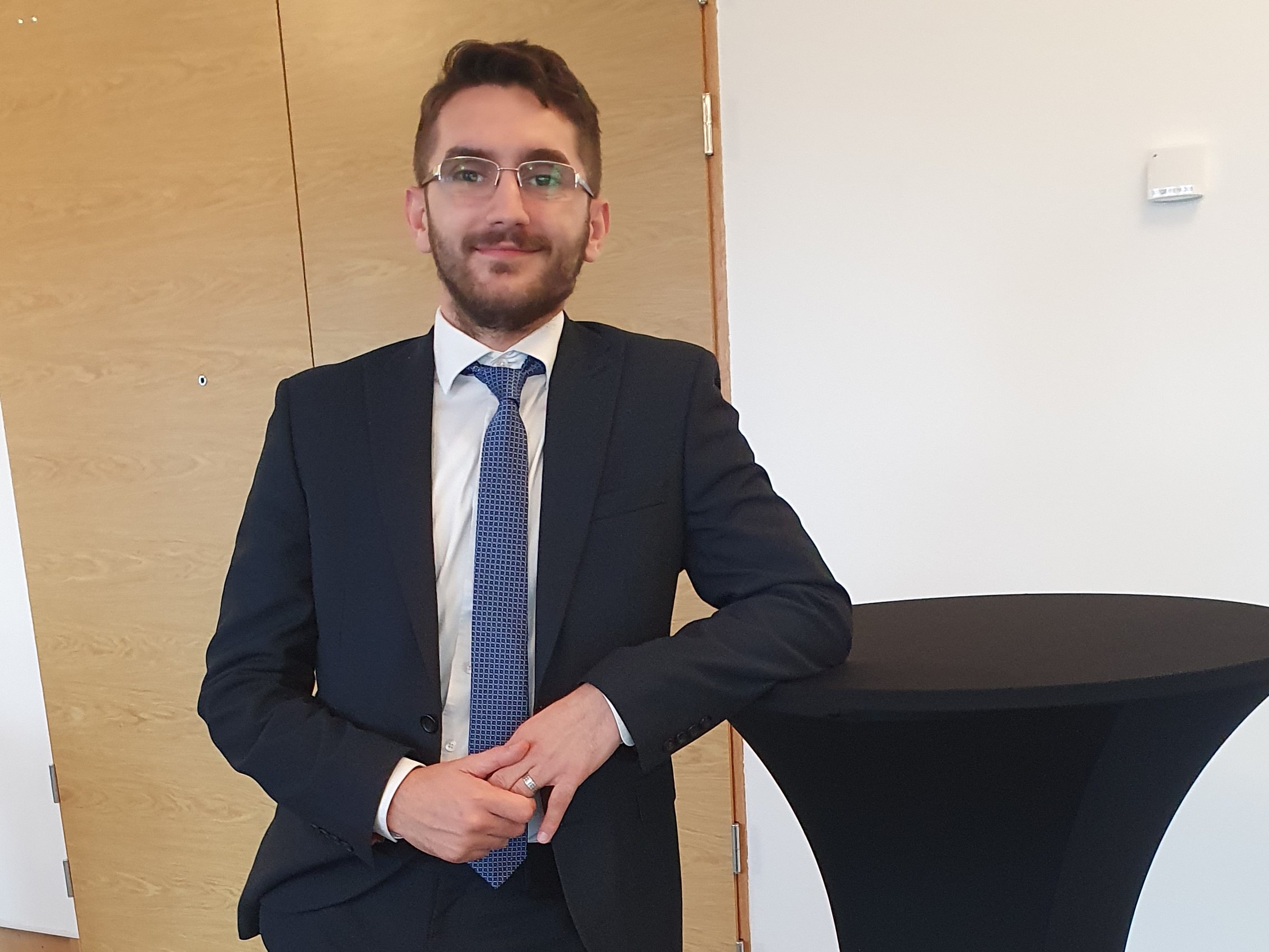
Immigration and emigration are sensitive topics to those who come to a new country and to those who accept the individuals. Those coming to a new country usually face struggle with integration and inclusion, especially when it comes to education and employment. The main barrier is often the language. My Finnish beginnings When I moved from Kosovo to Finland in July 2012, I started high school in Eira High School for Adults in Helsinki after less than a month. I, of course, started in an English-speaking program. Back then, I was completely new to my new home country and I was getting culture shocks almost every day, not only by Finland and the Finnish culture but by the international community within the program as well. I started learning basic Finnish immediately. However, after some time I noticed that my Finnish language progress was hindered by me speaking English all the time. I would switch to English completely when I did not remember a word in Finnish. When I started speaking Finnish with my friends who had the nerves to talk to me and correct me, it encouraged me to start switching from English speaking courses to Finnish ones. I started with Math where the need for complex vocabulary is not as relevant as in other subjects. Being in an international community in high school, I could hear every Finnish accent there is, which in hindsight benefited me massively as now I can easily understand different Finnish accents. Outside of school I started using Finnish in supermarkets and restaurants. When it came to the matriculation exams in Finnish language, I chose Finnish, Math, English and History. I barely passed them all, but did nonetheless. Even though my writing and spoken Finnish skills were not the best, I challenged myself, and I triumphed. Towards using the language at work My professional life in Finland has mostly consisted of working in Finnish speaking environments. When at the age of 18 I started a summer job working as a cleaner, I spoke only broken Finnish. By the next year I already saw an improvement in my spoken language skills. My Finnish was basic at the time but still it allowed me to access the coffee room discussions and gave me the necessary motivation one needs to continue learning. During my period when I worked as a security guard, I could no longer work with only broken Finnish, because the job required clear communication with people. For example, I could not use Google Translate in the spot, like I had when I worked as a cleaner. After the job as a security guard, I worked mainly in English for a while, gaining experience in Marketing and Content Creation. During my work placement in autumn 2020 at SIMHE services in Metropolia University of Applied Sciences, my professional Finnish has gone to another level. From the begining my focus was set into developing my Finnish in an office environment, also applying a model developed in SIMHE to support my language learning in a goal-oriented manner. This has boosted my confidence to use Finnish at work and improved my professional proficiency. Diverse workplace: not just the language, but also new perspectives and innovation Although employment might feel quite difficult for internationals in Finland, there is always hope and positive stories. I understand many of us search for jobs only in English, which are quite scarce, even though the number has been growing throughout the years. However, I would encourage everyone try and challenge yourself with Finnish. I have been through the process myself and I understand it is not easy and it gets tiring from time to time. It's good to keep in mind that we are trying to be professionals in a different country, which takes a lot of adapting and perseverance. At the end of the day, it is not all black clouds, because the international community is growing bigger and bigger in Finland, bringing a diverse set of skills to work communities. It’s good to understand that we as internationals not only represent our backgrounds and our culture, but we are skilled individuals as well, who bring innovation and other points of view to the table. Language is a barrier to be overcome, for sure - what we can do as foreigners is to try our best to adapt to the working culture and requirements in Finland. It takes courage to use Finnish as a beginner, but as long as you try, it shows professional motivation and opens a path to learning more. Ahmet Binaku is an intern at SIMHE Services and 4th year student in European Business Administration in Metropolia University of Applied Sciences (at the time of the writing)
Blog introduces information, tips and insights that help international talents with a higher education background to integrate and find their study and career paths in Finland. The blog is part of Metropolia’s #talentboost actions.
Outi Lemettinen (head editor)
Riikka Wallin
Anu Luoma
Email addresses: firstname.surname@metropolia.fi
Editorial Board handles all the publications of Various Variables blog before publishing.



Belongingness Career Career Boost careercoaching careers employability employment entrepreneur entrepreneurship Evaluation Finnish as a second language Finnish working life Guidance Happiness higher education higher education institutions highly educated immigrants Immigrants Inclusion Integration international student international talent job search job searching skills language learning learning platform mapping of competences mathematics mentoring Migration Moodle Networking networks online learning Participation Recognising competencies recognition of competences Research SIMHE SIMHE-Metropolia Skills Society strengths Studying in Finland talent boost