
Tag: highly educated immigrants
Now everybody’s viral – how we made it to the new decade of online education and work
Homework, experiments, essays, even physical education, all being done by children, adolescents and adult learners all over the world in front of their laptops, from their homes. Never before have parents, spouses and other significant others been so close to the pedagogical aspect of educational process. The coronavirus crisis has changed our daily life in so many ways, but education has been in the spotlight since the beginning of this uncertain new decade. The world from home By the end of March, Unesco estimates that almost 90% of the world’s student population has been affected by worldwide closures of schools. In Finland, contact teaching has been suspended from 17th March 2020 – except for early childhood and pre-primary education (grades 1 to 3). Thus, about one million learners from primary school pupils to higher education students are studying online at least until mid-May this year, without knowing exactly when they will return to school buildings and university campuses again. Remote learning has become a reality on such a scale that not even the most optimistic Edutech executive could have predicted. But it came with many concerns, too, especially for the vulnerable population being them in Finland or Somalia. Firstly, nearly 60% of the globe’s population is online, so a lack of access to the internet is still a barrier for many students. Secondly, specialists are concerned that remote learning could enlarge the gap of inequality. And last, but not least, many kids depend on the school to get a decent meal. Still, the general feeling is that governments, companies, and NGOs are making a considerable effort to keep the learning going. Google, Microsoft and Zoom, for example, are offering many of their video conference software for free since the beginning of the crisis. Finnish Edutechs partnered up to provide free resources suited for distance learning. The Hongkong government, for example, announced that it should maintain a consortium providing more than 900 educational assets for free even after COVID-19 is under control. Will this crisis change the way we see and implement education? Specialists of the World Economic Forum writes that this unique experience might also be an opportunity to remind ourselves of the skills students need in this unpredictable world. Resilience is a value that must be woven into the educational system to make sure that those skills continue to be a priority for all students. Chip Paucek, chief executive of the online education company 2U Inc., expects that after schools try online tools during the outbreak, they’ll be more inclined to opt for “blended” educational experiences that mix in-person classes with online tie-ins after the situation improves. As nobody is considering shutting down schools and universities forever, it seems that the task will be to retain the online learning aspects and integrate them with face-to-face learning. Hamish Coates, director of the Higher Education Division of the Institute of Education at Tsinghua University, told The Times Higher Education that “there will almost certainly be a post-virus boom” in online higher education. SIMHE-Metropolia moved services swiftly to the virtual mode The guidance and counselling services have now been implemented solely online since mid-March at SIMHE-Metropolia. In normal times, the majority of our guidance and counselling customers wish to meet face-to-face at the Metropolia Myllypuro campus. However, providing counselling via phone or over the internet is not totally alien to us as meeting remotely has served some customers’ needs the best in the past, too. Being available online gives a total new concept of accessibility and convenience for the personal guidance discussion as there is no need to travel anywhere on either side. There is also more flexibility in scheduling the meeting times and customers have been very up to the new mode of meeting so far. The downside is a lack of all cues of non-verbal communication and the closeness and togetherness that can be experienced when sharing the same physical space. For now, two Guidance Generalia lectures have taken place virtually with over 30 participants. All has gone remarkably well, and elements of two-way communication were established via chat and the attendants posed questions quite actively. The lecture series will be carried out as a web-based format for the rest of the spring-term, and perhaps continue to co-exist with the face-to-face lectures once we are able to be campus-based again. The digital future is already here Even though the digital leap of the 2020’s was somewhat forced for many, the elements of web-based learning have emerged prior to the crisis too. At Metropolia, online teaching and guidance and counselling for preparatory course for immigrants was tested out in 2019 as part of the Getting Ready - A higher education program for immigrants project. As we are facing a somewhat unpredictable future ahead, Metropolia will offer preparatory courses for immigrants online also in autumn 2020. Teachers now have needed to adjust, not only the methods, but how to acquire a new mindset towards teaching. For Anne-Mari Raivio, senior lecturer of School of Business at Metropolia, the next step is to focus not on the tools but on the pedagogical side of online teaching and learning. “After this mandatory digital leap we will have more brains thinking about how we can add and create meaningful digital encounters to enhance learning”, she says. Undebatably, the societies around the globe will wake up to a different morning once the pandemic has surpassed. Millions, if not billions, of people have now learnt to work and study from home and this is not to be regarded only as a bad thing. In Finland, like the students, over a million workers have confined themselves in a remote work-mode, and about half of them are willing to continue this way even after they are able return to the offices one day. We do not know how this all will end, but perhaps we could confide in Albert Einstein’s wisdom in his quote “In the midst of every crisis, lies great opportunity.” Writers Juliana Holanda is a Brazilian journalist who lives in Finland since 2019 and has used SIMHE-Metropolia's guidance and counselling services as part of her integration process. Marianne Autero works as a career coach at SIMHE-Metropolia. Sources COVID-19 Educational Disruption and Response. Viewed 6.4.2020 Digital trends 2020: Every single stat you need to know about the internet Viewed 6.4.2020 Helsingin Sanomat 13.4.2020. Etäopetusta saa nyt miljoona opiskelijaa, mutta varsinaista kotikoulua käy vain noin 400 oppilasta. Viewed 13.4.2020 Free apps and resources to support distance learning in schools affected by the coronavirus outbreak. Viewed 6.4.2020 3 ways the coronavirus pandemic could reshape education, World Economc Forum. Viewed 6.4.2020 This is online education’s moment’ as colleges close during coronavirus pandemic. Viewed 6.4.2020 Will the coronavirus make online education go viral? Viewed 6.4.2020 SIMHE-Metropolia. Viewed 6.4.2020 Metropolia Myllypuro campus. Viewed 7.4.2020 On-line counselling pros and cons. Viewed 13.4.2020 Guidance Generalia lectures. Viewed 13.4.2020 Getting Ready – A Higher Education Preparatory Program for Immigrants. Viewed 13.4.2020 SIMHE-Supporting Immigrants in Higher Education in Finland. Viewed 13.4.2020 E-mail interview with Senior Lecturer Anne-Mari Raivio, Metropolia University of Applied Sciences YLE uutiset.5.4.2020. Yli miljoona suomalaista siirtynyt etätöihin koronakriisin aikana - heistä noin puolet haluaa jatkaa etätöissä koronan jälkeenkin. Viewed 13.4.2020
SIMHE path ─ connecting Finnish employers and international talents
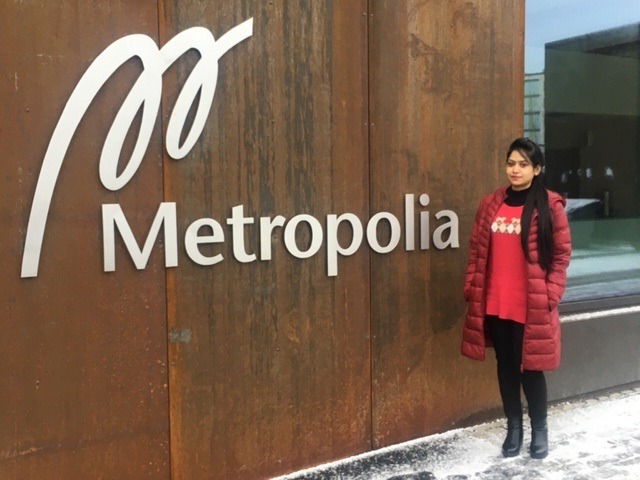
“Sisu. I love this word, it explains me very well!” exclaims Shaki, who is a business professional from Bangladesh. She is determined to build her career in Finland, which she has already learnt to call home. To boost her career, Shaki has taken part in SIMHE Path (1) during autumn 2019. The project is run by SIMHE-Metropolia (2) and it aims to build an educational model to promote the swift employment of highly educated immigrants by providing career counselling, mapping of competences, relevant supplementary studies and links to companies. Knowing the skills-set required in the Finnish labor market Shaki arrived in Finland just about a year ago, in January 2019. She holds an MBA degree and has several years of work experience in the field of accounting in an export-oriented company. She has also run a small online business. In Finland, Shaki would like to find a job related to accounting, investment, and banking. Having looked for jobs online, Shaki has noticed that most companies require a fluent command of Finnish. While improving her language skills, Shaki also realised that she needs to focus on how to fit her professional competences into the Finnish job market. This is where SIMHE path came to help her. “I know accounting techniques, but what I lack is the language skills needed to work in Finnish”, Shaki explains. Being able to communicate in Finnish can be a crucial skill in many jobs in terms of profession and interacting with co-workers (3). SIMHE path evaluates how your current competences fit the Finnish context Shaki first heard about SIMHE-Metropolia's services (4) on her Finnish course and immediately got interested. Luckily, the call for participants for SIMHE path in autumn 2019 happened to be open, and Shaki’s background in Business Administration matched the participant criteria (5). Shaki participated in an orientation session, an in-depth professional discussion with Metropolia’s Senior Lecturer in International Business, a CV workshop, and a feedback session during autumn 2019. As part of the in-depth professional discussion, Shaki also received an evaluation document that she can use for example in job-search as a reference of having her skills evaluated by a Finnish higher education institution. The Mapping of Competences (6) has been one of SIMHE-Metropolia’s services since 2016, and it is currently conducted as part of SIMHE path. Shaki has been happy with the process. In her words, it clarified things and helped her envision alternative paths. She will now look into the possibility of taking on additional studies, possibly in the field of ICT. Shaki is determined to make her way into the Finnish job market. University-level education, a keen motivation to study Finnish and sisu are a combination that will surely boost Shaki’s career and help her land her to find dream job in Finland. Shaki is open to new opportunities the future may bring: “Now I want to say yes, yes, yes!” she smiles. Spring 2020 SIMHE path to connect international ICT professionals with Finnish companies There are many immigrants residing in Helsinki and its surrounding Metropolitan area (7). Employment is seen as one of the best ways to integrate into society and it also helps in learning Finnish language. In spring 2020, we will pilot another round of SIMHE path, this time in close cooperation with ICT companies. The ICT field is growing rapidly, and up to 70 % of companies in the industry are hiring (8). In SIMHE Path, there will be a new call for participants during February 2020. This time it will be open for those who have completed a degree in ICT. Could that be you? Your competences will be mapped and compared to the companies’ needs, and the aim is to find you an internship in a company matching your background. Stay tuned, more information coming soon! Registration for spring 2020 SIMHE-path will begin on 7 February 2020. Link for enrolment will be provided on this blog post on the date. Writers Marianne Autero works as a Career Coach at SIMHE-Metropolia services. She focuses on especially in planning, developing and implementing guidance and counselling practices for immigrants and is responsible for the guidance process in the SIMHE Path project. Leena Honkasalo worked as Project Planner in the SIMHE Path project. Sources: 1) SIMHE path https://www.metropolia.fi/en/research-development-and-innovation/all-projects/simhe-path/ (Read 20.1.2020) 2) SIMHE-Metropolia https://www.metropolia.fi/en/about-us/simhe/ (Read 20.1.2020) 3) Stenberg H., Autero M & Häkkinen, M. 2017. Kielen merkitys korkeasti koulutettujen maahanmuuttajien ohjaamisessa. Kieliverkosto. https://www.kieliverkosto.fi/fi/journals/kieli-koulutus-ja-yhteiskunta-lokakuu-2017-2/kielen-merkitys-korkeasti-koulutettujen-maahanmuuttajien-ohjaamisessa (Read 20.1.2020) 3) Kyntäjä E. 2018. OECD-raportti maahanmuuttajien kotoutumisesta Suomeen. Virolaiset omaa luokkaansa – pärjäävät parhaiten https://www.tuglas.fi/oecd-raportti-maahanmuuttajien-kotoutumisesta-suomeen (Read 20.1.2020) 4) SIMHE-Metropolia services https://www.metropolia.fi/en/services/for-immigrants/ (Read 20.1.2020) 5) SIMHE-path supports employment https://www.metropolia.fi/en/academics/courses-for-immigrants/simhe/ (Read 20.1.2020) 6) Autero, M. 2018. Osaamisen kartoitus tukee maahanmuuttajan työelämään ohjaamista. Teoksessa Stenberg H., Autero M., Ala-Nikkola E. (Eds.)., (2018). Osaamisella ei ole rajoja: Vastuukorkeakoulutoiminta maahanmuuttajien integraation tukena Suomessa. Metropolia Ammattikorkeakoulu. URN:ISBN:978-952-328-081-6 6) Autero M. (2018). Supporting Highly Educated Immigrants’ Career Paths in Finland https://blogit.metropolia.fi/variousvariables/2018/02/13/supporting-highly-educated-immigrants-career-paths-finland/ 7) Helsingin tila ja kehitys 2019. https://tilajakehitys.hel.fi/ulkomaalaistaustaisten_tyollisyys (Read 20.1.2020) 8) Finnish Software and E-business Association (2019): Talouskasvun hiipuminen ei näy ohjelmistoalalla ja verkkoteollisuudessa. Press release 17.1.2019. Available online: https://www.ohjelmistoebusiness.fi/tiedotteet/talouskasvun-hiipuminen-ei-nay-ohjelmistoalalla-ja-verkkoteollisuudessa/.
Finding suitable career paths for the highly educated immigrants

SIMHE-Metropolia customers have many characteristics in common yet the need for an individual and personal approach for planning their path in Finland is highly demanded. The most frequently discussed topics, that are almost always in the core of the discussions when it comes to career paths and taking the first steps: how to create a coherent image of yourself as a professional, and how to sell and brand your competences to employers? Also, how does a certain field work in Finland, and which competences are appreciated in the field? How to update and supplement those competences if necessary? I will share some thoughts concerning these topics below. What are you made of? Knowing your skills and assets can take you far in today’s working life (1). To create a coherent image of you as an expert in your field, you could start by searching answers e.g. to these questions: What are your interests? Where are you good at? Which are your core skills and competences? What can you do with them? Which are concrete examples of your talents? It is also beneficial to strive to understand how your competences position you in your field in the Finnish context (2), as different skills might be appreciated, different applications used, or different educational level required. Finding out about the educations in your field gives you an image of the skills set that is valued and offered by the Finnish degrees. To perform a detailed comparison between your skills acquired in e.g. a degree in higher education and the Finnish counterpart, have a look at the curricula open for all at the websites of the higher education institutions. Do you know your field of expertise in Finland? It is important to understand the characteristics of the field you aim to, as fields can be different between countries. There are multiple ways to access information, but one could be through the organizations functioning in your field in Finland. You can get information e.g. about the different companies operating in your field. Another good way to get information is to go through the open job vacancies ads, as they give you information of what the employers are looking for. Remember, that you don’t have to tick every box to apply. Different mentoring programmes exist to give you an opportunity to connect with an expert from your own field to add to your field-specific knowledge, but also the opportunity to find out more e.g. about the practices for applying for a job and contacting interesting employers with an open application. Overall, networking is a key skill in today’s working life. Where can you update your skills set? At the moment, the pressure to continuous self-development and learning is strong in Finland, as job descriptions are more and more complex and multidisciplinary (1). This applies to everyone, not only immigrants. After mapping your competences, comparing them with the competences gained through the local degrees, and familiarizing yourself with the competences the working life requires, it might be easier to understand what kind of completing of your skills could benefit you. Options to build up your expertise could be e.g. open university/university of applied sciences studies, different educational opportunities offered by the TE-office or degree studies in an educational institution. Supplementary studies do not only increase your expertise, but also help you build up your networks and knowledge of your own field. (5.) Preparatory educations for immigrants aiming for studies in higher education can give you an intensive Finnish language learning opportunity. How to brand and sell yourself? The ability to brand yourself and to sell your skills is crucial, especially because it might be that the employers do not know what skills your degree completed abroad has given you. Research shows, that the employers find it difficult to comprehend the true skills of the immigrant applicants (3). At the same time, the capacity and potential of immigrants is not in full use (4). Building your cv towards a skill based cv could help. Instead of focusing only on the formal degrees you have completed, in a skill based cv you focus on outlining the key skills the degree and everything else in your life has given you. The emphasis is in describing how you convert all that learned into practice, with the help of practical examples from your personal history. Don't forget to add in the results you have gained during your work history. (6) Sources 1 Hakala, L. (2018) Työelämä muuttuu - mitä työelämävalmiuksia tarvitsemme? https://stm.fi/artikkeli/-/asset_publisher/tyoelama-muuttuu-mita-tyoelamavalmiuksia-tarvitsemme- 2 Autero, M. (2018) Osaamisen kartoitus tukee maahanmuuttajan työelämään ohjaamista. In the title Osaamisella ei ole rajoja – Vastuukorkeakoulutoiminta maahanmuuttajien integraation tukena Suomessa. https://www.metropolia.fi/fileadmin/user_upload/TK/Julkaisut/pdf/2018_stenberg_ym_osaamisella_ei_ole_rajoja_TAITO.pdf 3 Hakala, K. & Pesonen, J. (2018) Työnantajien haasteet korkeasti koulutettujen maahanmuuttajien työllistämisessä. https://unlimited.hamk.fi/ammatillinen-osaaminen-ja-opetus/tyonantajien-haasteet/ 4 Uudenmaan liitto. (2019) Helsingin seudun muuttotutkimus: Koulutettujen maahanmuuttajien osaamista ei hyödynnetä, paitsi huippualoilla. https://www.uudenmaanliitto.fi/uudenmaan_liitto/uutishuone/tiedotteet/helsingin_seudun_muuttotutkimus_koulutettujen_maahanmuuttajien_osaamista_ei_hyodynneta_paitsi_huippualoilla.34372.blog 5 Hiitelä, E. & Kolu, M. (2018) Korkeasti koulutettu maahanmuuttaja matkalla työelämään. https://verkkolehdet.jamk.fi/elo/2018/11/29/korkeasti-koulutettu-maahanmuuttaja-matkalla-tyoelamaan/ 6 Uusivirta, M. (2019) Pelkkä töiden listaus ei enää riitä - Näin laadit osaamista korostavan cv:n, jonka avulla erotut ja saat työpaikan varmemmin. https://www.hs.fi/ura/art-2000006091980.html
Blog introduces information, tips and insights that help international talents with a higher education background to integrate and find their study and career paths in Finland. The blog is part of Metropolia’s #talentboost actions.
Outi Lemettinen (head editor)
Riikka Wallin
Anu Luoma
Email addresses: firstname.surname@metropolia.fi
Editorial Board handles all the publications of Various Variables blog before publishing.



Belongingness Career Career Boost careercoaching careers Connecting employability employment entrepreneur entrepreneurship Finnish as a second language Finnish Job Market Finnish work culture Finnish working life Finnish workplace norms Guidance higher education higher education institutions highly educated immigrants Immigrants Inclusion Integration International jobseekers in Finland international student international talent job search job searching skills language learning mapping of competences mentoring Networking networks online learning recognition of competences Self-employment SIMHE SIMHE-Metropolia Skills Society strengths Studying in Finland Support talent boost Work in Finland Working in Finland