
365 steps later
Supporting Immigrants in Higher Education in Finland (SIMHE) has now been part of my professional life exactly for a year. It has most certainly been a year of many new encounters, views, angles, ideas, networks, seminars and happenings. This has been most apparent in terms of guidance and counselling as I have met around 300 educated immigrant-background people through one-to-one personal guidance discussions, Guidance Generalia lectures and in orientating customers to our Recognition of Competences Services. It was a very good year How could I describe the past year and its eventful occurrences? We started from an empty desk, only having a grasp of what there is to do, or what we wish to accomplish. Things evolved very fast and the first pilot in recognition of competences services, SIMHE-Metropolia internet pages and guidance and counselling services got a kick-start during April-May 2016. Evidently, once you get going, things tend to grow bigger and bigger, like a snowball effect. I have come across with people from many walks of life as my counselees have had education in engineering, nursing, law, medicine, business, pharmacology, languages and teaching, just mention a few. Some of them have been in Finland only for months, whereas some have been living here even for years. Despite their various backgrounds, all SIMHE customers share a need to get information and help in learning how to surf in the Finnish education system and labour market, or getting to know what are the authorities regulating certain professions in Finland. This has also put my skills to the test as I have myself learned so many new things by searching for information from various channels. Likewise, I have also learnt a lot from my customers and their international experience. It’s all about networks Many SIMHE customers’ main objective is to get employed in their field of expertise. Job-searching has been a daunting experience for many as there is little or no response from the employers, even after numerous applications and contact-making. It has become as a surprise to some that having the credentials and qualifications is somewhat meaningless, unless you have the networks and connections with the local people. It is a matter of trust, or sometimes of mere existence. If you have no one to endorse you and your competences, you are non-visible in the labour market. Thus, one of our challenges is to help to create such networks in making people exist in the eyes of the Finnish employers. Again, we aim to support this through our own networks like TE-office, Helsinki Chamber of Commerce and Start-Up Refugees in addition to our Recognition of Competences Services. The show must go on SIMHE-Metropolia and SIMHE-Jyväskylä pioneered the concept throughout 2016 with good results and a strong support from Ministry of Education and Culture. Issues revolving around immigration phenomenon have become more and more prevalent in Finland and the implications are apparent on all levels of education. The actions to be taken are described on The educational tracks and integration of immigrants - problematic areas and proposals for actions document that was handed to Minister of Education and Culture, Sanni Grahn-Laasonen, at Metropolia in mid-February 2017. SIMHE is getting even a stronger foothold in 2017 as more educational institutions are joining the concept and the work will continue until the end of 2020, or even beyond. We are very happy to welcome University of Helsinki, University of Turku, Oulu UAS and Karelia UAS to heighten the service concept and bring in fresh views and ideas. There is most certainly a need to open-up and brush-up the existing policies to create ways for immigrants to have an access to education, also on its highest level. SIMHE-concept could work as a stepping stone for supporting more inclusive education in catering the needs of immigrants and the Finnish society.
Mathematics and various variables

Supporting Immigrants in Higher Education in Finland (SIMHE) assists higher educated people with immigrant background in finding suitable education and career paths through guidance and by recognizing their competences. The main title for the blog, Various Variables, describes the diversity and complexity of the phenomenon at hand well. The etymological background for the words various and variables can be traced back to mathematics, where functions of various variables are often discussed. Currently, many functions are being made to handle these various variables we have faced through immigration and getting accustomed to the changed circumstances. This blog has not yet equated mathematics into its topics, so now it’s time to make a change! Mathematics is a universal language One part of the SIMHE services is recognizing competences that has been acquired through prior studies and work experience. This helps the customer in finding suitable supplementary education. People from different countries have different kinds of education and career backgrounds, which contributes to several challenges in recognizing their competences. Language barriers and cultural differences also play their part in these challenges. In the beginning of recognizing competences, it is the easiest to focus on areas that are shared globally and needed in several educational fields. A prime example of these universal fields is mathematics, which is a central part in the field of technology all over the world. The language of symbols in mathematics remains mainly the same compared to the spoken language that tends to change when moving to a different country or region. It was decided that mathematics would be a part of the first pilot project of recognition of competences within the SIMHE project. Tasks that demand complex verbal descriptions were left out at this stage to avoid language barriers and a burdensome translation process. Instead, this test included tasks in which the language of symbols in mathematics is enough to understand the tasks as well as short expressions such as “simplify the expression” or “solve the equation”. Unfortunately, this approach does not measure the most essential competences needed for working as an engineer. These competences were measured in other parts of the test. Preparatory education for immigrants Preparatory education for people with immigrant backgrounds has been organized at Metropolia already years before SIMHE was founded. This education helps students develop for example their linguistic and mathematic knowledge as well as digital know-how to meet the requirements for higher education. The aim of the education in mathematical subjects is to prepare for the entrance examination in the field of technology and transportation at universities of applied sciences. The task series used within the SIMHE project were also applied in the preparatory education for immigrants in autumn 2016. However, the topics were broadened to also include applied functions, and the tasks were completed on a digital learning platform. The first test run by SIMHE was organised using only pen and paper to avoid technical issues. 20 students who participated in the preparatory education for immigrants this year, had a relatively homogenous educational background. Only a few of them have a higher education degree, whereas most have completed their studies in the secondary level. The age in the group ranged from around 20 to almost 40 years of age, while the average age was around 30. Revision is needed sometimes Despite knowing mathematics before, it can be difficult to solve a more complex task after a long break without solving basic arithmetic calculations. This has also been proven to be true both when recognising competences as well as in preparatory education for immigrants. The results in mathematics in the first test of recognising competences were not on the strong side. However, when collecting feedback from the test, many of the participants suggested they would have done better in the test after a short revision. They have mastered mathematics before, but have forgotten the details for now. Some participants aired the same thought during the test. In this situation it is comforting that a very short revision and refreshing of the memory is sufficient in recalling earlier competences. This probably does not only apply to mathematics but also to other fields, which is good to keep in mind when planning how to recognise such competences in the future. This blog post was additionally composed by Ellen Avellan, Marianne Autero and Birgitta Nenonen-Andersson.
Can you see it more clearly now?
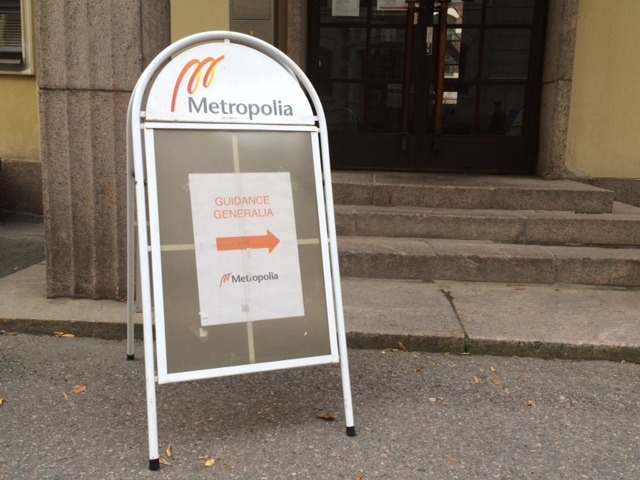
SIMHE-Metropolia services has now reached its next step – or even two of them – in making the Finnish education and higher education system more approachable and understandable for the immigrants living in Finland. We launched the monthly Guidance Generalia lecture series in June and now, after the round two in the end of August, it is time to evaluate the outcome. Don’t you Know, it’s all so simple from early day care to the doctoral level! Guidance Generalia lecture aims at unravelling the mysteries of the Finnish education system and how to enter in the higher education in particular. The lecture is open for anyone and is advertised on SIMHE’s For Immigrants website and through other networks. We are also introducing guest speakers this autumn from many relevant arenas such as TE-office, National Board of Education, Kela for Finnish Social Security System and so forth to help people to make the most of the events. For us, who have travelled through the system from early childhood day care to the higher education, all is very smooth and clear; this is how the story goes and we take this highly praised system for granted. However, for those, who come from the outside, it may come across as foggy and almost unreal: there are free meals in the primary and secondary levels of education and what does it even mean to have a dual model in the tertiary level? Overcoming the language barrier The first ever Guidance Generalia in June, set the mark for what we wish to reach. We have a service promise to master the lecture in Finnish and in English, simultaneously. It is even possible to have an interpret on our expense, if there is enough demand for additional languages on top of these two. The limits of our language were certainly not the limits of our world as the June lecture was managed in Finnish, in English and in Arabic with the help of an interpret. Or, perhaps, it was muddled through as having three different languages made it feel like being in an international airport at times. The message went through to the twenty something participants, even though them, the interpret and I were mopping sweat from our foreheads after two hours of intensive schooling. However, as we are able and capable to develop, the August lecture introduced the renewed state of the affairs with a new set of slides to help to overcome the language malarkey. We are in this together August setting was thus thoroughly planned and the session welcomed yet again some thirty participants. This time we were lucky in terms of lingua franca as all participants were able to follow the lecture in English. We managed to create a very reciprocal way of making the education system more familiar to the participants and the lecture passed by with many questions, comments and remarks. Participants were very pleased that someone offers such services just for them and for their needs. We were also happy to invite the first guest speakers, Bayazidi Saeed and Ahmad Moussa from Uudenmaan TE-Office where they work with highly educated immigrants to support their employment. Mr Saeed and Mr Moussa explained the role of TE-office in supporting education for immigrants during and after their integration program period. They gave an invaluable insight into the TE-office services for independent education. Expanding the cooperation Guidance Generalia has proven to add up substance to SIMHE’s service palette. It is also a very good forum to meet up with people to tackle questions that are general to all. Additionally, it enables us to reach those who need more personal support in their individual quest in the Finnish education system. The next session will take place in September with a guest speaker from the Finnish National Board of Education who will tell us more about recognition of international qualifications in Finland. We are also expanding our horizons as the lecture will be simultaneously streamed to participants in central Finland in cooperation with SIMHE-Jyväskylä and JAMK University of Applied Sciences.
Blog introduces information, tips and insights that help international talents with a higher education background to integrate and find their study and career paths in Finland. The blog is part of Metropolia’s #talentboost actions.
Outi Lemettinen (head editor)
Riikka Wallin
Anu Luoma
Email addresses: firstname.surname@metropolia.fi
Editorial Board handles all the publications of Various Variables blog before publishing.


Belongingness Career Career Boost careercoaching careers Connecting employability employment entrepreneur entrepreneurship Finnish as a second language Finnish Job Market Finnish work culture Finnish working life Finnish workplace norms Guidance higher education higher education institutions highly educated immigrants Immigrants Inclusion Integration International jobseekers in Finland international student international talent job search job searching skills language learning mapping of competences mentoring Networking networks online learning recognition of competences Self-employment SIMHE SIMHE-Metropolia Skills Society strengths Studying in Finland Support talent boost Work in Finland Working in Finland