

Under the leadership of Development Manager Mika Hämäläinen, Metropolia’s AI team is developing various solutions based on large language models to address the organization’s challenges. The core idea is to solve real problems in a user-centered and agile manner. Since large language models are constantly evolving, there is no longer a need to develop the AI itself — instead, our task is to adopt AI and integrate it into everyday life in an easy-to-use form.
Our team currently includes software developers Lev Kharlashkin, Melany Macías Morán and Leo Huovinen, as well as student interns Yehor Tereshchenko, Sheng Tai and Aki Morooka. The tools we have developed are named OpintoHain, Oracle, Grant Writing Assistant, Curriculum Tool, and Moodle AI plugin.
OpintoHain
OpintoHain was developed as part of a project led by Sonja Saarikivi, with the goal of creating a tool for lifelong learners. The target audience consists of individuals external to Metropolia who wish to update their skills and study at Metropolia — whether by taking a single course or potentially pursuing a suitable Master’s degree.

We responded to the challenge by developing a chatbot that understands the course offerings of Metropolia’s Open University. The tool is powered by a RAG (Retrieval-Augmented Generation) model that is familiar with Metropolia’s courses and degree programs. It also includes a multi-agent system with dedicated agents for course and degree recommendations, as well as for study guidance. The OpintoHain tool is available for testing on Metropolia’s website.
Oracle
Foresight has taken on an increasingly important role at Metropolia — everyone is expected to anticipate future developments, but how? We set out to address this challenge with the Oracle tool, which ingests online content such as news articles and job postings. Based on this input, we can analyze the data using vectorization and clustering techniques. We have already developed methods for identifying weak signals and megatrends, detecting drivers of change, conducting data-driven scenario work and implementing an automated multi-agent version of the Delphi method.

The guiding idea is that AI processes foresight data into a ready-to-use format, so that the end user can gain maximum benefit from the insights, even if they have little to no prior knowledge of foresight practices themselves. In putting Oracle into practical use to support real-world applications, we are supported by the foresight working group led by Maani Nyqvist, along with foresight expert Marita Huhtaniemi.

Grant Writing Assistant
The importance of external funding is growing in the higher education sector. Competition for funding is fierce, and often even strong applications go unfunded. We are developing an AI tool in collaboration with Maarit Haataja, Director of RDI and Project Services, and her team, to enhance Metropolia’s chances of securing external funding.

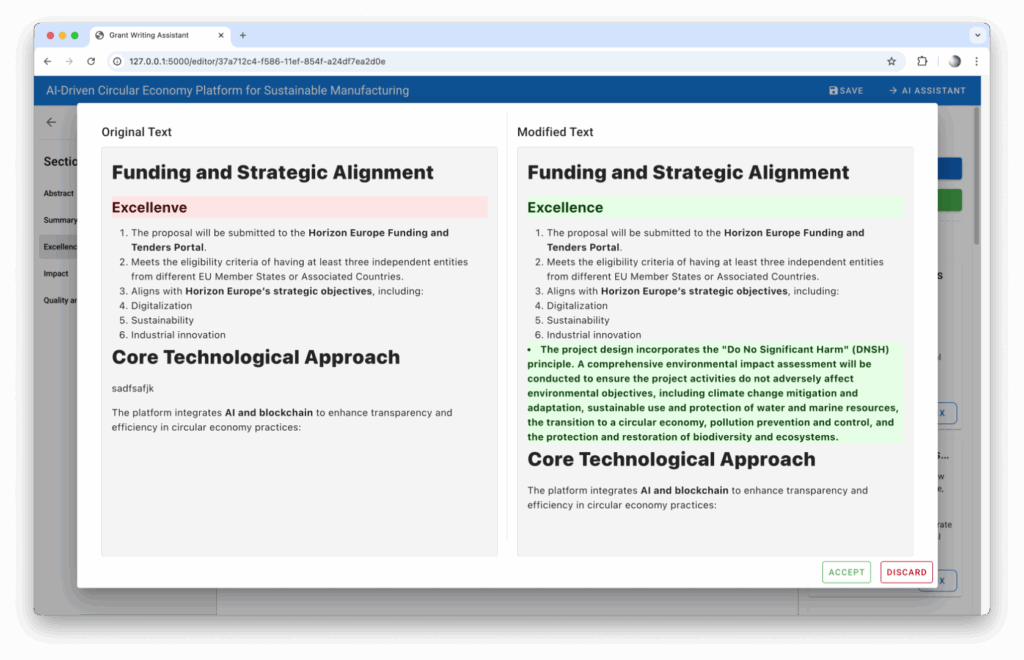
In EU Horizon funding calls in particular, it is crucial that every section of the call for proposals is addressed within the application. Even a strong application can be rejected if it fails to mention even a single sub-point. Grant Writing Assistant automatically analyzes the call for proposals and compares it with the content of the application. Any missing elements are clearly reported to the user, who can then choose to correct them manually or have the AI automatically insert the missing content. The tool is also capable of identifying risks and breaking the project down into work packages.
Curriculum Tool
Writing curricula is a time-consuming process. Each course-level curriculum should reflect both the goals of sustainable development and Arene competencies. To support this, we developed the Curriculum Tool, which analyzes curricula and visualizes the content of degree programs from the perspectives of Arene competencies and sustainable development. In the development of this tool, Metsälintu Pahkin played a valuable role as a liaison with the degree coordinators. You can read the scientific publication describing the tool for more details.

Moodle AI Plugin
The Moodle AI Plugin was developed for teachers, enabling them to automatically generate assignments directly in Moodle based on their own course materials. The core idea has been to integrate AI directly into a familiar tool, rather than creating a separate system. Senior Lecturer Tricia Cleland-Silva served as a valuable liaison with the teaching staff during the development process. You can read the scientific publication describing this tool for further insights.






Comments
No comments