
Year: 2022
Designing for Sustainability in Berlin. A master´s study trip to “International Week on Sustainability 2022”
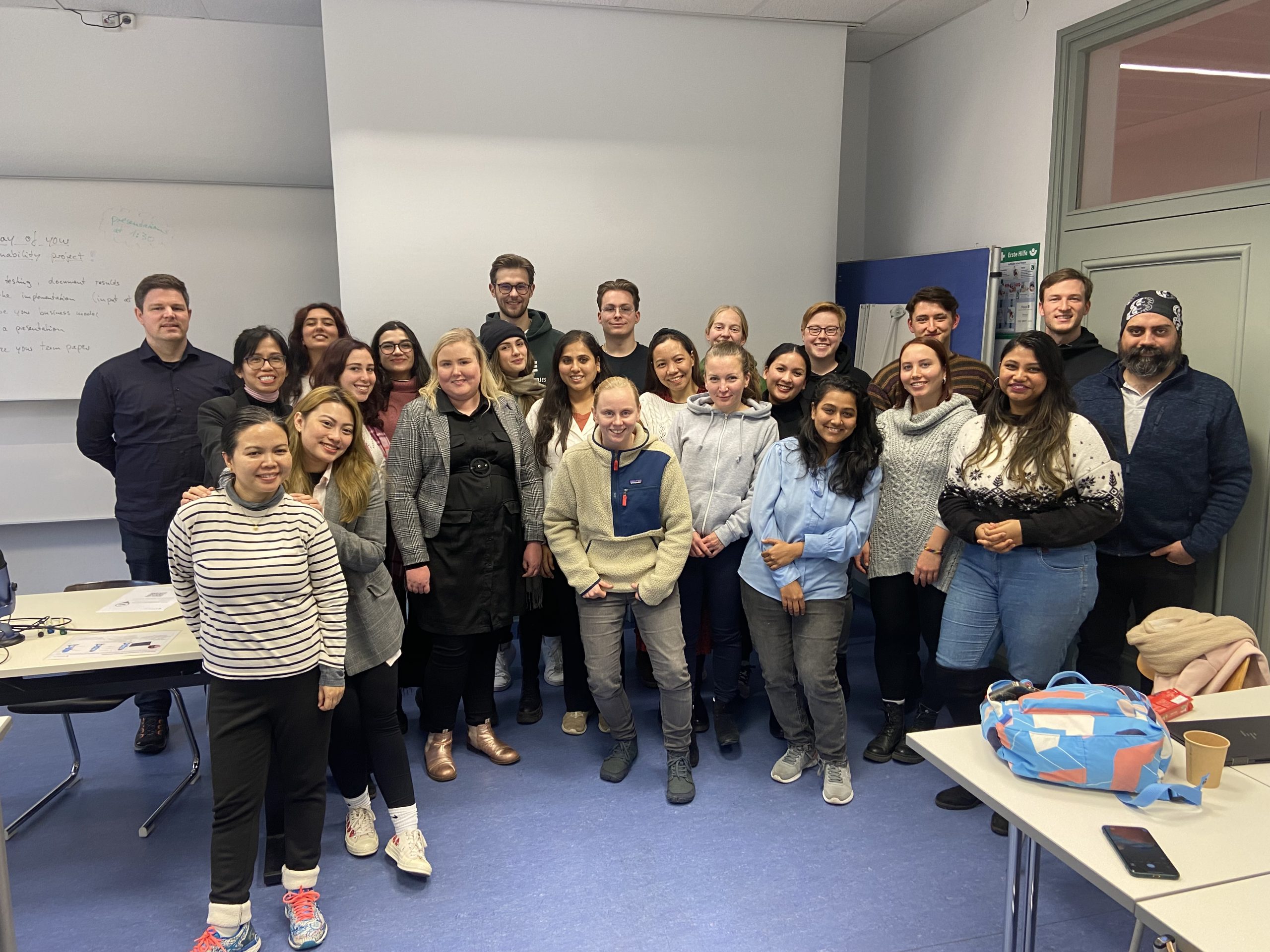
The Berlin School of Economics and Law (1) organizes the annual International Week on Sustainability (IWS) since 2019 with the goal is to integrate sustainability into the higher education curriculum. This year 2022, HWR invited master’s students from Metropolia for the second time to participate in the design and development of sustainable solutions together with companies and students from other countries in a series of workshops that lasted for 4 days, 18-21 November 2022. Our group of 10 master´s students was excited to get an approval from Meropolia´s International office. Additionally, the IWS study trip offered a chance to earn 3ECTS while solving real-world sustainability concerns, so we longed to go and try. The final argument in favor of the trip was its destination, as Berlin represents significant historical legacy, making it a unique opportunity to visit and experience it, difficult to pass by. Fast forward to November, it felt surreal to land at Berlin airport, and we were too excited to feel exhausted. Even the rain, slushy streets, and chilly air could not dim our spirits. In Berlin, we were all determined to expand our knowledge and make new connections. Day 1. Opening Day and Kick-off The program kick-off took place in HWR Startup Incubator Space located in the Siemens industrial park. It started with a briefing with project partners from Startup Incubator Berlin, which featured the startups in the sustainability field. The introduction also included a brief review of Service Design methods and tools covered by Prof. Christian Klang of HWR. There were about 30 participants coming from different academic and business fields who were assigned to five working teams. Each team selected one of the following challenges: 1) incentivizing nature-based solutions to climate change; 2) making travel sustainable and meaningful; 3) incentivizing CO2 reduction during commute; and 4) communicating vegan food delivery effectively. Teams put their hands to work on the challenge they had selected. The startups sat down with the teams to explain their projects and share their motivations and visions. Ideas poured in as each team concentrated on solving the issues and gathering data. Day 1 came to a close with more questions than answers. Day 2 and 3. Ideation and Prototyping Day 2 sessions were held on the HWR campus (2). As we had grown accustomed to the modern design of Metropolia´s campuses, the large corridors, arched hallways, and marble floors in the HWR campus were a little surprising. Teams worked seriously to build and test their prototypes. It became obvious that cooperation is essential to the success of the projects and this is where online tools for team collaboration became critically useful. Ideas and information were together put in an online board to make sure that good ideas and critical pieces of information are not missed out. The challenge was to make business sense out of all the ideas and information that we had, as we quickly realized that bright ideas and passion were necessary but not enough. We kept reminding ourselves that we needed to find solutions that would be viable, feasible, doable, and would make business sense for our partner startup. The second day ended with coffee and laughter, as we watched the first snowfall of the year covering HWR. On Day 3, we went to The Morp Company, a consulting firm that offers sustainability advice. A brief workshop on the use of the business model canvas as a tool to address corporate sustainability concerns was held and received very well as a hands-on new tool. Day 4. Pitch for Impact Day 4 was a pitching day. As teams presented their ideas and answered questions from partner startups and other participants, it was inspiring to see the variety of proposed solutions. There were no earthshaking proposals, but the teams focused on concepts that made real business sense and would advance true sustainability. Although the solution reports still need to be finalized, we felt a sense of accomplishment for having done something worthwhile as the last session ended. Discovering Berlin In all honesty, finding our way to the session locations in the morning was a bit challenging. Because of this, coffee and Google Maps have become our close allies. When in Berlin, we didn’t just snap pictures. We needed to get out there, interact, and connect. Berlin is blissful for shoppers and vibrant for foodies and art lovers. A frequent conversation starter during this trip was “Is this your first time in Berlin?” It was easy to say “Yes” in response to this question. “How do you find Berlin?” and “Which sites have you visited?” were the typical follow-up queries. With each passing day, we would find ourselves giving different answers because Berlin is too diverse to describe in a few words. Despite our time constraints due to working 4 full days on projects, we were nevertheless able to visit some famous sites. We were lucky to witness the start of Berlin's Christmas market and were able to sample local food including currywurst, kebab, stollen cake, and local wine. We had our taste of misadventure too during the first attempt to visit the Brandenburg gate, as we ended up at a factory site due to our over-reliance on Google Maps. On the last day of the trip, it was difficult to bid Berlin goodbye. Armed with new knowledge and filled with the brilliant sparks of Berlin, we boarded our plane to return to Finland. References The Berlin School of Economics and Law (Hochschule für Wirtschaft und Recht, HWR, Berlin) is one of the largest universities of applied sciences in Berlin. It was founded in 2009 as a result of merged of two other big higher education institutions, and it now enjoys more than 150 partners around the globe, including Metropolia UAS, its long-time partner. Read more about HWR from its web-pages: https://www.hwr-berlin.de/en/ Berlin School of Economics and Law, Badensche Str. 52, 10825 Berlin. The picture below shows the marble floors and grand interiors of this campus. About the author Karen Espiritu is a 1st year MBA student in Business Informatics at Metropolia Business School. Karen is a certified project manager and a result-driven professional who is passionate about fostering organizational sustainability on all three fronts: economic, social, and environmental. She enjoys blogging in her spare time and is an active student ambassador of Metropolia. Her video about IWS-2022 in Berlin can be found here: https://www.youtube.com/watch?v=DPiUds0fVvo
Creating a Roadmap to Digital Transformation: A strategic plan to overcome the barriers to digital acceleration

Today, the digital opportunities are evolving faster than the pace of transformation in the organizations. To better understand the path our business is on, where to focus the efforts, and how to overcome the disruption and resistance to change, I decided to use this challenge as a topic for my Master´s thesis and created a roadmap for accelerating the digital transformation towards achieving my company’s future state (1). In the course of this research and development project, I realized several important things which I want to share with the readers. What is Digital Transformation? Many companies often end up with misunderstanding the concept of digital transformation. They often do not differentiate between beliefs and realities about digital transformation. Instead, before embarking on a digital transformation journey, companies need to become aware of a wide professional discussion going on in the professional world and be aware of key findings that business practitioners have came up with based on the experience of industry leaders. I summarize these key points below: First, digital transformation is not just about implementing new technology. It is about the adoption of digital technology to improve business processes, value for customers and innovation. (2) Second, digital transformation is not just a buzzword for business but a way to grow. Therefore, it requires clear targets for each source of value creation and ensuring that the entire company shares one digital vision. Third, digital transformation is not optional, it is mandatory for business success. It helps company businesses gain a competitive advantage. (3) Last, digital transformation is often mistaken for digitization or digitalization, but there are some significant differences. Digitization is, according to Wikipedia (4), the process of converting information into digital. Digitalization is, as Gartner (5) defines it, the use of digital technologies to change a business model and provide revenue and new value opportunities. While digital transformation is about transforming the customer experience and changing how to operate and deliver value to customers. What does acceleration of digital transformation mean? For most of digital services companies, the COVID-19 crisis has had an “all-or-nothing effect” on their digital strategy agenda. As reported by Deloitte (6), 77% of CEOs considered that the pandemic had sped up their company’s digital transformation plans. The crisis has significantly accelerated the digitization in terms of way of working and do business. Many businesses have already embraced transformational change. However, this large scale change should be fast. To leverage the opportunities quicker and overcome the possible challenges faster than the competitors, you don’t have to rush to the corner shop to buy the smartest gadgets. Instead, your company will need to start enhancing systematically your organization culture, operations, and capabilities for the workforce of the future. This phenomenon is called acceleration of digital transformation. McKinsey (7) suggests that the “digital first movers and fast followers capture more value within their industries than slower-moving companies”, taking the lead on digital transformation. It is just what Klaus Schwab, Executive Chairman of the World Economic Forum, said about the impact of speed on the business level: “In the new world, it is not anymore so much about the big fish which eats the small fish, it’s the fast fish which eats the slow fish.” What are the key enablers of digital transformation? The digital transformation is a journey where the desired destination and the path are different for every company. Like on any journey, a careful planning and a well-organized process would help the company to reach the destination safely and avoid back-roads and unnecessary costs. An analysis of the digital maturity of a digital services company, using BCG’s Digital Acceleration Index (8), reviled three relevant domains impacting its journey to successful digital transformation. First, the operations optimization needs a systematic digital approach in decision making to improve the quality of work and ensure customer satisfaction. Second, the digital talent is needed to enhance the changes to digital transformation to succeed points to building capabilities for the workforce of the future. Third, the dynamic organization that lies in creating an agile culture and new ways of working. As the figure below shows, the enablers for accelerating the digital transformation include precisely these three elements: the optimized operations, engaged digital talent & leaders, and dynamic organization. In other words, the chances for a successful digital transformation will be greatly increased in case your organization is able of doing: quick decision making, building the digital capabilities for the workforce of the future, rolling out an agile culture, and establishing new ways of working. What is a digital transformation roadmap and why do we need it? Most importantly, making your organization succeed in the digital transformation needs a plan with clear steps and effective actions to achieve the goals as part of your growth strategy. Mapping out these steps on a timeline with clear milestones builds a digital transformation roadmap. The roadmap that I proposed in my thesis for accelerating the digital transformation of my company that provides digital services defines three major elements to reach the digital transformation acceleration: 1) implementing a systematic approach in decision making, 2) building digital capabilities for the workforce of the future, and 3) creating an agile culture and a new way of working. By doing all of these, the company can better deliver relevant business outcomes to customers with fast payback and also enhance employee performance. On an EndNote Industry leaders often want to understand how far they are on the road of digital transformation. This was also the case with my organization that is concerned with the same question. After completing my investigation, my conclusion is this. Your organization is a digital transformation “performer” if (a) it has started to adopt the new ways of working, (b) has taken the efforts to build a more agile culture, (c) it has developed new digital capabilities, (d) it has a leadership mindset, and (e) it has streamlined the operations across its teams and organization. About the author Violeta Tudose is a seasoned professional with a MSc in Computer Science and many years of industry experience. Currently, Violeta is a Huld Leader at Huld ltd. Recently, Violeta decided to take up yet another challenge and graduated as Master of Business Administration from the Master’s programme in Business Informatics. Welcome to contact Violeta via violeta.tudose@huld.io and her LinkedIn. References: (1) Tudose, V. (2022). Roadmap to Digital Transformation. Master´s Thesis. Metropolia University of Applied Sciences. Available from: https://www.theseus.fi/handle/10024/783038 (2) Shaban, H. (2022). Digital Transformation Process: 5 Factors That Can Empower Your Transformation Strategy: Blog. Apti.io (18 February 2022). Available from: https://www.apty.io/blog/digital-transformation-process (3) Chakravarty, V., Wang, J, and Ahuja, S. (2021). Why digital transformation doesn’t have to be hard. (Online publication). Available from: https://www.ey.com/en_ph/board-matters/why-digital-transformation-doesnt-have-to-be-hard (4) Digitalization. Wikipedia (Definition). Available from: https://en.wikipedia.org/wiki/Digitization (Assessed 24 November 2022). (5) Digitalization. Gartner Glossary (definition). Available from: https://www.gartner.com/en/information-technology/glossary/digitalization (6) Kane, G.C., Phillips, A. N., Copulsky, J., and Nanda, R. (2020). Digital Transformation through the lens of COVID-2019: A case of acute disruption. Deloitte Insights. Availabe from: https://www2.deloitte.com/us/en/insights/topics/digital-transformation/digital-transformation-COVID-19.html (7) Booth, A., De Jong, E., Peters, P. (2018). Accelerating digital transformations: A playbook for utilities. McKinsey. Available from: https://www.mckinsey.com/~/media/mckinsey/business%20functions/mckinsey%20digital/our%20insights/accelerating%20digital%20transformations%20a%20playbook%20for%20utilities/accelerating-digital-transformation_a-playbook-for-utilities-vf.pdf?shouldIndex=false (8) Boston Consulting Group, BCG (2020). Accelerating digital to build the ´bionic company´: BCG´s Digital Acceleation Index (DAI) to more digital maturity. Digital BCG. Available from: https://cdn.auckland.ac.nz/assets/auckland/business/our-research/docs/CODE/Accelerating%20digital%20to%20build%20the%20'bionic%20company'%20Framework%20and%20case%20study.pdf
My Remote Studies in Procurement MBA

Only a few of us envisage a career path that we eventually end up following or foresee the choices that we will make along the way. But each professional and academic choice shapes us and broadens our perspectives, growing our network and leading to new opportunities. The Master´s degree programme in Procurement at Metropolia University of Applied Sciences was a choice that I was often asked about. Why study in Finland at Metropolia when I live and work in the United Kingdom? In times of turbulence, uncertainty, and change, it proved to be a choice that benefited me personally and professionally as a procurement leader. I was able to learn from senior people in the industry and apply examples of digital procurement technology and sustainability where Finland leads the way. However, studying whilst working full time can be a daunting experience, especially remotely or as a foreign student. So, I want to share my tips for getting the most out of your master´s studies and review my Finnish student experience. Start by choosing what you want to study I found the Procurement MBA programme through StudyPortals.com. I’ve studied in Sweden and England previously, so I was not intimidated by the prospect of studying in Finland. The degree was in English and fully remote, and covered those aspects of procurement that I was particularly interested in, including digital procurement technology, strategy, innovation management and circular economy. So, my advice is to choose a subject that you find interesting and valuable to your career and use the studies to develop yourself further in that field. Commit to your studies and organise yourself ahead by sharing your commitment with your line manager, with your family and friends. They are likely to be very supportive of your drive towards improving your knowledge and building upon your skills, and they may help by giving you the time and space needed for you to complete studies. Stay in control Studying for a master’s degree means that you are responsible for managing your time, allocating resource, and sticking to deadlines. My Metropolia study coordinator helped me with planning, so that I was able to build my own academic calendar and use the spectrum of online tools available such as OMA, Moodle, Tuudo, and other apps to ensure I was always up to date. My advice would be to start with listing all the deadlines for your assignments and other obligations, subscribing to learning resources that are available, being proactive in contacting lecturers and fellow students, and asking questions. If you miss something, think before putting the blame to others. Apply yourself We often hear the phrase ‘apply yourself’, but what does it mean for students? It means committing to the task and managing it like you would manage a project at work. In other words, prepare in advance, gather books, articles, and notes, and organize yourself into group roles with your fellow students. Pick a leader and make sure they do a good job at allocating resources and splitting tasks along a critical path. Maintain a healthy work-study-life balance My most important advice is to maintain a healthy body and a healthy mind. Don’t stretch yourself too thin so that you are not your best self. Ensure that you get plenty of sleep, eat well and take a day off so you can rest from your studies and work. Then you will get the desired results. Also, take part in extracurricular activities such as trips and evenings out that allow you to build your long term professional and social networks. Ask for support You will find that studying abroad or remotely can be difficult. You will have a whole new culture to adapt to, a different setting and a new academic system that you may be unfamiliar with. However, help is always available to those that ask for it. Reach out to Metropolia´s Student services and your Study coordinator for support. If you find yourself falling behind during your studies, be proactive in voicing your concerns to your lecturers. For me, studying procurement at the master’s level at Metropolia was an energising experience. I was able to relate to my previous work experiences and apply my corporate procurement knowledge in the academic setting, and thus got the most out of my studies. About the author Mindaugas Jočbalis is an MBA graduate from the Master´s degree programme in procurement at Metropolia UAS and a Category Leader for Packaging Procurement at Associated British Foods plc., looking after Europe, Middle East and Africa since 2018. In his career, Mindaugas has often worked in procurement, but never studied it. He started his career as a retail store manager, and later managed social corporate projects at Marks and Spencer. Following this, he then moved into a graduate procurement role at AkzoNobel in the decorative paints industry in 2013. As part of his professional development, Mindaugas has completed a single year master’s degree remotely at Malmo University, Sweden, studying Communication for Development in 2016. Having completed this graduate programme, he was offered a role at GlaxoSmithKline and looked after consumer healthcare packaging for two and a half years.
Corporate Ride-Sharing: Yet another promising option in sharing economy

Technology creates possibilities for organisations, and one of the well-known existing problems of commuting can be solved by integrating and promoting a ridesharing application within corporations. A ridesharing service refers to any method of transportation in which commuters use a single vehicle, either a private or company vehicle, to reach a similar destination. So far, ridesharing is known through initiatives such as Uber, Lyft, Taxify, Gett, Juno, and smaller providers around the world. It has its advantages and limitations, as with any initiative in the sharing economy. In this blog, a corporate ride-share service is described that was proposed as a student´s thesis project for the Aviapolis area, Vantaa, an area popular with companies and corporations. History of Ride Sharing The earliest reports of ridesharing arise in early 20th century America. The consent found between 1914 -1918, known as the Jitney craze (1), allowed individuals to think of an innovative and effective way to use their vehicles. With mass-produced cars flooding the market and the early stages of a recession coming into play, enterprising car owners in 1914 began offering rides in their vehicles for a “jitney” – five-cent streetcar fare. The idea grew from Los Angeles across America in less than 12 months, with an estimated 1,400 jitneys operating in San Francisco alone. Ride Sharing As economic growth increased, mobility became more important to support human activities and needs. One of the most prevalent needs is transportation to and from work. Long commutes cost employees and their companies considerable time, wasted resources, productivity, and additional expenses (emotional, physical, financial). New, fast-growing business regions located away from city centers are especially affected by this. In Helsinki, one such example is the Aviapolis business district (2), which is currently transforming into a business hub. More than 37,000 people are employed by more than 1,000 companies in the area. The area, however, faces its challenges with complicated commuter traffic and a congested parking lot, and main roads are highly congested during business hours. Corporate Ride Sharing The goal of this Master's thesis was to present an application for corporate ridesharing as a possible solution to this problem. In this thesis, we describe a solution to a common need: traveling between two locations. Some areas lack frequent public transportation, which means that the time interval between transport is very high or varies — resulting in long waiting hours, long traveling time, and higher costs. Corporate Ridesharing is one of the most valuable solutions when there are no other means of transportation to a specific location. The new service was outlined based on extensive analysis of the customer needs of the employees at several companies in the Aviapolis area. It was followed by the development of the actual application based on the PiggyBaggy platform. PiggyBaggy is another excellent example of how innovations help the world run better (3). The thesis combined web technology into a ridesharing solution to help provide immediate economic, environmental, and social benefits to the companies and their employees in the Aviapolis region. The application developed in the Master´s thesis was launched successfully(4), providing an easy platform to the employees of participating companies. There were also two pilots done in 2020-2021. Turku Pilot We have commenced a pilot where the objective is to create an incentive for drivers to offer rides in their car by giving in return access to parking places in prime locations in the city center . Additionally, we are testing in a particular area whether a combination of community services in addition to ride-sharing would increase participation. Tampere Pilot In this case, it was a public hospital, and the parking place management was again taken care of by a local operator. The participant numbers were encouraging, and the employer (hospital) issuing the parking place incentive is keen on considering scaling up the trial in the Fall. Results: Users in PSHP-group: 56 Rides executed: 232 Rides per month: 123 Because the trials were limited in duration, we did not reach the targets for shared-ride numbers as planned. However, I strongly believe that we planted the seed for Ridesharing and its benefits among many employees, which I believe will grow over time. The service is being improved by integrating AI-based trip and transport mode detection to automatically create routes for offering or requesting rides, as well as integrating with MaaS services (make transport capacity visible, e.g., in Matkahuolto Reitit ja Liput). About the Author Usman Khanzada earned his Master's degree in Business Informatics from Metropolia UAS. Professionally working as a Client Integration Manager for In4mo Solera. His career trajectory is based on Client management, process improvement, and project management in the information technology and services industry. He is passionate about finding ways to reduce CO2 in the corporate sector by taking the right steps and addressing the issues essential to the future health and well-being of employees, the community, and the planet. References Ride Share Research. (2009, 24 January). Massachusetts Institute of technology, Rideshare History & Statistics. MIT “Real-Time” Rideshare Research. [Online] Available at: http://ridesharechoices.scripts.mit.edu/home/histstats/ [Accessed June 2021] City Vantaa (2022). Aviapolis Major Region. Available at: https://www.vantaa.fi/en/regions-and-districts/aviapolis-major-region [Accessed November 2022] Piggy Baggy. (2021). KCity Market. K-citymarket Lahti Paavola hypermarket. [Online] Available at: https://pages.piggybaggy.com/en/partners/ [Accessed June 2021]. Usman, K. (2021). Corporate Ridesharing Application for Aviapolis Business Region. Metropolia University of Applied Sciences: Master´s Thesis [Online] Available at: https://www.theseus.fi/handle/10024/501460
Electric car batteries are considered “dead” when they still have 70% capacity. How to make electric car batteries live a second life.
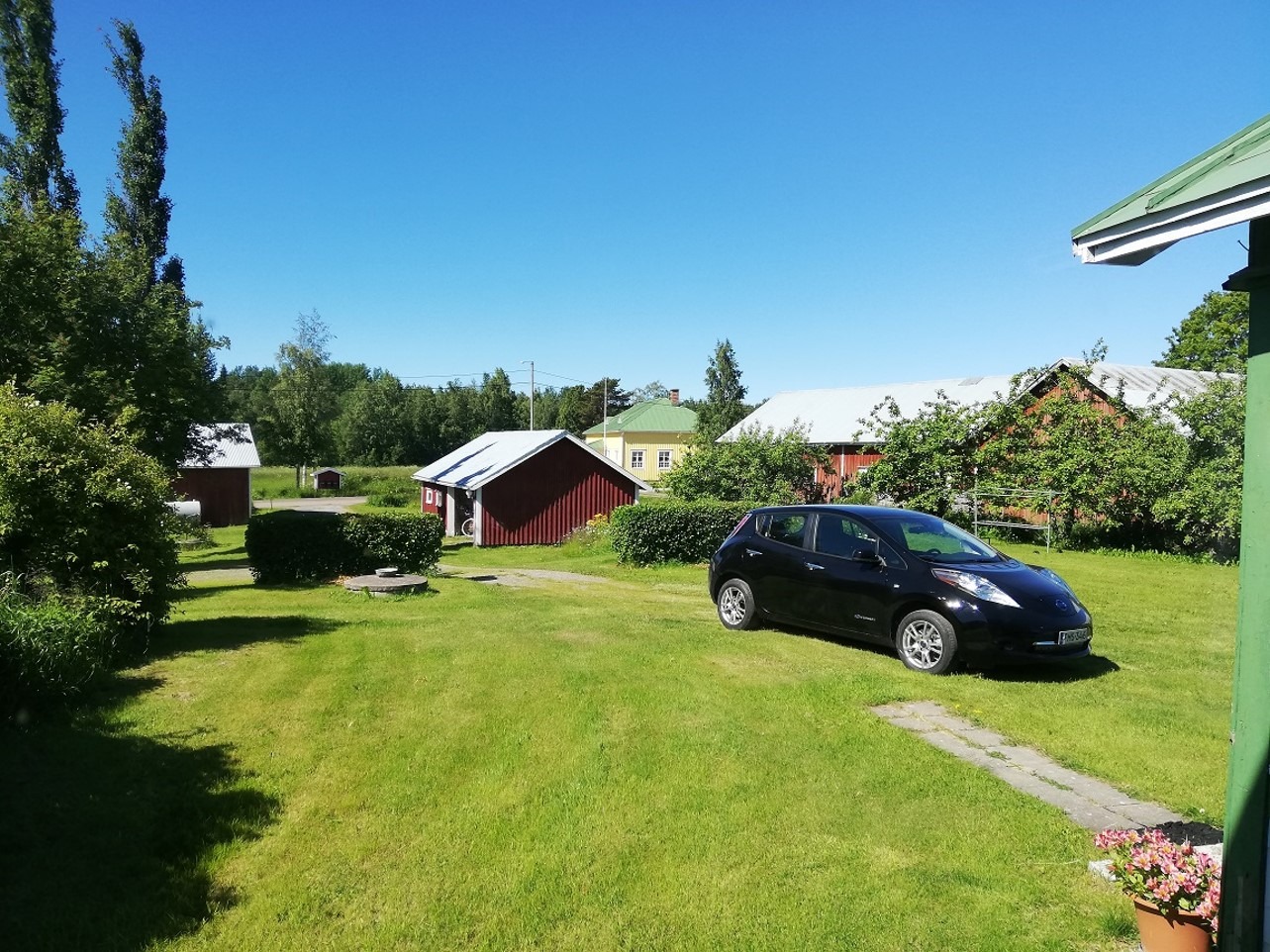
“Circular economy” Master´s course at Metropolia had an amazing guest from Vaasa. Daniel Öster, an electric car enthusiast and a start-up entrepreneur told the students about his passion for EVs (electric vehicles) and his innovation that allows electric car batteries to live up to 22 years, instead of 10 years guaranteed by manufactures. Daniel´s story tells about curiosity, passion, persistence, and a long journey of exploration on the way to realizing his own innovative idea. “I am a car guy, - told Daniel to the students at his presentation at Metropolia, - and I was excited by Tesla. What an excellent car, no emission! But there was one problem, I could not afford it. So, I decided to make my on EV, electric vehicle, from scratch. For this end, I started collecting old laptop batteries that were thrown away in trash. I opened them and looked at their cells, to see which were good or dead. I continued till I collected 2000 cells, it was enough to assemble my own car. I thought, excellent! I will soon start a zero-emission life!” “Out of the collected laptop batteries, I assembled my first power-bank as a proof of concept. It worked”, - continued Daniel, showing his pictures from the past. “It was 2018. As soon as I collected enough second-hand laptop batteries, I went to netti.auto and bought a very cheap e-car. It was a fully electric Nissan “Leaf” manufactured in 2015. The seller was very optimistic (he owned it for 1 year), while I myself did not know much about e-cars yet. I thought, the battery would most likely need a bit of a face-lift… But it was a much bigger disappointment. My new car could only ride for 25 km! (instead of 125 km shown on the tool bar). What could I do? I was truly devastated. You can imagine how it felt. I just spent over 10 000 euros on something that I could not use. After contacting the local dealer, it felt like I did a horrible mistake. Nissan suggested to replace my old battery for another one for 10 000 euro. Oh, gosh!..” - remembered Daniel about his first steps of having an electric vehicle. “I was used to having internal combustion engines, and did not expect this kind of difficulties. But I was determined to have my electric car!” - told Daniel about his brave decision. “Being an engineer by education, I downloaded the app and checked the state of my battery. It was evident that only 2 elements of the battery were low. That was good news. I decided, if I could fix them, I am saved! I deconstructed the battery – and voila! – I fixed my battery! And it worked! And my car could ride for 125 km just by fixing these 2 elements! – and everyone whom I spoke about it could not believe it. How could it really be so easy? People started saying, Daniel you should start a business about it. And I did!” “But let´s say first about the combustion car engine (traditional). The normal engine has many rotating powers and only convert about 30% of liquid energy to movement. To be able to convert it, the traditional engine has more than 2 000 components! As a result, it needs a lot of maintenance, or it will die prematurely,” - explained Daniel the difference between the combustion and e-car engines. “In the e-car engine, however, there is only 1 rotating part! It means, there is no need for a periodic service, and it turns 90% of energy into movement! So it is a truly unique solution! (Yes, the initial price is high, but in the total cost of ownership it is much cheaper)”. “Although the solution itself seems to be perfect, there was a practical problem related to my old e-car. For example, in Vaasa, where I live, there is little e-infrastructure (in other words, e-charging stations where I can recharge my e-car). It means I needed to stop quite frequently to charge it. So, very soon after fixing my 2 elements, I started wondering if it could be possible to put a bigger battery into my car? I investigated this problem and purchased a bigger battery from the car scrap, from Norway. It was actually the biggest old e-car battery available. Nissan and all literature would say it is NOT possible (companies do not want people to put bigger batteries). Luckily, since I was Wärtsilä employee at that time, I had wide networks of excellent specialists to consult. It took me many nights to do trouble-shooting – and compare new batteries and old batteries – and making tables comparing them, with graphs and calculations. The software was the most challenging part. Finally, I had found how to communicate to the battery via a CAN-bridge and it was a success! I managed, first, to upgrade my own EV, so that it could go 300 km. It felt so great! No more anxiety that I would get stuck in the night somewhere! And later, I turned it into a service offered by my own start-up,” - told Daniel about the development of his business. Daniel feels very proud. “By now, I have done 8 successful upgrades myself and also sold hardware, so that my customers can do their own upgrades. I have 45 customers by now who upgraded their batteries themselves using my hardware! These are not many people, as reverse engineering battery upgrade requires considerable efforts. But I promoted this knowledge. Also, those who cannot do it themselves, can ask for my services,” - tells Daniel about his current situation. “These e-cars that I am serving with my skills and hardware are already over 10 years old. It means my services relate only to these early adopters. At the time of their production, the batteries were not that advanced, and these cars would otherwise be discarded into waste. So, I am happy that I am doing a good thing! Manufactures want to you to drop such cars instead, but why?” - argues Daniel explaining how he can considerably prolong the life cycle of both, the early e-cars and their batteries. Based on his experience, Daniel calculated that the batteries that are considered as “end-of-life” by manufacturers (with still having 70% of original capacity!) with the help of his services can be used for much longer, up to 22 years as Daniel projects. Moreover, when they become worn out even further, Daniel figures out how to continue their second life in various stationary installations, such as power-banks in individual houses. The story about installing “old” e-car batterers in private houses continues after the picture. Figure 5. The extended electric car battery life cycle and the business idea that emerged from Daniel´s experiments with electric car batteries (from own presentation). Daniel continues: “I was very excited about my findings. Just think about it! Batteries that are considered “dead” still have about 70% capacity. EV manufacturers give 8-10 years guaranty before reaching “end-of-life”. But I have proven that early technologies are still good even after 10 years after the upgrade! That was my initial insight. After that, I was faced with another practical challenge. As a result of my experiments, I ended up with a lot of batteries. I faced a question, what to do with them?” “I decided to try and use these second-life batteries with private individuals and install them into own houses as power-banks. Nowadays, individual households can produce own energy via solar panels, for example, of other small-scale energy technologies. But it turns out to be not cost-effective to sell the excessive power generated by own solar panels back to the grid. It is more efficient to store own energy and then use it later. In other words, private household can basically earn more money by using own energy, in case they have a battery for accumulating it. This is how another idea for using old batteries emerged,” - explained Daniel his innovative idea that sprang from his initial service. The picture below shows a typical customer case for a power-bank. “This is still a very recent idea. One year ago I sold the first set of batteries, and now – 1 year ago – the customer came back to me and bough another set, and now he is fully off the grid! He uses his own energy. (Importantly, in this second life, the old batteries are expected to still stay active for another 10 years),” adds Daniel and demonstrates how the power-bank looks like. “For this purpose, you do not need to have fancy batteries, just old batteries will do”. Daniel says that there could be many more ideas for the second life solutions for old electric car batteries. He shows pictures of the other use cases for Nissan´s “Leaf” and Tesla´s old batteries: This inspirational example of Daniel´s innovations opens a truly new avenue for re-use of car batteries. Daniel´s proposals allow to keep car batteries out of the waste landfills for tens of years. Moreover, they manage to create new value by facilitating effective energy use. Such proposal directly contribute to improving sustainability and heading for circular economy. Daniel adds that, when he hears concerns about the challenges related to the manufacturing and recycling of old car batteries, he always wants to remind about the great advantages and a truly huge potential provided by electric cars - from reducing the fossil fuel consumption, cutting emissions and reducing noise, to many other striking features of electric cars. His message to the world is that the electric batteries can live surprisingly long! And Daniel wants the humankind not to throw away the electric old cars and batteries, but to re-use them wisely and find other benefits in this great opportunity. The story is presented by Daniel Öster and written down by Zinaida Grabovskaia, Master Degree Programme in Business informatics. Daniel Öster - an electric car enthusiast, a former Wärtsilä engineer and now Kempower expert, and a start-up entrepreneur and founder of “Dala´s EV Repair” who participated in the “Circular Economy” course at Metropolia. Daniel develops his innovative ideas around electric car batteries. Daniel has developed a technology to upgrade the early generation electric car batteries that allows to radically extend their life. He is also active in disseminating his knowledge about re-use of batteries: https://www.youtube.com/channel/UCc3g-KhOBoicgOrB4KkMeew His most recent idea relates to re-using the old batteries as power-banks for energy storage in private households. Daniel lives and works in Vaasa, and continues to generate innovations inspired by versatile use of electric car batteries for various businesses.

The editorial team will provide the content of the Masterminds blog before publication.
The editorial team started its work at the beginning of 2022.
Pia Koirikivi, chief editor in Masterminds blog, Pedagogical Specialist
Minna Kaihovirta, Manager of Dialog
Iira Lankinen, Principal Lecturer
Riikka Wallin, Publications Specialist
Zinaida Grabovskaia, Senior Lecturer
Salla Kivelä, Principal Lecturer
Ai technology Business Informatics Master’s Program circular economy continuous delivery Corporate Social Responsibility CRASH cultural well-being Demand Forecasting digital transformation electric car engineering ethichs IPR Machine Learning Master's Degree in Procurement Master's Thesis Master Degree Programme in Business Informatics Masters programme master student Master studies master thesis Master’s Programme in Creativity and Arts in Social and Health Fields Metropolia Business School online studies patent management remote studies Reshoring ride-sharing Security software student experience study abroad Study exchange study trip Supply Planning Sustainability technology
